
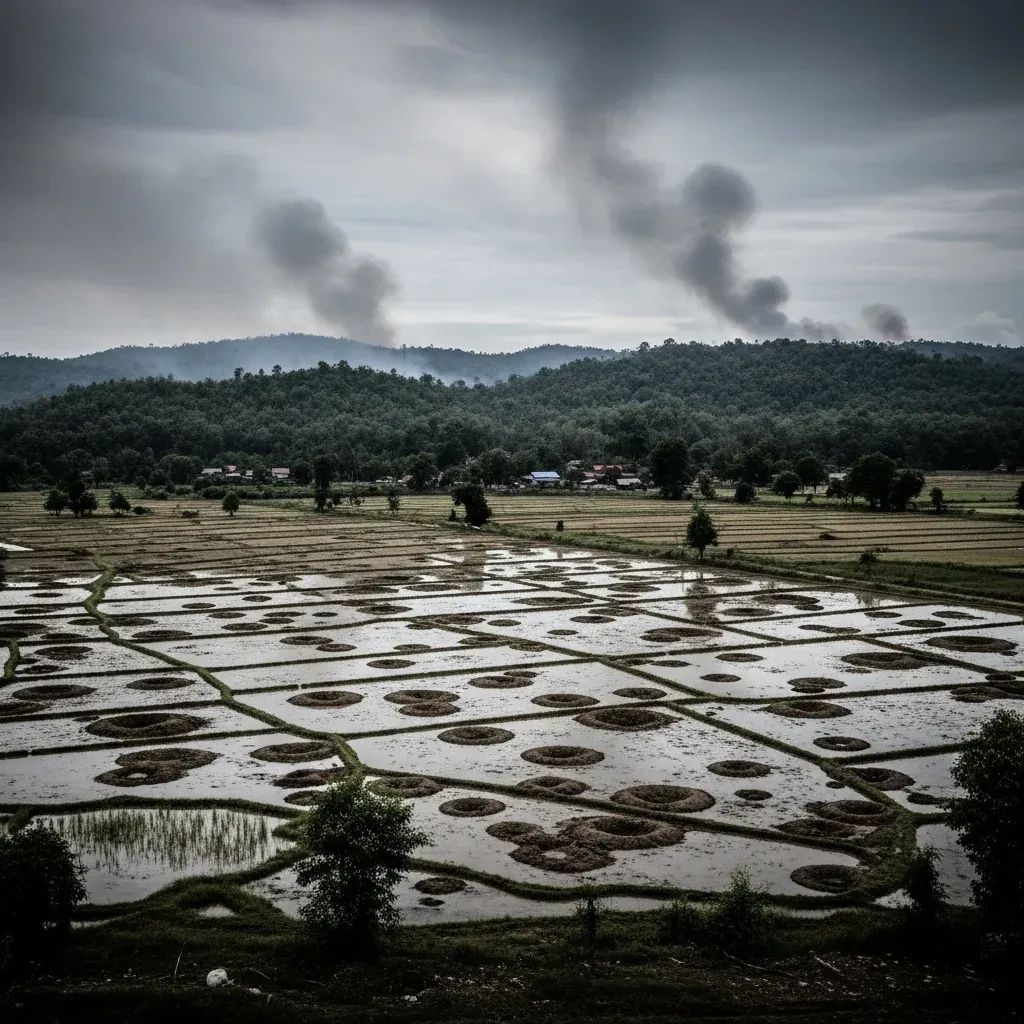
Northern Thailand confronts the persistence of illegal weaponry and rural conflict—a story that extends far beyond a single violent act. On Tuesday, May 12, 2026, authorities arrested a suspect in connection with the shooting of his neighbor in Phayao province, an incident that authorities are now treating as emblematic of deeper challenges facing Thailand's enforcement apparatus and village-level governance in regions where improvised firearms remain disturbingly accessible.
Why This Matters:
• Enforcement gap exposed: Despite nationwide efforts, homemade weapons continue fueling rural violence; the Phayao case suggests current detection methods remain insufficient.
• Village safety protocols lag behind reality: Background checks and community monitoring failed to prevent a volatile resident from obtaining a weapon and returning to his community.
• Digital work creates unexpected friction: As remote content creation spreads to rural areas, tensions with neighbors unaccustomed to home-based commercial activity are emerging as a genuine safety factor.
The Incident: What Happened on May 12, 2026
Around 5:11 PM on Tuesday, a 22-year-old was in the middle of livestreaming a product review from his home when he was shot. The attack occurred while the broadcast was live—a witness present during the stream saw the shooting unfold in real time and became an immediate source of testimony for investigators.
Police launched a search that concluded when officers located the suspect hiding in a rubber plantation approximately 10 kilometers from the village. Authorities recovered components of a homemade long-barreled shotgun at the suspect's residence. Forensic teams are now working to establish whether these weapon components match the victim's injuries and the ballistic evidence from the scene.
The victim is receiving medical treatment, though authorities have not disclosed the specifics of his condition or expected recovery timeline. The suspect has denied involvement, claiming he was working at the time and heard no gunfire.
The Relationship Behind the Violence
Local investigators traced the shooting to what they characterized as a long-standing noise complaint. The suspect allegedly objected to the volume and frequency of his neighbor's livestreaming activities, which centered on product demonstrations and reviews.
The victim's family presents a different version. They maintain that broadcasts were conducted at reasonable volumes and describe their neighbor as a responsible, engaged member of the community.
What police records indicate is a history of conflict between the two parties—neighbors reported tensions and disputes over several months prior to the incident. This history raises critical questions about how community safety gaps allowed the situation to escalate to violence.
Thailand's Broader Struggle With Improvised Weapons
The Phayao shooting cannot be separated from a broader national challenge that authorities across Thailand have struggled to contain. Homemade firearms present a detection problem fundamentally different from registered weapons. Unlike licensed guns that exist in databases and can be tracked, improvised shotguns and rifles are assembled from commercially available hardware store components using information readily available online. No registry exists for parts; no background check occurs; no permit is required. A neighbor building a weapon behind closed doors is invisible to authorities until the gun is used.
Agricultural regions like northern Phayao present particular challenges. The terrain—rubber plantations, farmland, forested areas—provides concealment for both the manufacturing of weapons and their eventual use. A cultural familiarity with tools and mechanical work means residents possess baseline knowledge to attempt such projects.
What This Incident Exposes About Rural Safety
For residents across Thailand's provincial areas, the Phayao shooting underscores several vulnerabilities that go beyond this single case.
Village governance has structural limitations. The case suggests that community monitoring systems and communication channels between residents and local authorities may not adequately track individuals returning to communities or flag emerging conflicts between neighbors. Village councils operate with limited resources and varying formal authority structures. When neighbor disputes escalate rapidly, who is responsible for intervention?
The economics of digital work collide with community norms. As more Thais earn income through livestreaming, content creation, and online product sales from residential homes, they are introducing commercial activity into spaces traditionally understood as domestic. Not all communities have adapted to this shift. Neighbors accustomed to quiet residential areas may perceive constant filming and streaming as disruptive even if sound levels are objectively reasonable. This disconnect between perception and reality—but where perception can motivate action—particularly risks individuals already prone to confrontation.
For content creators across Thailand considering working from home or from rural properties, the Phayao incident is a practical warning: proactive communication with neighbors about home-based digital activity can matter. Informal relationships and transparency about what activities are occurring and why can prevent misunderstandings from festering into resentment.
Enforcement agencies face structural challenges in detecting homemade weapons. Detecting homemade weapons before they are used requires either intelligence (community tips) or luck (random seizures). Neither is systematic or reliable at scale. Public awareness campaigns encouraging community members to report illegal firearms are important, but they place responsibility on civilians to do enforcement work that police resources cannot cover comprehensively.
What Residents Should Know: Firearms Laws and Safety
Thailand maintains strict firearms regulations. Civilian possession of firearms is highly restricted; ownership requires official government approval and is limited to specific circumstances. Possession of illegal weapons, including homemade firearms, carries severe penalties including lengthy imprisonment. If residents suspect illegal firearms in their community, reporting to local police (191 for emergencies, or local station for non-urgent reports) is the appropriate action.
For neighbor disputes, most Thai communities have formal and informal mediation structures. Village headmen (Kamnan) or sub-district administrators (Phuyai Ban) can facilitate resolution between conflicting parties before situations escalate. Documenting disputes, maintaining communication with community leaders, and seeking formal mediation are safer alternatives to confrontation.
The Investigation and Next Steps
Authorities in Phayao have committed to prosecuting the suspect, with investigators working to match weapon components recovered from the suspect's property with ballistic and injury evidence from the victim. The presence of a witness present during the livestream—someone who saw the attack unfold in real time—provides investigators with strong immediate testimony.
The swift apprehension of the suspect—accomplished within hours despite his flight to a rubber plantation in rural terrain—demonstrates effective coordination between local officers and provincial police units. However, the larger point remains: the suspect should never have had access to the weapon in the first place, and mechanisms to prevent such incidents need strengthening at the community level.
What Recovery Looks Like
In the weeks ahead, the affected village will face practical decisions about safety and community governance. Village elders and local officials will likely review processes for addressing neighbor disputes and consider whether additional mechanisms are needed to identify and address emerging conflicts before they escalate to violence. Some communities may explore or strengthen dispute mediation services—formal or informal structures designed to address neighbor conflicts systematically.
For the victim and his family, recovery is both physical and social. Beyond medical treatment, there is the question of whether they will feel safe continuing their livestreaming activities from the same location, and whether other content creators in rural areas will perceive a chilling effect on their work.
For Thai residents in rural and provincial areas, the message from this incident is clear: community engagement with local authorities, proactive neighbor communication, and awareness of escalating tensions are practical safeguards. Reporting illegal weapons immediately to police remains essential. In rural Thailand, where detection of homemade weapons is nearly impossible without community intelligence, such cooperation is not just recommended—it is necessary for collective safety.


