
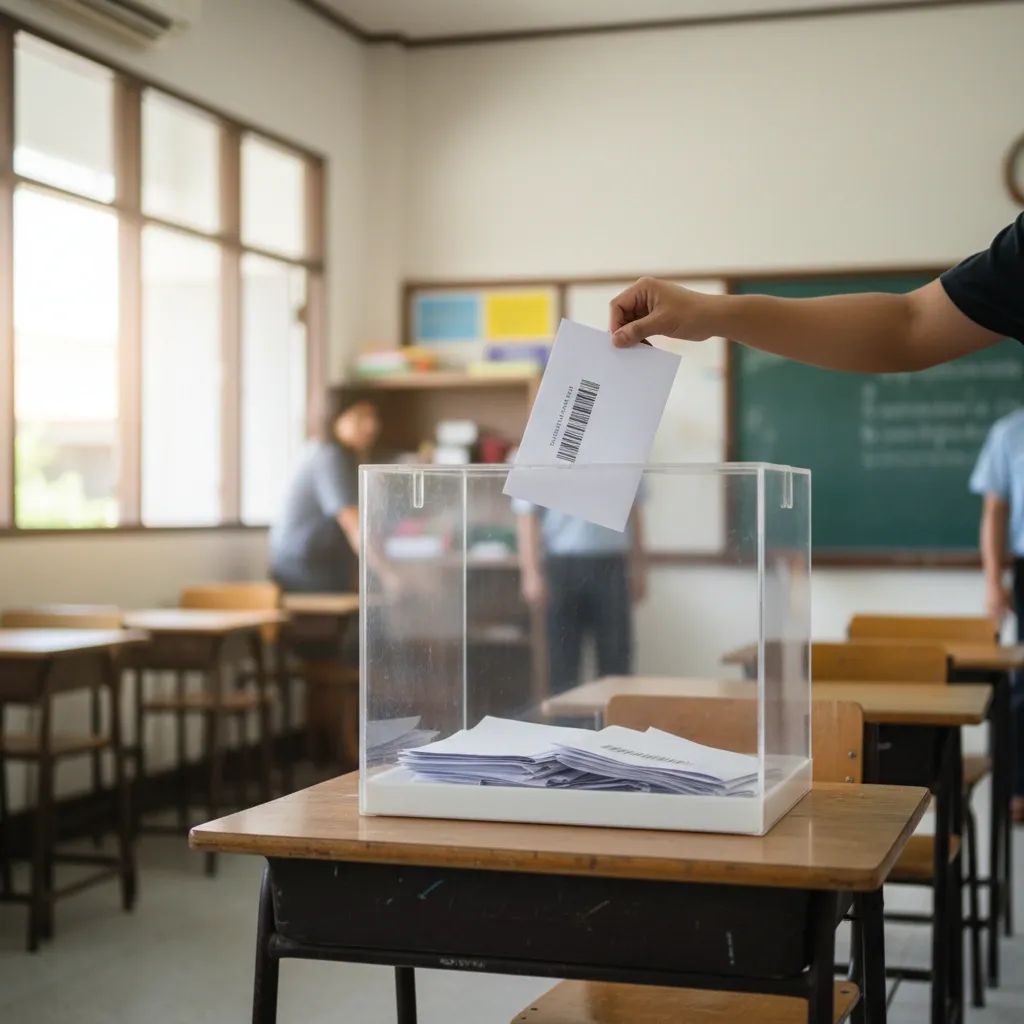
Thailand Election Commission faces mounting pressure to disclose procurement records behind the controversial barcode and QR code system used in the February 8 general election, as a former commissioner publicly questions whether the technology ever received formal approval from the five-member commission.
Writing in May 2026, three months after the controversial February 8 election, the barcode dispute continues to threaten the legitimacy of the vote itself, with multiple courts now reviewing the system's constitutionality.
Why This Matters
• Legal challenge underway: The Constitutional Court has accepted a petition to review whether the February 2026 election should be voided due to the barcode controversy.
• Cost transparency: The EC spent 204M baht printing ballots with the tracking codes—pink party-list ballots at 1.40 baht each, green constituency ballots at 1.20 baht, and yellow referendum ballots at 1 baht.
• Secret ballot concerns: Critics claim the system could trace individual votes back to specific voters, undermining constitutional protections.
• Procurement timeline questioned: Contract approvals occurred on December 29, 2025, with winning bidders announced December 30—a 24-hour turnaround that raises eyebrows.
Former Commissioner Demands Paper Trail
Somchai Srisutthiyakorn, who served on the Thailand Election Commission until his term ended, has submitted a formal request for 20 separate documents related to the barcode implementation. The list includes EC resolutions approving the codes, technical specifications for anti-counterfeiting measures, voter data protection policies, and crucially, the Terms of Reference that would have outlined requirements for ballot printers.
No draft TOR documents were ever released for public review before the contracts were awarded, according to records reviewed. The procurement process moved at breakneck speed: purchase authorization reports were approved on December 29, 2025, and contract winners were announced the very next day.
Chan Wanich Security Printing Co., Ltd. secured the party-list ballot contract for 81.3M baht to print 56.1M sheets, while T.K.S. Technologies Plc won the constituency ballot printing for 67.3M baht. A third contractor handled the referendum ballots. The combined printing cost represents a fraction of the 8.97B baht total election budget—making the February vote the most expensive in Thailand's history.
What This Means for Residents
The legal uncertainty surrounding the election threatens to extend political instability well into the year. If the Constitutional Court rules the barcode system violated the charter's secret ballot provisions, it could nullify the entire February election and force a do-over without the tracking codes.
For ordinary voters, the controversy centers on a technical but critical distinction: The Thailand EC maintains the codes only identify which ballot booklet and polling station produced each ballot, not individual voters. Critics counter that because ballots are torn from numbered stubs in sequence—voters receive ballots torn sequentially from numbered booklets at polling stations, creating an inherent voting order record—combining the barcode data with stub numbers could theoretically reveal who voted for whom. This sequential distribution system, when paired with barcode tracking, creates a potential roadmap back to individual voters.
Somchai has repeatedly challenged the current commission to conduct a simulated election to prove the codes cannot identify voters. He claims previous mock elections showed 3 out of 5 independent teams successfully matched ballots to voters with 100% accuracy using the barcode system.
The Central Administrative Court is separately reviewing a lawsuit seeking to halt result certification and potentially declare the election void. The Ombudsman's office has also forwarded a petition to the Constitutional Court after requesting—but not receiving satisfactory—clarification within seven days on whether the codes breached constitutional secrecy rules.
Technical Debate Over Security Versus Privacy
The Thailand Election Commission has consistently defended the barcode and QR code system as essential for preventing ballot counterfeiting and managing distribution. According to official statements, the codes verify ballots were not printed in excess, confirm complete ballot booklets reached polling stations, and prevent "floating ballots" that could be used for fraud.
The EC points to Regulation 129, which grants the commission authority to add special codes or markings to ballots without advance public notice. The agency argues multiple security features already exist—invisible ink, microscopic text, specialized watermarks, and deliberate printing imperfections—but the digital codes add a modern verification layer.
Somchai Srisutthiyakorn, who left the commission after completing his term with a reputation as an advocate for electoral transparency within EC circles, disputes this logic entirely. He contends the existing analog security measures already provide more than sufficient protection against forgery, and that adding digital tracking codes serves no legitimate purpose while introducing unacceptable privacy risks. He notes the barcode requirement also limited which printing companies could bid for contracts, potentially reducing competition and driving up costs.
The distinction between the 2023 and 2026 systems has become central to the legal debate. In the 2023 election, codes only identified ballot booklets at the batch level. The 2026 implementation allegedly allows tracing to specific ballot stubs, which when combined with the sequential tear-off distribution system, creates a potential roadmap to individual voters.
Transparency Push Meets Resistance
Beyond the technical arguments, the dispute reflects broader concerns about Election Commission transparency and accountability. Somchai's 20-document request seeks to establish a basic fact: Did the full commission ever formally vote to approve the barcode system, or was it implemented through administrative channels without proper authorization?
The requested documents include not just procurement contracts but also the policy framework for handling voter data collected through the system, technical explanations of how the anti-counterfeiting measures function, and any EC resolutions specifically authorizing the codes.
As of May 2026, three months after the election, those documents have not been publicly released. The lack of disclosure has fueled speculation that the system may have been implemented without proper deliberation or legal authority.
Impact on Expats & Investors
For foreign residents and business interests monitoring Thailand's political stability, the barcode controversy represents more than bureaucratic infighting. The possibility of a court-ordered election re-run would extend the current government's uncertain mandate and create real consequences for international stakeholders.
If a new election is ordered, implementation would likely delay several pending policy initiatives affecting expat residents directly. Visa reform proposals under discussion—including potential changes to long-stay visa categories and retirement visa requirements—may be shelved during prolonged political uncertainty. Similarly, pending tax reform proposals affecting foreign business entities and expat income taxation could face indefinite postponement if the government's mandate remains contested.
Infrastructure projects with international components also hang in the balance. Several major development initiatives in Bangkok, the Eastern Economic Corridor, and Northern Thailand have been contingent on cabinet approval from a newly elected government. Delay or re-election scenarios could push these projects back by 6-12 months or more.
The 8.97B baht price tag for the February election—already a record—would need to be replicated if the Constitutional Court orders a new vote. That additional fiscal burden would come as Thailand navigates competing budget priorities including economic stimulus measures and regional development programs.
Constitutional Court proceedings typically span 4-8 months for complex cases, though politically sensitive electoral disputes can extend to 12+ months. Residents should prepare for a timeline extending well into late 2026 or potentially early 2027 before definitive resolution.
International observers have noted the controversy also touches on digital governance standards increasingly scrutinized in Southeast Asian democracies. Whether Thailand's courts ultimately find the barcode system constitutional could influence how other countries in the region approach election technology adoption, particularly regarding the balance between security and voter privacy.
Somchai has announced plans to file a defamation lawsuit against the EC and nine other individuals on May 20, claiming leaked documents from an EC legal filing damaged his reputation. That lawsuit promises to escalate the confrontation between the former commissioner and the current election authority.
What Comes Next
The Constitutional Court has accepted the petition to review the election's validity but has not announced a timeline for its ruling. Thai constitutional proceedings can stretch for months, meaning definitive resolution may not arrive until mid-2026 or later.
For residents tracking the timeline: the Constitutional Court typically holds hearings over a 2-3 month period before deliberating. Expect preliminary rulings or hearing schedules to be announced within 30-60 days. Watch the Office of the Constitutional Court official announcements for hearing dates.
Meanwhile, the Central Administrative Court case seeking to halt result certification proceeds on a separate track. If that court issues an injunction before the Constitutional Court rules, it could freeze the political landscape in limbo.
The Thailand EC has shown no indication it plans to voluntarily release the procurement documents Somchai requested, meaning transparency may ultimately require court orders or intervention from oversight bodies like the Ombudsman or the National Anti-Corruption Commission.
For residents trying to parse whether their February votes will ultimately count, the answer remains frustratingly unclear. The barcode controversy has transformed what should have been routine election administration into a constitutional crisis that could reshape Thai electoral procedures for years to come. Residents should anticipate ongoing legal proceedings through at least late 2026, with potential re-election scenarios remaining on the table until the Constitutional Court rules definitively.


