
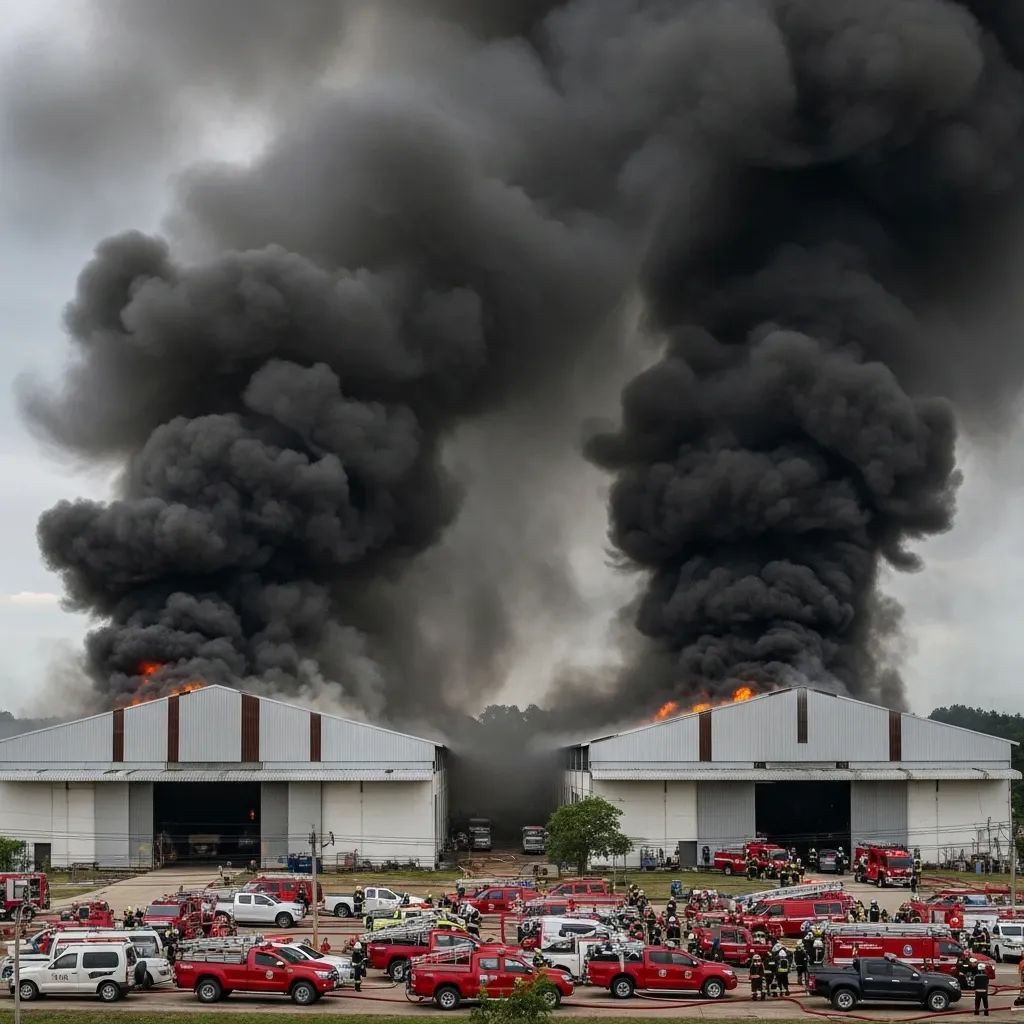
An industrial warehouse under construction in Sriracha, Chonburi collapsed on Friday afternoon, killing one worker and leaving another in critical condition. The incident has spotlighted long-standing enforcement gaps in Thailand's construction safety framework, particularly for projects operating under tight timelines in the country's bustling Eastern Economic Corridor. Two workers escaped the falling steel structure, while two parked vehicles were destroyed in the collapse.
Why This Matters
• One fatality confirmed: A 54-year-old worker died at Laem Chabang Hospital; a 60-year-old colleague remains hospitalized in critical condition.
• Wind factor raises questions: Witnesses reported sudden wind gusts that lifted the partially completed steel frame before it collapsed, suggesting gaps in weather-monitoring protocols during construction.
• Regulatory oversight at issue: The incident exposes recurring blind spots in how Thailand enforces its existing safety laws for structures under construction, where accountability can remain unclear between contractors and site supervisors.
How the Collapse Unfolded
Around 3:30 PM on May 8, workers at the Fuchitex Auto Interior facility in Nong Kham subdistrict were overseeing final preparations for a warehouse roof expansion. The site sits behind the company's main automotive interior parts factory, an operation typical of the thousands of small manufacturing facilities clustered in Sriracha's industrial zone. When the steel frame suddenly gave way, it triggered what witnesses described as a domino-like collapse—pieces stacking down onto the workers below.
Rescue teams from Sawang Prateep Sriracha reached the scene within minutes. They found two men trapped under twisted metal beams and wreckage. Both were unconscious and bleeding heavily. The Nong Kham Police Station coordinated the extraction, and ambulances raced both injured workers to separate hospitals—Laem Chabang Hospital and Vibharam Laem Chabang Hospital—roughly 15 kilometers from the site. One died hours later from internal injuries; the other remains sedated in intensive care, his prognosis uncertain as of this weekend.
Two additional workers who were present managed to leap clear seconds before the structure fell. Their quick reflexes likely saved their lives. A black Haval sedan and a white MG pickup truck parked in the work zone were crushed beneath the steel frame, reducing both vehicles to twisted metal.
The Weather Factor and Design Vulnerability
Witness accounts point to powerful wind gusts that appeared suddenly during the afternoon. One worker reportedly told police that the wind came from underneath the partially completed steel frame, lifting the structure momentarily before it pitched sideways and crashed down.
This detail matters because Thailand's Ministerial Regulation on Load Bearing, Durability, and Resistance of Buildings and Soil Foundations to Earthquake Forces B.E. 2564 (2021) explicitly mandates that structural designs account for environmental forces, including wind load. The regulation sets minimum standards for resistance to lateral forces for buildings in designated zones. A partially completed steel frame—essentially a skeletal lattice with no bracing walls or reinforcing panels—would theoretically be more vulnerable to wind lift than a finished structure with integrated walls and roof panels providing lateral bracing.
The Regulatory Minefield for Incomplete Projects
Thailand's construction safety apparatus is densely written but notoriously inconsistent in application. The Building Control Act B.E. 2522 (1979) and the Occupational Safety, Health, and Environment Act B.E. 2554 (2011) together create what appears on paper to be a comprehensive safeguard system. Yet structures under construction occupy a regulatory gray zone.
Before any building can legally begin, contractors must obtain a Building Permit or Letter of Notification from local authorities, complete with detailed architectural and engineering plans. These documents are supposed to include structural calculations and load assessments. However, enforcement at this stage varies wildly depending on whether the local municipality has adequate staff and whether the contractor is known to the authorities. Smaller subcontractors—which handle much of Thailand's industrial warehouse expansion—sometimes operate with minimal scrutiny during the early phases.
Once construction commences, the applicable standards shift. The Building Control Act specifies guardrail heights (at least 90 centimeters), requirements for safety cables at heights exceeding 2 meters, and mandates that scaffolding be made of strong, suitable materials such as keruing wood or equivalent. The Ministry of Labour has issued detailed guidance on these specifics, and factories exceeding 20 employees are required to appoint a safety officer responsible for risk assessments and worker training. Yet a warehouse frame being assembled by a third-party contractor may fall outside the purview of the factory's internal safety apparatus—creating confusion about who bears responsibility for on-site oversight.
Accountability Questions Hanging Over the Investigation
Lieutenant Panachai Wannasri of Nong Kham Police Station has launched a formal investigation with structural engineers from local authorities. Key questions now being examined include whether the contractor filed detailed structural calculations accounting for wind forces, whether a safety officer was present on-site, and whether materials met Thai standards for steel frame construction.
If investigators determine that the contractor failed to submit required documentation, the penalties can be severe. Under Thai law, the responsible contractor or site supervisor faces potential demolition orders, fines reaching hundreds of thousands of baht, and possible imprisonment for failing to meet safety standards. However, Thailand's track record shows that penalties are typically imposed only after someone dies—a reactive rather than preventive approach.
What Changed—And What Hasn't
The Ministry of Labour's Special Task Force on Labour Safety theoretically conducts unannounced on-site inspections of high-risk construction projects. Yet critics have long noted the task force is chronically understaffed relative to the number of active construction sites across Thailand. The Eastern Economic Corridor alone hosts hundreds of ongoing industrial projects at any given time. On-site monitoring remains sporadic rather than continuous.
Additionally, insurance and liability coverage creates an additional layer of complexity. Under Thai law, employers bear primary responsibility for workplace injuries, but the terms of liability—who pays for medical care, disability, or death benefits—depends on contract language between the factory owner, the contractor, and potentially a sub-subcontractor. The 60-year-old worker now in intensive care faces an uncertain compensation path. If he is not a direct employee of the factory but rather a temporary or contract laborer, his access to Thailand's standard work injury benefits may be limited or disputed. Workers classified as contractors rather than direct employees may face additional hurdles in claiming benefits under Thailand's workplace injury laws.
Broader Implications for Chonburi's Industrial Boom
The collapse raises uncomfortable questions about how aggressively the Eastern Economic Corridor can continue to expand without improving enforcement capacity. Chonburi province has seen massive foreign direct investment in automotive manufacturing, electronics, petrochemicals, and logistics over the past decade. The province now functions as a critical hub for Thailand's export economy, with factories operated by multinational corporations, regional suppliers, and locally owned manufacturers occupying adjacent industrial parks.
A structure collapse at a major automotive supplier facility generates concern among investors and operators. It suggests that cost-cutting on construction oversight—a common practice when contractors bid competitively for projects—can result in deaths. Insurance companies may begin requiring tighter third-party inspections before underwriting policies for new industrial construction in the province. Foreign firms may demand that Thai subcontractors hire independent structural engineers to verify steel frame installations before work proceeds. These cascading requirements could slow construction timelines and increase project costs across the region.
What Must Change
Investigators will eventually release their findings, likely concluding that inadequate wind monitoring, insufficient bracing, or substandard materials contributed to the collapse. Fines will be imposed. The contractor may be prosecuted. Yet unless the Ministry of Labour and local authorities commit to more proactive inspections—particularly for incomplete structures in areas prone to sudden weather changes—similar collapses remain probable.
Some industrial developers and foreign investors are already turning to third-party inspection firms that conduct real-time site monitoring, material testing, and structural verification. These services add cost but reduce liability exposure. For smaller contractors operating on thin margins, such services remain cost-prohibitive. This disparity means smaller projects may continue operating with minimal oversight.
Both the fatal injury and the survivor's condition underscore a critical vulnerability in Thailand's labor market. While the country's regulations for factory safety are comprehensive, the workers they are intended to protect often lack the leverage to insist on full compliance. Employers sometimes prioritize construction schedules over meticulous adherence to wind-monitoring protocols or material verification. Workers face implicit pressure to keep working during questionable conditions rather than raise safety objections that might result in dismissal. The deceased worker's family and the survivor's long-term recovery prospects depend significantly on how courts ultimately determine liability and compensation under Thailand's workplace injury laws.


