
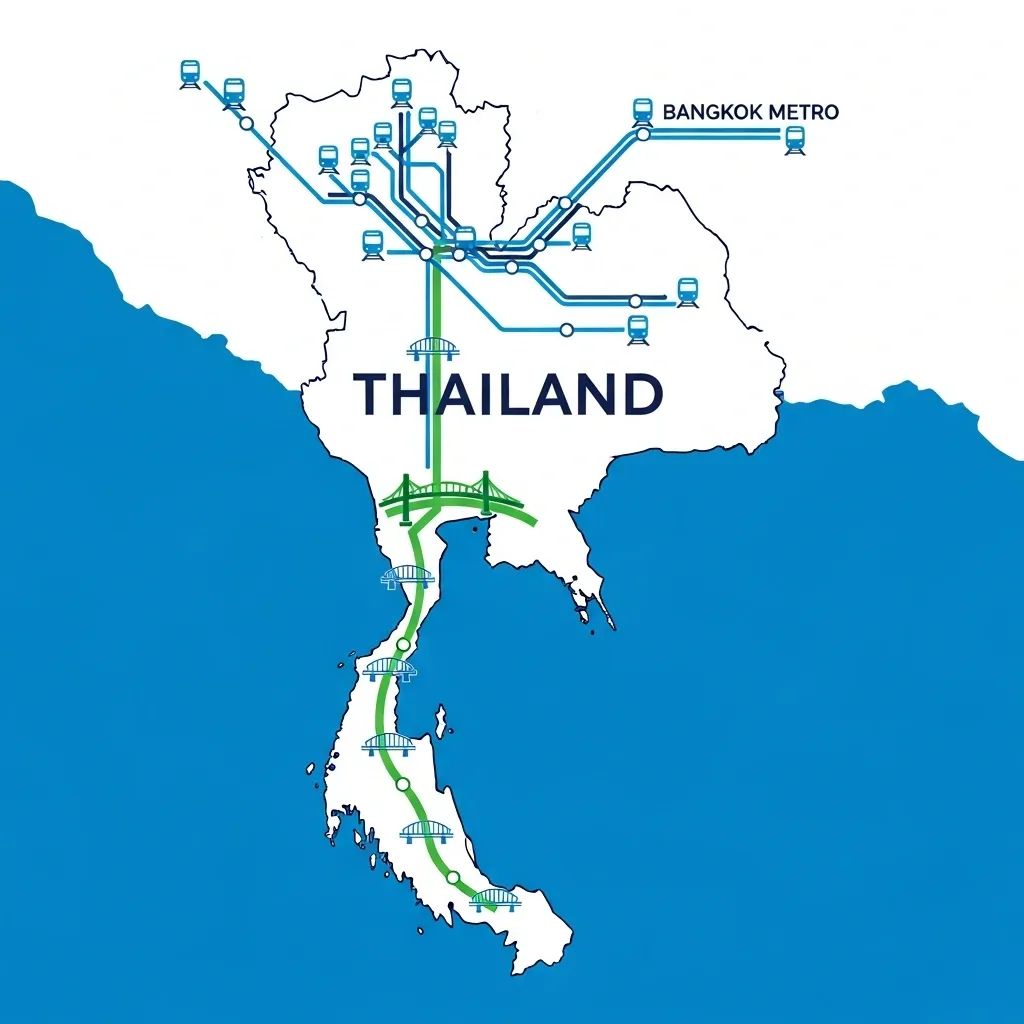
The Thailand Cabinet is scheduled to receive a formal proposal on the controversial Land Bridge megaproject between June and July, but a new academic assessment from Chulalongkorn University's Transportation Institute warns the 900 billion to 1 trillion baht scheme may fail to deliver promised economic gains, raising fresh doubts about a project already facing environmental backlash and geopolitical uncertainty.
Why This Matters
• Economic risk: Without industrial expansion to support cargo origination, the Land Bridge could operate below capacity, driving up per-container costs by as much as US$252 compared to the Strait of Malacca.
• Higher costs, not savings: Independent analysis suggests round-trip costs through the proposed corridor could run nearly $2 M higher than conventional routes—a 25% premium over the Malacca passage.
• Timeline in flux: Prime Minister Anutin Charnvirakul ordered a 90-day reassessment in May, delaying what was once billed as a fast-tracked solution to regional shipping bottlenecks.
What the University Found
Researchers at Chulalongkorn's Academic Service Centre concluded that the Chumphon–Ranong corridor—a 90-kilometer link comprising motorway, dual-gauge rail, and pipelines—ranks as the least favorable option among four alternatives assessed for connecting the Gulf of Thailand and the Andaman Sea. The study, conducted in collaboration with the Office of the National Economic and Social Development Council (NESDC), points to three structural weaknesses that could undermine the project's competitiveness.
First, the scheme is designed almost exclusively as a transshipment hub, meaning containers would arrive by sea, transfer overland, and reload onto another vessel. That model requires extensive port-handling infrastructure and risks cargo imbalance between the two terminals: Chumphon is projected to handle 13.8 M TEUs annually, while Ranong would process up to 19.4 M TEUs. Asymmetric flows mean vessels often sail half-empty in one direction, eroding margin and increasing per-unit cost.
Second, the "One Port Two Side" transfer protocol is estimated to take 54 hours—six hours longer than a conventional voyage through the Strait of Malacca, which typically clears in 48 hours. Government projections claim a four-day saving on end-to-end routes between the Middle East and East Asia, but maritime analysts counter that the time advantage disappears once unloading, cross-land transport, and reloading are factored in.
Third, researchers warn that unless Thailand builds out complementary industrial zones to generate export cargo, the corridor will struggle to function as a gateway port rather than a simple transfer point. That would require manufacturing clusters, petrochemical complexes, and agribusiness processing facilities—all capital-intensive ventures that are not yet part of the official plan. Without them, the Land Bridge risks becoming a white elephant, offering a service global shipping operators may decline to use at premium rates.
Government Response and Review Process
Deputy Prime Minister and Finance Minister Ekniti Nitithanprapas is leading the reassessment, which considers geopolitical instability—including disruptions in the Strait of Hormuz—alongside environmental consequences, social impact, and local community acceptance. Officials frame the project as a hedge against chokepoint risk: the Strait of Malacca handles 25% to 30% of global seaborne trade, with more than 94,000 vessels annually squeezing through a passage that narrows to just 2.8 kilometers at the Phillips Channel near Singapore.
Yet the government acknowledges the scheme will require private capital to proceed. Bangkok plans to grant long-term land concessions—potentially up to 50 years—rather than fund construction directly. A single-stage bidding process is expected in late 2026, with construction targeting a 2030 start and the first phase operational by 2030–2031. Full completion is penciled in for 2039.
Proponents highlight job-creation estimates of more than 280,000 positions and an annual economic contribution exceeding 500 billion baht, equivalent to roughly 1.7% of Thailand's GDP at current exchange rates. The Office of Transport and Traffic Policy and Planning (OTP) forecasts 58 billion baht in first-year revenue, chiefly from fuel bunkering services for vessels avoiding the longer Lombok or Sunda Strait detours around Indonesia.
Environmental and Social Pushback
More than 100,000 signatures have been collected on a petition demanding a full environmental and social review. Coastal communities in Chumphon and Ranong provinces—many reliant on fishing and marine tourism—warn that dredging for deep-water berths will disrupt mangrove ecosystems, alter tidal flows, and threaten coral reef biodiversity. The Chulalongkorn study flagged risks to national forest reserves, wildlife sanctuaries, and internationally protected wetlands, noting that construction crews would cut through forested corridors and fragment habitat.
Government officials have promised "extensive environmental assessments" and emphasized stakeholder consultation, but local residents remain skeptical. Land-expropriation concerns loom large, particularly for smallholder farmers and fishing families who fear compensation packages will fall short of replacement cost.
What This Means for Residents
For expatriates, investors, and Thailand-based businesses, the Land Bridge represents both opportunity and uncertainty. If the project proceeds and attracts anchor tenants—China, Japan, Saudi Arabia, and the United States have all signaled interest—southern Thailand could evolve into a logistics and petrochemical corridor, driving real-estate demand and creating secondary service industries from warehousing to maritime insurance. Port cities like Chumphon and Ranong, currently provincial backwaters, would see infrastructure upgrades in roads, utilities, and telecommunications.
Conversely, cost overruns, regulatory delays, or failure to secure private investment could saddle taxpayers with stranded assets. The 25% cost premium flagged by independent analysts suggests shipping lines may simply continue using Malacca, leaving the new ports underutilized. Environmental litigation or community resistance could further delay timelines, pushing full operation well beyond 2039.
Residents in coastal zones should monitor public hearings and environmental-impact statements closely; relocation orders and land-valuation disputes are likely flashpoints. Those in export-oriented manufacturing may benefit if industrial estates materialize around the corridor, but the Chulalongkorn analysis makes clear that such development is not yet guaranteed.
Competing Routes and Regional Context
The Strait of Malacca remains the world's second-busiest maritime chokepoint after the Strait of Hormuz, carrying 15 M to 17 M barrels of oil daily and 40% of global LNG shipments. Alternative passages—Sunda and Lombok Straits—add 4,600 kilometers and roughly 170 hours to voyages, increasing costs by an estimated 20%. For vessels that exceed Malaccamax draft limits (25 meters), those detours are unavoidable, which is why Thailand argues a land bridge offers strategic redundancy.
Yet Singapore-based maritime consultancies note that Malacca benefits from decades of established bunkering, repair, and customs infrastructure, plus a regulatory framework that minimizes dwell time. The Thailand corridor, by contrast, would require shippers to navigate two sets of port authorities, dual customs clearances, and coordination between rail and trucking operators—a recipe for friction and delay unless Bangkok streamlines procedures well in advance.
The Road Ahead
With the Cabinet decision slated for mid-2026 and the reassessment still underway, the project sits at a crossroads. Thailand's broader infrastructure agenda for 2025–2026—including 265 billion baht in transport spending across 223 projects—demonstrates appetite for large-scale development, from the Thai–China high-speed rail to Suvarnabhumi Airport's South Terminal. Yet the Land Bridge dwarfs all of them in cost and complexity.
Whether Thailand can marshal the private capital, address environmental objections, and prove the commercial case for a $31 billion overland shortcut will determine if the scheme reshapes regional shipping—or joins the long list of mega-projects that never left the drawing board. For now, the Chulalongkorn study serves as a cautionary flag: infrastructure alone does not guarantee competitiveness, and without a robust industrial hinterland, even the most ambitious corridor risks operating in the red.


