
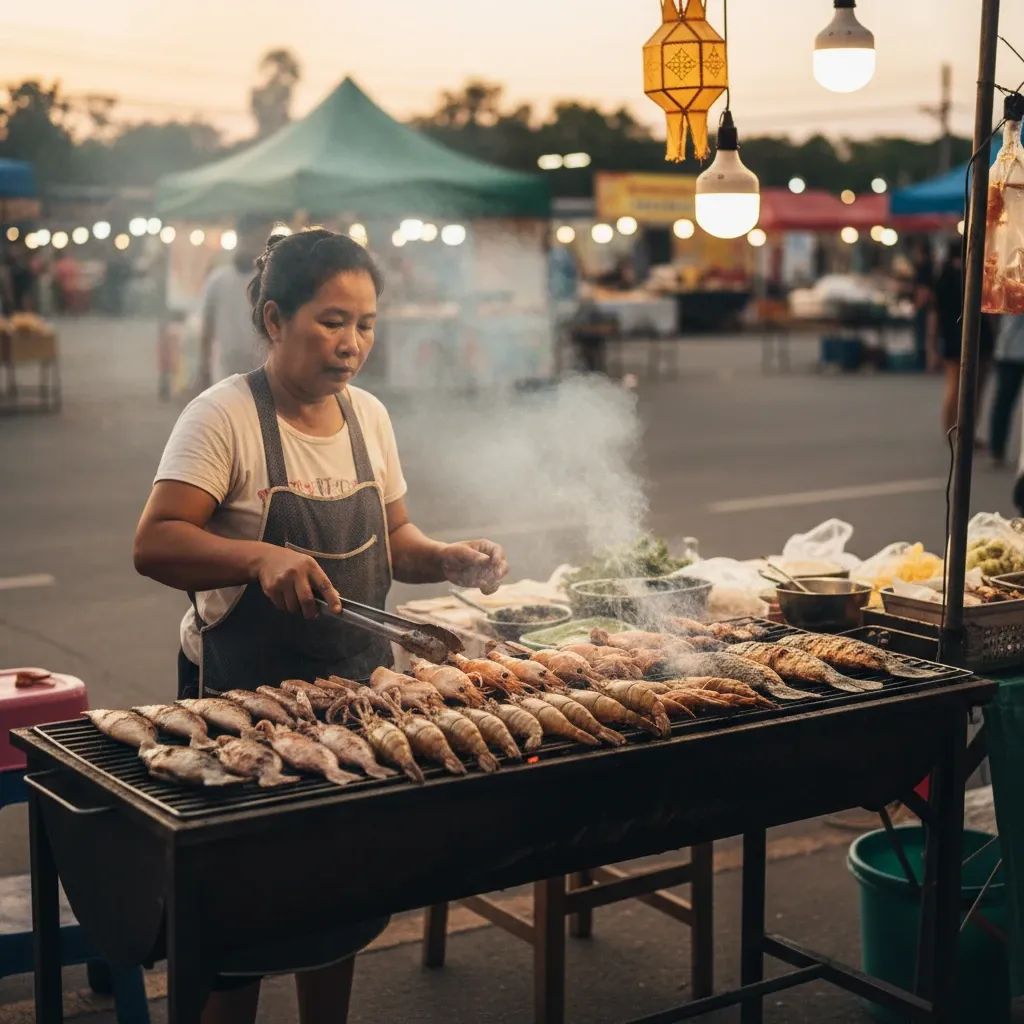
A grilled squid vendor in Kanchanaburi has become an unlikely social media success story after posting a candid TikTok video showing himself as the sole remaining trader at a nearly deserted agricultural fair.
The clip documented his lonely vigil at what was supposed to be a bustling festival. Rather than closing shop early when fellow traders left, he decided to film the empty stalls and his lone grilling station still producing smoke—capturing the unglamorous reality of a slow business day.
Within hours, curious locals and sympathetic viewers began arriving specifically to support the vendor, many citing the viral clip as their reason for making the trip. What began as a quiet afternoon transformed into a bustling evening, with the vendor managing to sell out his entire inventory well before his planned closing time at 8pm.
Why This Matters
• Social media rescue: A struggling street vendor's honest video transformed business prospects within hours
• Festival attendance issues: Agricultural fairs in provincial Thailand face growing challenges attracting steady crowds
• Digital commerce lifeline: TikTok continues to prove itself a critical tool for Thailand's informal economy vendors
The Solitary Seller at the Fair
The vendor was operating at a plant festival in Tha Muang district, Kanchanaburi province when he found himself in an awkward position. As fellow traders packed up and left throughout the day, the vendor faced a critical decision: close shop early and guarantee zero revenue, or stay open despite the sparse crowd and hope for last-minute customers.
The incident highlights a growing trend across Thailand where small-scale vendors leverage social media transparency to connect directly with consumers. Rather than polished marketing, the unvarnored reality of struggling to make a sale resonated more powerfully with audiences. The vendor's decision to document his predicament—instead of suffering in silence—proved to be the difference between breaking even and a total loss.
Provincial Vendor Economics
For vendors selling perishable items like grilled seafood, attendance fluctuations at agricultural fairs present acute challenges. Unlike handicraft sellers who can pack unsold inventory for the next day, food vendors face total loss if products don't move.
Street food and festival vendors typically operate on margins of 30-50% after accounting for raw materials, fuel, labor, and location fees. A grilled squid vendor at a provincial fair likely pays 500-1,500 baht daily for booth space, with raw squid costing 200-350 baht per kilogram depending on size and quality. A slow day with minimal sales can result in losses of 2,000-3,000 baht or more when unsold inventory spoils.
This economic reality explains why the vendor remained open late despite the deserted fair. Closing early guarantees zero revenue, while staying open preserves at least the possibility of sales.
TikTok as Economic Lifeline
The Thailand Department of Internal Trade has actively promoted TikTok as a platform for agricultural vendors, recognizing its unique ability to convert casual scrolling into purchasing behavior. The platform's algorithm tends to amplify authentic, emotionally resonant content—precisely what the vendor provided with his honest documentation of a slow day.
The squid vendor's case represents an organic version of deliberate social media strategy. Without formal training or sophisticated equipment, his simple act of showing reality generated the engagement that polished marketing campaigns often fail to achieve. His transparency worked because it was genuine, not calculated.
What This Means for Thailand Residents
For Thais navigating the informal economy, particularly those in agriculture and street vending, this incident underscores several practical lessons:
Transparency sells. Consumers respond positively to vendors who show the unglamorous realities of small business, creating opportunities for those willing to be vulnerable online.
Platform literacy matters. Understanding how to create content that algorithms favor—authentic, emotional, visually interesting—translates directly into revenue for vendors operating on thin margins.
Provincial markets remain fragile. While Bangkok and major tourist destinations provide relatively stable customer flows, vendors in secondary cities face unpredictable attendance that can make or break their daily economics.
Community support is real but fleeting. The rush of customers responding to viral moments provides immediate relief but rarely translates into sustained business. Vendors need strategies beyond one-time social media surges.
The Bigger Picture
For Thailand's estimated 430,000 street food vendors and countless more operating at markets, festivals, and events, the lesson may be less about TikTok specifically and more about adapting quickly when circumstances change. The vendor who documented his situation, posted immediately, and remained open long enough for the video to circulate demonstrated the kind of entrepreneurial flexibility that survival in Thailand's informal economy increasingly requires.
Whether this model can replicate remains unclear. Social media audiences show finite patience for repeated appeals, and vendors who post repeatedly about struggling may face diminishing returns. The novelty of being the "last man standing" carries narrative power once—less so the second or third time.
Yet for one Kanchanaburi vendor on one difficult day, a single honest video made all the difference between loss and survival. In an economy where thousands of small operators face similar daily uncertainties, that difference can be everything.


