
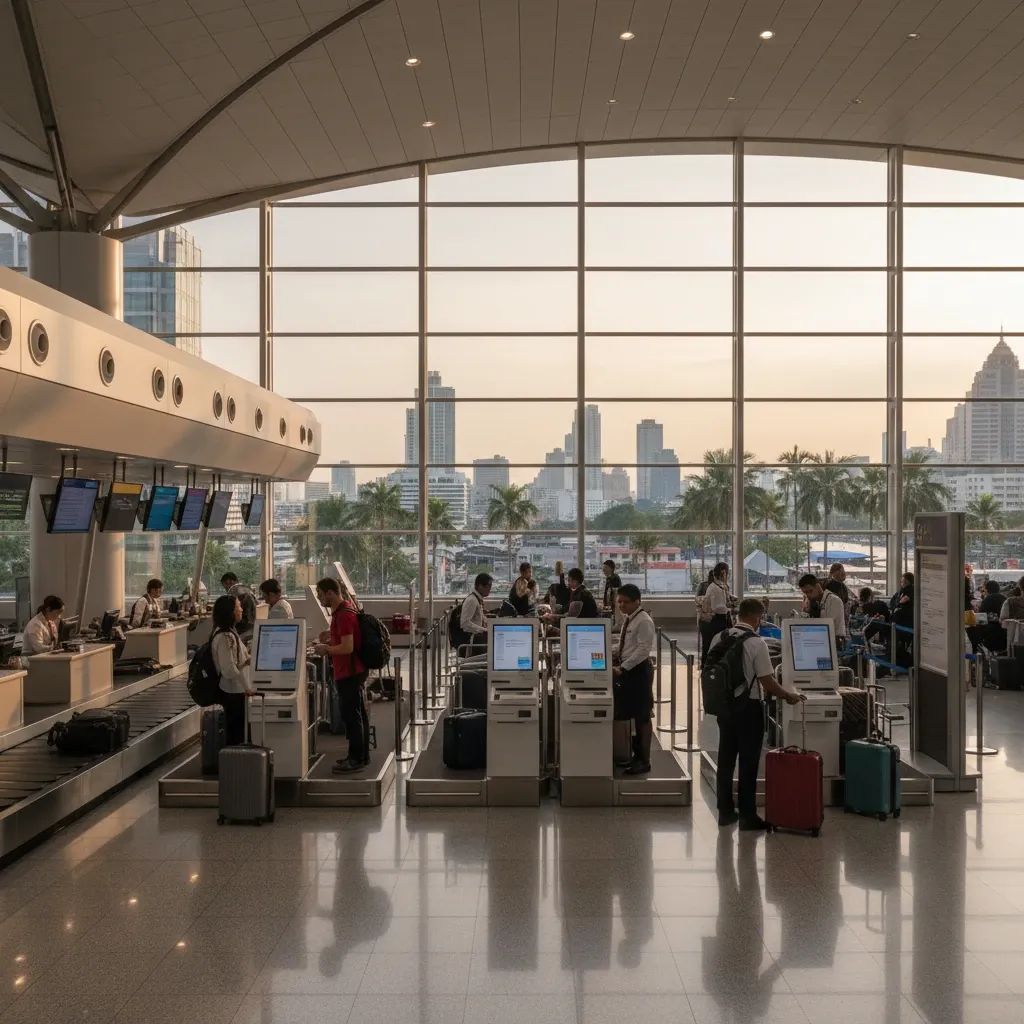
The Thailand Tourism and Sports Ministry faces mounting pressure from industry operators who argue that a wave of new travel taxes lacks transparency and threatens the nation's competitive edge in Southeast Asia's crowded tourism market. With a 300-baht entry fee and a 53% airport tax hike both slated for 2026, hoteliers and travel agencies are demanding detailed spending plans before new levies take effect.
Why This Matters:
• Entry fee approved: Foreign arrivals by air will pay 300 baht ($9) starting mid-2026, bundled into airline tickets.
• Airport charge jumps June 20, 2026: Departing passengers face a 390-baht increase to 1,120 baht at six major airports.
• Expats with work permits are EXEMPT from entry fee: Only the 53% airport departure charge increase applies to residents with valid employment authorization.
• Revenue allocation unclear: Operators say the government has failed to specify how billions in new collections will fund tourism infrastructure.
• Regional competition: Malaysia charges $2.25 per night, Bali levies $10 once, while Thailand now stacks multiple fees.
Who Pays What:
• Tourists arriving by air: 300 baht entry + 1,120 baht departure = 1,420 baht total per round-trip
• Expats with work permits: EXEMPT from entry fee, pay only 1,120 baht departure (390 baht increase from current 730 baht rate)
• All international departures affected: June 20, 2026 onwards
The Fee Structure Taking Shape
The Thailand Cabinet is finalizing approval for a 300-baht tourist entry fee applicable to foreign nationals arriving by air under visa-exempt, tourist visa, or visa-on-arrival schemes. Children under two, diplomatic passport holders, and expatriates with valid work permits remain exempt. Earlier proposals for a 150-baht charge on land and sea arrivals have been shelved to spare cross-border commuters and day-trippers.
Revenue from the entry fee is earmarked for basic travel insurance covering accidents and emergencies, plus unspecified improvements to tourism infrastructure and public facilities. Collection will mirror departure tax models in other nations, with the charge embedded in ticket pricing rather than collected at immigration counters.
Separately, Airports of Thailand (AoT) confirmed that the international passenger service charge will climb from 730 baht to 1,120 baht on June 20, 2026, affecting all departures from Don Mueang, Suvarnabhumi, Phuket, Chiang Mai, and Chiang Rai international airports. The state enterprise posted strong profits in recent quarters yet has provided only vague justifications for the increase, citing airport development and smoother transfers.
What This Means for Residents and Visitors
For expats and long-term residents in Thailand, the immediate impact is straightforward: international departures become 53% more expensive starting June 20, 2026. A family of four leaving for a regional holiday will pay an additional 1,560 baht ($44) in airport fees alone.
For frequent regional travelers, the cumulative annual impact is significant. Expats traveling regionally 4-6 times per year will see airport charges increase by 1,560 to 2,340 baht ($44-66) annually—a meaningful adjustment to regular travel budgets.
Short-term tourists planning multi-country Southeast Asian itineraries may recalibrate budgets. A visitor splitting two weeks between Thailand and Vietnam previously paid standard airport fees; now that same traveler shoulders an upfront 300-baht entry charge plus the elevated departure levy. Industry observers note this could tilt price-sensitive backpackers toward Cambodia or Laos, where no comparable entry fees exist and airport charges remain modest.
The Thai Hotels Association has publicly stated it does not oppose fees in principle but insists authorities must detail spending plans with line-item transparency. Association representatives argue that AoT's profitability undermines the case for infrastructure funding through passenger charges, suggesting the state enterprise could finance upgrades from operating surpluses rather than passing costs to travelers.
Operator Pushback and Regional Context
Tourism operators frame their opposition around three pillars: timing, transparency, and competitive parity. The Thai Travel Agents Association (TTAA) contends that layering new fees atop existing value-added tax structures creates redundancy, particularly for package tours where travelers already pay destination taxes. Operators also highlight that independent tourists booking directly with hotels and airlines face no equivalent VAT on overseas components, creating an uneven burden.
Regional comparisons complicate the picture. Malaysia collects RM10 ($2.25) per room per night from foreign passport holders, generating an estimated RM655 million annually while exempting citizens and permanent residents. Bali's one-time IDR150,000 ($10) levy raised IDR369 billion ($23 million) in 2025, falling short of its IDR500 billion target despite record arrivals of 7.1 million visitors. Both jurisdictions tie revenue directly to environmental conservation, temple restoration, and waste management—specific projects with measurable outcomes.
Singapore, by contrast, charges only SGD1 per guest per night as a tourism tax yet generated S$32.8 billion ($24.2 billion) in tourism receipts in 2025 from 16.9 million visitors, underscoring that modest levies paired with world-class infrastructure can sustain high-value tourism. Cambodia has moved in the opposite direction, extending tax exemptions for Siem Reap tourism enterprises through December 2026 after international arrivals to Angkor dropped 36% year-over-year in January.
Quality Over Quantity Strategy
Behind the fee proposals lies a broader policy shift. The Thailand Ministry of Tourism and Sports has signaled intent to pursue "quality over quantity" tourism, prioritizing higher-spending visitors and reducing strain on popular destinations. This aligns with visa policy changes under review: the Ministry of Foreign Affairs proposes cutting the current 60-day visa-free stay to 30 days with a 30-day extension option, aiming to curb system abuse and address security concerns flagged by law enforcement.
A mandatory health insurance requirement for all visitors is also under consideration, designed to offset unpaid medical bills that currently burden public hospitals and taxpayers. The government defends the entry fee as a mechanism to pre-fund visitor insurance, effectively addressing emergency medical costs upfront.
Government officials argue this approach aligns with broader cost management, though operators question whether 300 baht per arrival sufficiently covers actuarial risk, particularly for high-cost medical evacuations or extended hospital stays.
The Revenue Allocation Gap
The crux of industry opposition centers on allocation opacity. While the government cites tourism infrastructure and public facility improvements, no published budget breakdown exists detailing how many baht will flow to beach cleanup, provincial road upgrades, tourist police staffing, or digital wayfinding systems. Operators argue this lack of specificity breeds skepticism, especially when AoT's financial statements show robust cash reserves and profit margins.
The Thai Hotels Association has requested stakeholder participation in determining fund usage, proposing a joint committee model where industry representatives approve infrastructure projects funded by passenger fees. This mirrors practices in Australia and New Zealand, where tourism levies feed dedicated accounts with transparent annual reports and industry advisory boards.
Separately, the government is exploring a merger of the Ministry of Tourism and Sports with the Ministry of Culture to create a unified Ministry of Tourism and Culture, a restructuring intended to streamline policy and reduce bureaucratic overlap. Whether this consolidation will improve revenue transparency remains uncertain.
Competing Priorities and Implementation Timeline
No firm start date exists for the 300-baht entry fee beyond "mid-2026," pending final Cabinet approval. The June 20, 2026 airport charge increase, however, is locked in, giving travelers less than six weeks from the announcement to book departures under the old rate. Travelers planning to depart before June 20, 2026, should book immediately to avoid the 390-baht increase. Airlines have begun updating fare structures to reflect the higher levy, with tickets for June 20+ departures automatically including the 1,120-baht charge.
Tourism operators have also proposed alternatives: redirect existing AoT profits toward infrastructure, implement tiered tax rebates for domestic travel to support provincial economies, and focus enforcement on illegal accommodation providers that evade existing hotel taxes rather than imposing broad-based levies. The Philippine model offers a cautionary tale—business groups there warned that new taxes on foreign booking platforms and tour operators risked double taxation and inflated hotel rates, dampening arrivals.
Thailand's tourism sector generated approximately 2.86 trillion baht in revenue in 2025, though distribution was uneven, with Bangkok and Phuket capturing disproportionate shares while secondary cities lagged. Operators argue that without transparent allocation mechanisms, new fees risk exacerbating this imbalance, funneling collections into central budgets rather than dispersing them to underserved provinces that most need infrastructure investment.
The Road Ahead
For now, the debate remains unresolved. The government maintains that modest fees align with regional norms and provide essential funding for tourism sector improvements. Operators counter that vague promises and opaque budgets undermine trust, particularly when state enterprises like AoT continue posting strong financial results without resorting to passenger-funded expansion.
International visitors planning trips to Thailand in the second half of 2026 should budget for the combined impact: 300 baht on arrival, 1,120 baht on departure—a total of 1,420 baht ($40) in Thailand-specific fees per round-trip journey, regardless of trip length. Whether these charges materialize as upgraded airports, cleaner beaches, and enhanced tourist safety, or simply vanish into consolidated revenue accounts, will depend on the transparency and accountability the government demonstrates in the months ahead.


