
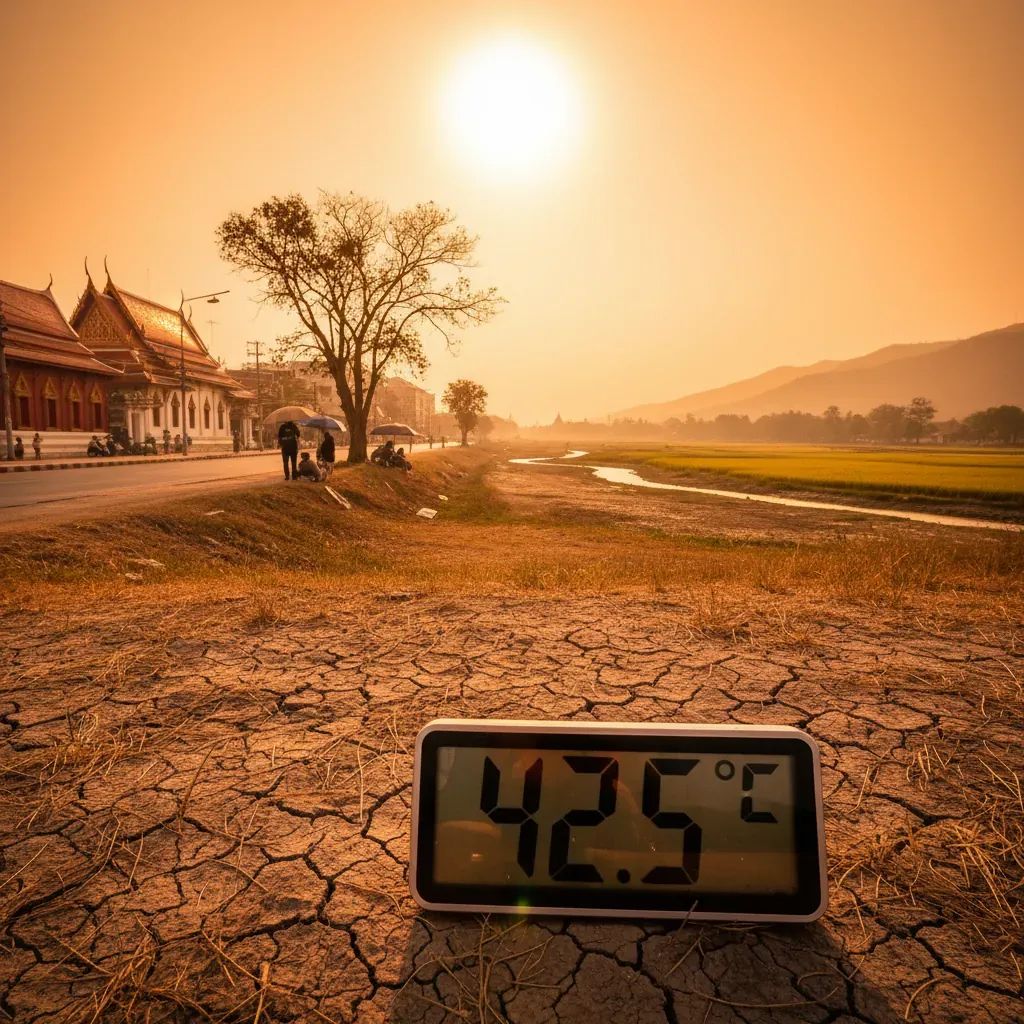
Millions of residents across Thailand face a dangerous week of extreme heat, with temperatures climbing to 41°C and isolated thunderstorms threatening eight provinces through Saturday morning. The culprit: a stalled weather system anchored over northern and northeastern regions that meteorologists describe as a "heat dome"—weak regional winds lack the strength to push the system eastward or disperse accumulated warmth. For outdoor workers, families with children or elderly members, and coastal communities, this extended hot spell demands immediate preparation and vigilance.
The Thailand Meteorological Department attributes this phenomenon to a stationary low-pressure system creating conditions where thermal energy accumulates daily without adequate wind shear to redistribute it. Unlike typical March weather patterns where systems roll through bringing temporary relief, residents should expect persistence—heat building steadily each afternoon, with isolated thunderstorms forming unpredictably when atmospheric instability peaks, then dissipating while the underlying heat dome remains intact.
Why This Matters
• Temperatures peaking between 37-41°C in the North, Northeast, and Central regions; Bangkok will see 35-39°C with persistent haze.
• Risk concentrated in eight provinces where isolated thunderstorms could generate winds exceeding 30 km/h; highest threat in Bueng Kan, Chaiyaphum, Nakhon Ratchasima, Nakhon Nayok, Chanthaburi, and Trat.
• Labor productivity and health concerns spike when outdoor work occurs during 11am-3pm peak heat; construction crews and street vendors face serious dehydration risks.
• Coastal hazards accelerate: Gulf of Thailand waves could exceed 1 meter during storm cells; fishing operations and small vessels require operational caution.
The Atmospheric Stall and What It Means
Late March typically marks Thailand's transition from cool-season relief into the grinding heat of April and May. This year's pattern differs fundamentally in one critical aspect: the heat isn't moving. Southerly and southeasterly winds currently measure only 5-15 km/h across the north—below the threshold needed to shift major weather systems or introduce cooler air masses from surrounding regions. Meteorologically, this creates what forecasters call a "stalled system," where thermal energy accumulates through successive days without adequate wind shear to redistribute it.
Residents accustomed to seeing weather systems roll through—bringing temporary rain, then departing with fresher conditions—should abandon that expectation. Instead, plan for persistence. Heat will build steadily each afternoon as solar radiation accumulates. Isolated thunderstorms will trigger unpredictably when the temperature gradient between ground-level furnace-like conditions and cooler upper atmosphere becomes steep enough to destabilize the air mass. These cells will form, potentially intensify rapidly, release concentrated rainfall and winds, then dissipate—leaving the underlying heat dome intact.
The Thailand Meteorological Department released this assessment on Friday, emphasizing that conventional cooling patterns won't arrive quickly.
Geographic Specificity: Where Danger Concentrates Most
The North experiences the most extreme thermal volatility. Mountain valleys surrounding Chiang Mai, Lampang, and Nan will witness overnight temperatures dropping to 16°C—cold enough to require bedding—before climbing to 41°C by late afternoon. This 25-degree swing creates physiological stress. Laborers beginning work in relatively cool morning hours often fail to anticipate the brutality of midday exposure, arriving underprepared with insufficient hydration and inadequate clothing protection from solar radiation. Residual haze from March agricultural burning traps heat closer to ground level, compounding respiratory strain and reducing air quality visibility to hazardous levels. Weak southwesterly winds provide virtually no relief.
The Northeast encompasses Thailand's largest population concentration and faces nearly identical heat extremes plus an additional thunderstorm complication. The Bueng Kan-Chaiyaphum-Nakhon Ratchasima corridor sits along the region's southern periphery where occasional moisture drifting from the Gulf of Thailand collides with inland heating. When these systems develop, wind gusts frequently exceed 30 km/h—forceful enough to snap tree branches, topple temporary market shelters dotting rural townships, and damage agricultural structures. Residents in these three provinces should inspect properties for loose roofing, trim overhanging branches, and secure outdoor equipment before afternoon hours. Power outages affecting rural areas remain a secondary risk if storms damage utility infrastructure.
Central Thailand stretches from industrial zones north of Bangkok through agricultural regions like Nakhon Sawan and Phichit. Terrain here is flat, offering no natural wind corridors or cooling from elevation changes. Dense urban concentrations—particularly Nonthaburi and Pathum Thani—create peak demand for electrical cooling. The combination of 37-40°C temperatures, dense vehicle traffic generating waste heat, and factory operations means grid-wide cooling demand will spike substantially. Electricity authorities have indicated adequate capacity, yet unexpected demand surges could trigger localized load management, affecting areas without priority protection.
Eastern provinces from Rayong through Chanthaburi to Trat benefit from stronger southeasterly winds (15-30 km/h) that typically reduce temperatures 2-5°C relative to inland equivalents. However, the storm-risk trio—Nakhon Nayok, Chanthaburi, and Trat—remain under thunderstorm surveillance. Popular tourist destinations like Chanthaburi's gem and fruit markets and Trat's beaches could experience sudden operational disruptions if storms intensify. Maritime activities and tourism operators should monitor forecast updates closely.
Southern Thailand represents the least extreme zone. Songkhla and Yala on the east coast face only light rain showers rather than thunderstorm activity, while the Andaman Sea coast remains stable with 1-meter wave heights and predictable conditions.
Health Implications and Vulnerable Populations
The Thailand Ministry of Public Health hasn't issued specific guidance yet, though sustained heat events typically trigger institutional messaging. The practical reality for personal health during this period is severe. Peak solar radiation occurs between 11am-3pm, when ground-level heat and reflected radiation from concrete and asphalt surfaces amplify perceived temperatures 5-10°C above meteorological readings in urban environments.
Outdoor workers represent the highest-risk demographic. Construction laborers, street food vendors, agricultural workers, and taxi drivers—occupations collectively representing millions of Thai workers—operate under constrained schedules offering minimal heat-avoidance flexibility. Dehydration develops rapidly in 40°C conditions, with early symptoms (dizziness, cognitive impairment, muscle cramping) frequently going unrecognized until heatstroke becomes medically critical. Employers operating construction projects or logistics operations should mandate hydration stations every 50 meters, implement shade breaks of 15 minutes per work hour during 11am-3pm, and train supervisors to recognize heat exhaustion warning signs.
Children possess underdeveloped thermoregulation systems; elderly residents often take medications impairing heat dissipation (blood pressure medications, antihistamines, certain cardiac drugs). Families should prioritize air-conditioned indoor environments for these populations during midday hours rather than assuming standard precautions provide adequate protection.
Storm Mechanics and Localized Preparedness
Heat-driven thunderstorms differ fundamentally from monsoon systems. Rather than sustained rain fronts persisting for hours, heat-generated cells form rapidly, release intense but brief precipitation, and produce wind gusts disproportionate to rainfall volume. This creates specific hazards: airborne debris, downed power lines from swaying trees, sudden visibility collapse during downpours, and flash flooding in low-lying drainage zones unable to process rapid water volumes.
For residents in the eight provinces under thunderstorm surveillance, practical preparation includes: securing outdoor items (trash receptacles, garden equipment, market awnings), parking vehicles away from large trees, avoiding driving into visibly flooded areas, and maintaining emergency contact numbers for local rescue services easily accessible.
Maritime Operations and Fishing Communities
Fishermen and recreational boaters operating from eastern ports should apply heightened caution through Saturday. The Thailand Meteorological Department specifies 1-meter waves under baseline conditions with potential increases "during thundershowers." In shallow coastal waters like Chanthaburi Bay or Trat's archipelago, 2-meter waves combined with gusty winds create genuinely dangerous conditions for small vessels. Commercial fishing operations may face brief operational pauses if storm cells intensify unexpectedly. Charter boat operators and diving companies should review cancellation policies and communication protocols with clients.
Economic and Agricultural Dimensions
Agricultural regions face conflicting demands. Irrigated farms require water during peak heat hours to prevent crop stress, yet afternoon storms deliver water rapidly and create erosion hazards. Rice paddies across the Central Plains require consistent moisture management—heat accelerates evaporation, necessitating increased irrigation pumping, while storms create localized flooding risks. Vegetable and fruit operations in the North face similar pressures. Economic impacts extend beyond individual farms: reduced outdoor labor productivity (workers must increase break frequency), elevated electricity costs for cooling and irrigation systems, and potential crop damage from hail or excessive wind gusts.
Research from international occupational health organizations indicates productivity declines of 10-20% in non-air-conditioned workplaces during sustained heat above 38°C. For businesses operating on narrow margins, this translates to measurable economic impact beyond worker discomfort—reduced output, higher labor costs to maintain productivity targets, and potential quality issues if monitoring capacity diminishes under heat stress.
Monitoring and Forecast Updates
The Thailand Meteorological Department releases detailed forecasts twice daily at 6am and 6pm, with provincial-level breakdowns available through the TMD website, mobile application, and Thai-language media outlets. Residents should monitor updates through Saturday morning to track when the heat system begins dispersing or whether atmospheric stalling persists longer than current modeling suggests.
Historically, this intensity of March heat represents the opening phase of Thailand's hottest season—April traditionally brings peaks of 41-43°C across northern regions before monsoon onset in May brings relief. The current pattern suggests extended periods of 40°C+ temperatures will strain power infrastructure, elevate heat-related hospital admissions, and reduce economic productivity across multiple sectors through mid-April.


