
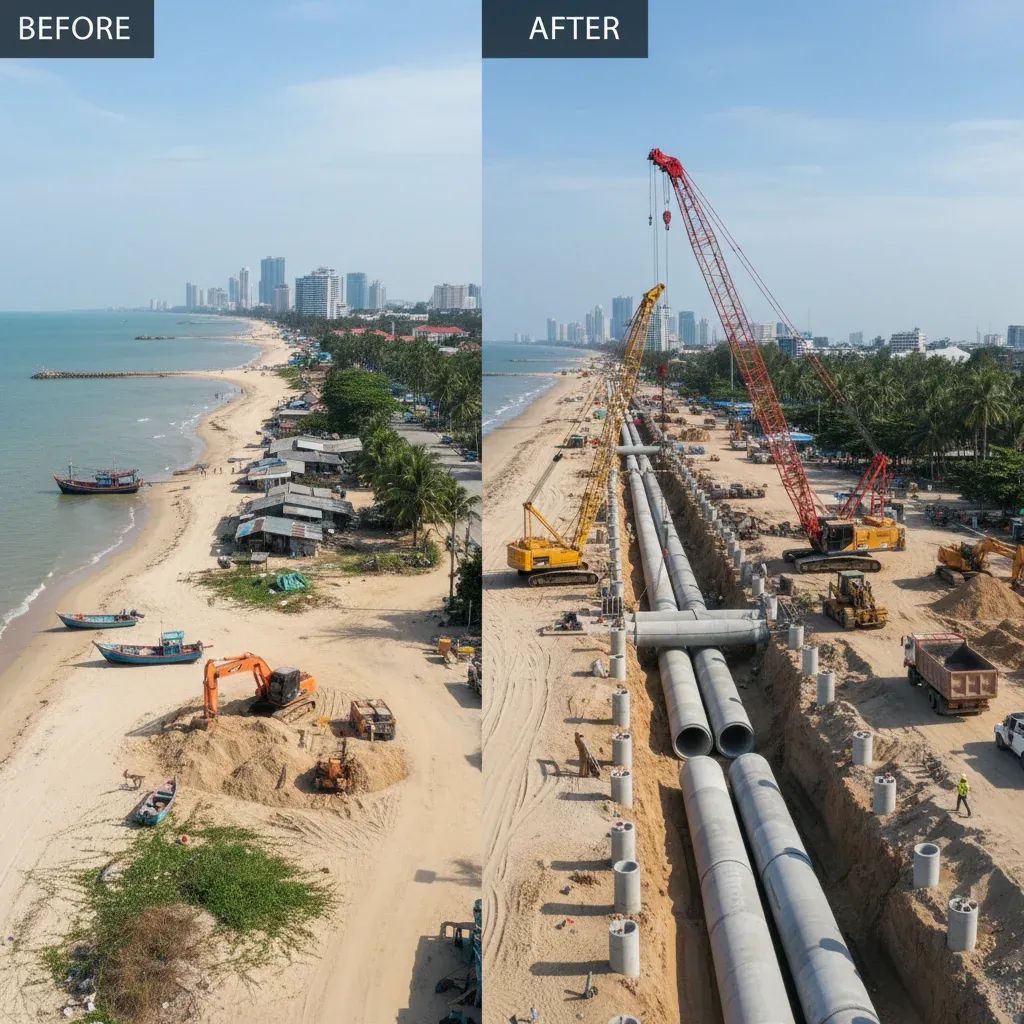
Thailand's Pattaya has completed over 80% of a major infrastructure overhaul along Jomtien Beach—a project budgeted at more than 200M baht—that expands vehicle parking capacity and installs large-diameter storm drains to address chronic flooding concerns, fundamentally reshaping one of the country's most visited coastal strips.
Why This Matters
• Parking expansion: New infrastructure increases parking capacity to more than 700 vehicles across the beach area.
• Flood defense: Storm-water pipes up to 2 meters in diameter are being laid to tackle monsoon-related water pooling issues.
• Improved walkways: New sidewalk paving and street lighting upgrades enhance pedestrian access and safety along the beachfront.
• Coastal infrastructure: The project focuses on upgrading drainage systems, widening pedestrian pathways, and improving overall street infrastructure to support increased visitor capacity.
A 200M Baht Investment in Coastal Resilience
The Pattaya City Council launched this infrastructure initiative to address long-standing challenges: traffic congestion and seasonal flooding that have impacted the area during monsoon periods. The project stretches across a significant section of Jomtien Beach, embedding high-capacity drainage tunnels, widening footpaths, and installing improved lighting systems designed to enhance evening walkability along the promenade. Officials frame it as part of Thailand's Eastern Economic Corridor (EEC) push to develop Pattaya as a major tourism and residential destination.
Infrastructure Improvements Drive Development
The upgrade includes expanded parking facilities capable of accommodating more than 700 vehicles, addressing a persistent bottleneck for visitors and residents navigating the busy beachfront. Drainage infrastructure improvements—particularly the installation of 2-meter diameter pipes—represent a significant engineering investment designed to prevent the waterlogging that has historically plagued the area during southwest-monsoon months.
The project also prioritizes pedestrian infrastructure, with widened sidewalks and enhanced street lighting intended to improve safety and walkability during peak visitor hours and evening periods. These upgrades aim to support Jomtien's role as a major recreational hub within the Eastern Economic Corridor.
Comparative Context: Jomtien's Regional Role
Thailand's major resort cities are investing heavily in infrastructure to manage capacity and enhance livability. Jomtien's approach emphasizes concrete drainage improvements, parking expansion, and pedestrian amenities—foundational investments that support both tourism and residential development.
The Chonburi provincial development plan (2023–2027) designates Pattaya-Jomtien as a key zone for integrated urban development under the EEC umbrella, providing access to national infrastructure funding that enables projects of this scale.
Impact on Residents and Investors
For the foreign and Thai residents concentrated in Jomtien and neighboring areas, improved infrastructure typically supports both quality-of-life enhancements and property-value stability. Completed sections—cleaner sidewalks, better lighting, expanded parking—contribute to the area's appeal as a long-term residential destination.
The expansion of parking and pedestrian facilities addresses practical concerns that have long affected commercial activity and visitor experience along the beach. Enhanced drainage capacity is particularly significant given the area's vulnerability to seasonal flooding.
Timeline and Completion Status
The project remains approximately 80% complete, with infrastructure improvements rolling out in phases. Most functional sections are already accessible to residents and visitors, though final completion of all drainage and paving work is ongoing. The phased approach allows sections to open as they pass inspection rather than delaying public access until the entire 3.2 km zone is finished.
Completion of remaining work is targeted for late 2025, though typical construction timelines may result in minor delays into early 2026. The staging strategy balances the need for thorough infrastructure installation with the practical benefits of delivering improvements to the public as soon as they are ready.
The Road Ahead
Once the infrastructure work concludes, Jomtien will have upgraded foundational systems engineered to support heavier precipitation, higher traffic volumes, and the denser development that continued growth will create. For anyone living, working, or investing in Thailand's eastern seaboard, Jomtien's infrastructure development offers a case study in how mid-tier resort zones invest in the practical systems required to sustain both tourism and residential growth.
The completed drainage infrastructure will be tested during the next southwest-monsoon season in July and August, providing a real-world assessment of the system's effectiveness. These upgrades represent a substantial commitment to ensuring that Jomtien remains a viable, functional destination for residents and visitors alike.


