
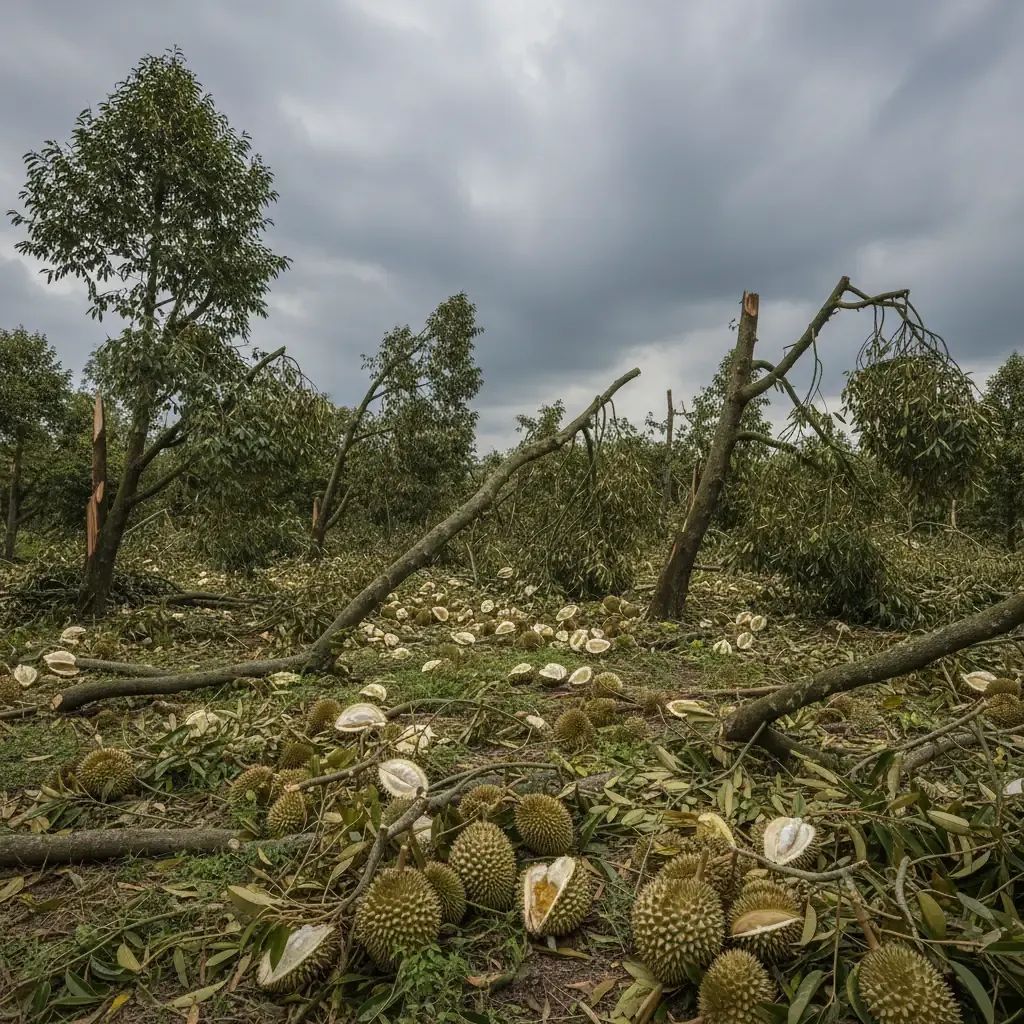
The Thailand Rayong Provincial Agricultural Office is racing to assess the economic toll after a violent summer storm tore through durian orchards on May 9–10, leaving 146 farmers counting the cost of 43 tonnes of lost fruit valued at more than ฿4.3M.
Why This Matters
• Harvest timing: The storm struck just as durian—one of Thailand's most lucrative fruit exports—was entering the critical harvest window.
• Quality control risk: Authorities are now scrambling to prevent premature or damaged fruit from flooding the market and damaging Rayong's reputation.
• Aid eligibility: Only farmers with updated registrations before the disaster will qualify for emergency compensation—up to ฿4,048 per rai.
• Price volatility ahead: With regional output already forecast to surge 22.4% this season, storm losses may tighten supply and stabilize prices that were trending downward.
What This Means for Residents – Action Items
If you're a durian grower in Rayong or the wider Eastern region, three action items matter immediately:
Register or update your farmer profile with the Department of Agricultural Extension before the next weather event. Only those on file before a disaster can access emergency relief compensation under the applicable Emergency Disaster Relief Regulation. The application window starts the moment the governor declares a disaster zone, so time is critical for affected households.
Check your crop insurance status. Contact your agricultural cooperative, the Bank for Agriculture and Agricultural Cooperatives (BAAC), or your insurance provider to understand what coverage applies to your orchards. Mobile apps and local offices can assist with damage reporting and claim filing processes.
Monitor the weather radar obsessively. The Thai Meteorological Department has issued repeat warnings for thunderstorms, gusty winds, hail, and flash flooding through mid-May. Summer storms in Thailand are notoriously unpredictable, forming rapidly as hot air collides with moisture from the Gulf of Thailand. Growers near the coast or in exposed upland plots should consider pre-harvest for any fruit nearing maturity rather than gambling on stable conditions.
Four Districts Hit, One-Third of Crop Gone
The storm swept through Wang Chan, Pluak Daeng, Khao Chamao, and Klaeng districts, damaging orchards across 12 sub-districts and 31 villages. Wang Chan bore the brunt: 18.1 tonnes of fruit destroyed and 16 trees toppled, affecting 77 growers. Khao Chamao lost another 18 tonnes spread across just 9 farms, while Klaeng saw lighter volume damage—3.95 tonnes—but the highest number of affected households at 56, suggesting many smaller plots were hit.
Provincial agricultural officers arrived within hours to document the wreckage and counsel growers on immediate triage: pruning shattered branches, propping leaning trunks, and rigging supports to prevent further fruit drop. For durian showing early color change, the guidance was clear—process it immediately into fried durian, ice cream, or paste rather than attempt fresh sales. Unripe fallen fruit was to be composted to salvage some nutrient value and limit total losses.
The "Storm Durian" Enforcement Push
Even as cleanup continues, the Thailand Agricultural Office in Rayong has coordinated with the Department of Agricultural Extension and quality control task forces to mount an intensive surveillance operation. The target: "durian lom"—literally "wind durian"—immature or damaged fruit that unscrupulous traders might rush to market while supply is disrupted.
Rayong durian commands premium prices domestically and abroad, particularly the Monthong and Musang King varietals that dominate local orchards. Any influx of substandard fruit risks tarnishing the province's brand and triggering complaints from wholesale buyers in Bangkok and export partners in China. Inspectors have been deployed to major packing houses and roadside stalls, cross-referencing shipment volumes against registered harvest windows to flag irregularities.
Growers caught selling storm-damaged fruit outside approved channels face fines and potential suspension from cooperative marketing programs. The message from officials: salvage what you can through processing, compost the rest, but do not compromise the collective reputation of Rayong durian.
Price Dynamics and Market Outlook
The timing could not be worse—or, paradoxically, slightly better—for Rayong's growers. Pre-storm forecasts anticipated a 1.07M-tonne harvest across Rayong, Chanthaburi, and Trat provinces, a 22.4% year-on-year jump that was already pressuring wholesale prices downward. In March, Musang King was fetching ฿220 per fruit at the orchard gate, down from ฿280 last season. Monthong harvest, which began mid-April, faced similar headwinds.
The storm's destruction of 43 tonnes represents a minuscule fraction of total regional output—barely 0.004%—but the psychological impact on traders and the Khao Din wholesale market in Rayong may be disproportionate. If the "storm durian" crackdown succeeds and quality remains high, reduced supply at peak season could arrest the price slide, at least temporarily. Conversely, any flood of substandard fruit will accelerate the downward spiral, punishing growers who maintained quality through the disaster.
Retail durian buffets in Rayong—like the ฿650–690 all-you-can-eat deals at Suphattraland running through August—may see margin pressure if wholesale costs stabilize or tick upward. For consumers, expect modest price firming at Bangkok's Chatuchak and Or Tor Kor markets if follow-on weather disrupts the late-May harvest peak.
Climate Adaptation and the Bigger Picture
This storm is a microcosm of the volatility facing Thailand's agricultural sector as climate patterns shift. Studies and initiatives from the Ministry of Agriculture and Cooperatives emphasize that erratic rainfall and extreme weather events pose growing risks to fruit trees and other crops. Average temperatures and humidity patterns already stress crop performance for smallholders lacking adequate irrigation access and climate-resilient practices.
In response, the government has drafted a 10-Year Climate Adaptation Technology Plan for Agriculture, prioritizing advanced weather forecasting, climate-resilient seed development, and precision farming tools. For durian growers, recommended strategies include:
• Windbreak planting: Perimeter trees to deflect gusts.
• Canopy thinning: Reducing wind resistance by pruning dense foliage that doesn't bear fruit.
• Branch bracing and fruit nets: Physical supports to prevent drop during storms.
• Diversified cropping: Mixing durian with shorter-cycle crops like papaya or banana to spread risk.
The Thai-German Climate Cooperation Program has piloted some of these techniques in rice paddies; adapting them for tree crops remains a work in progress. Meanwhile, crop insurance for durian is expanding, though availability varies by region and premiums depend on local risk assessments.
What Comes Next
The Rayong Governor's Office is expected to formally declare the four affected districts disaster zones within days, triggering the application clock for emergency aid. Agricultural officers are compiling damage reports and verifying farmer registrations to expedite payouts. Growers without current documentation will be left out—a harsh but deliberate policy choice to incentivize proactive record-keeping.
For the 146 affected households, the immediate challenge is salvaging income from damaged fruit through processing and ensuring next year's crop survives. Trees that remained standing but lost canopy will need intensive fertilization and pest monitoring to recover vigor. Those that toppled face a multi-year replanting cycle before returning to full production.
Broader market observers will watch whether Rayong's quality controls hold. If "storm durian" slips through to wholesale channels, buyer confidence could erode, depressing prices for compliant growers across the province. If enforcement succeeds, Rayong may emerge with its premium reputation intact—a small silver lining in an otherwise bruising season.
For now, the message from provincial authorities is clear: update your registration, watch the sky, and process or compost anything that hits the ground early. The next storm could arrive before the harvest window closes.


