
The Diesel Trail: What a Tak Seizure Reveals About Thailand's Fuel Underground Economy
Two arrests in Tak Province on the Myanmar border have exposed the mechanics of an operation that costs Thailand's government tens of millions of baht monthly in uncollected taxes. When officers intercepted 16,000 liters of unmarked diesel valued at ฿652,800 in Tha Song Yang district, they weren't just stopping a truck — they were interrupting a supply chain that feeds a parallel fuel market that undercuts licensed retailers and starves public coffers.
Why This Matters
• Your fuel costs more: Licensed service stations pay full excise tax and Oil Fund contributions, which translate to ฿3-5 per liter in taxes that smuggled diesel avoids entirely.
• Substandard fuel risk: Contraband diesel often lacks quality certification and may be adulterated with industrial solvents, damaging engines and voiding warranties.
• Border enforcement is escalating: The government has mobilized eight agencies with new inter-agency protocols, signaling that fuel smuggling is now treated as a national security priority, not just a customs matter.
How the Border Becomes a Smuggling Corridor
The seizure happened on a stretch of Highway 1085 in tambon Mae Song, an area where mountains, informal crossings, and price disparities create a perfect smuggling environment. Myanmar's diesel — often subsidized or sourced from gray-market refineries — costs significantly less than what Thailand's consumers pay after excise tax, VAT, and Oil Fund contributions are factored in.
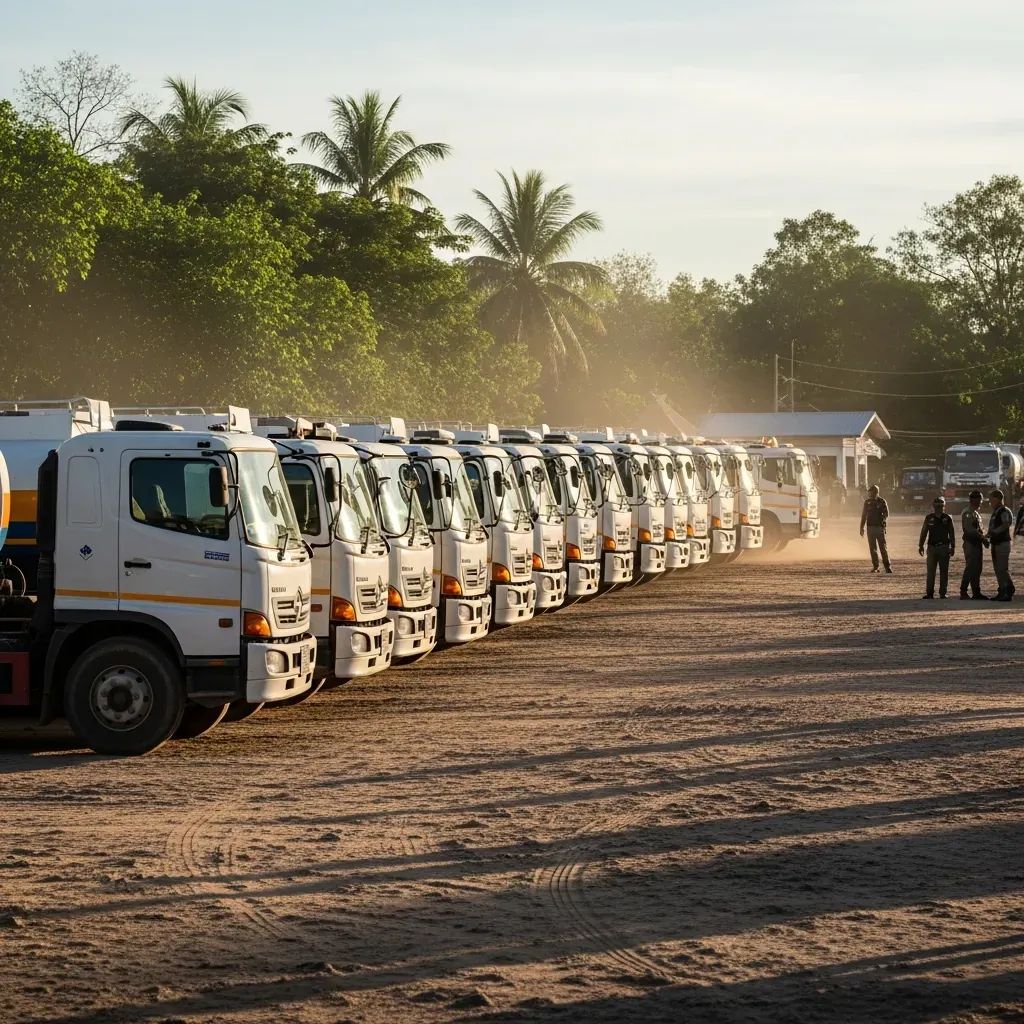
When a joint task force patrol spotted two six-wheel trucks draped in tarpaulins — a standard concealment tactic — and accelerated toward them, the drivers made a split-second decision. Instead of stopping, they floored it, hoping to reach a safer stretch of highway. The chase ended when both vehicles were boxed in along the road.
Inside each truck sat 80 sealed drums, each holding 200 liters of diesel. None carried customs paperwork or excise stamps. The drivers, whose identities remain undisclosed pending charges, now face prosecution under the Emergency Decree on Fuel Supply Protection (B.E. 2516), which carries prison time and asset confiscation.
The Economics of the Black Market
Smugglers exploit a consistent price gap. A liter of legal diesel in Thailand might cost ฿38-40 at the pump after all taxes. Across the border in Myanmar, depending on subsidies and sourcing, the same fuel might cost ฿20-25 wholesale. A smuggler who buys 16,000 liters at ฿25 and sells it to jobbers (small distributors) at ฿35 pockets ฿160,000 — before moving costs. From the government's perspective, that's ฿48,000-80,000 in lost excise revenue on that single load.
Scale this across hundreds of trucks monthly, and the revenue hemorrhage becomes apparent. The Department of Excise historically estimated annual losses at ฿5-6 billion, though analysts suspect the real figure is higher when accounting for jobber tax evasion, false export claims, and fuel diverted from subsidized agricultural programs.
In fiscal year 2024, the Thai government collected ฿200 billion in fuel excise revenue — a significant baseline before the enforcement escalation that followed. The growth in collections reflects intensified enforcement efforts undertaken in subsequent years. Yet that growth masks a persistent underlying problem: as long as diesel costs significantly less in Myanmar, the incentive to smuggle remains powerful.
The Government's Response: From Nuisance to National Security
In recent years, fuel smuggling has been reclassified from a routine customs matter to a priority enforcement concern. The Department of Special Investigation (DSI) now handles large-scale operations as organized crime, enabling financial intelligence gathering, asset freezes, and expanded surveillance authority.
Eight agencies — the Department of Special Investigation, the Royal Thai Police, the Customs Department, the Department of Energy Business, the Marine Interests Protection Command (ศรชล.), the Department of Internal Trade, the Port Authority, and the Department of Excise — now coordinate under unified protocols. In coastal provinces, the Marine Interests Protection Command has deployed aerial drones to intercept maritime smuggling, where operators disable AIS transponders or deliberately slow transit to evade detection. Ship-to-ship transfers in international waters are a particular focus after DSI uncovered a network in Surat Thani that was suspected of moving 57 million liters of fuel through untracked maritime channels.
In Tak, the strategy is terrestrial: roving patrols, informant networks, and intelligence-sharing with Myanmar border authorities where cooperation exists. The 16,000-liter seizure represents a mid-tier interception — large enough to suggest organized logistics, yet likely one of dozens of similar runs attempted each month in the northern region alone.
Casualties: The Legitimate Fuel Business
For independent service station operators and franchise owners in border provinces, contraband diesel is an existential threat. A pump attendant at a branded station in Mae Sot earning ฿13,000 monthly watches customers walk across town to a jobber's depot offering diesel at ฿4-5 per liter below legal rates. The station's margin evaporates. Over months, sales volume declines. Some operators close.
Legitimate distributors report inventory losses as customers defect to cheaper, untaxed sources. The businesses paying wages, property taxes, and excise duties find themselves undercut by an invisible competitor that pays nothing to the state.
This creates a two-tier market: the formal economy, burdened by compliance costs, and the shadow economy, agile and tax-free. The result is not just revenue loss; it's market distortion that rewards lawbreakers and punishes rule-followers.
Quality and Environmental Cost
Contraband fuel often lacks quality certification. Some batches are adulterated with industrial solvents or low-grade distillates to increase volume and margin. A vehicle engine designed for Thai-standard diesel — with specific sulfur content and detergent packages — encounters a fuel that doesn't match specifications. Fuel injectors clog. Engine knock occurs. Warranty claims are denied because the fuel itself was contraband.
At scale, this means thousands of vehicles across northern provinces operating on substandard fuel, increasing local particulate emissions and contributing to seasonal air quality degradation during the dry season.
What Comes Next for the Detained Drivers
The two men arrested in Tha Song Yang face charges carrying penalties of multiple years in prison and confiscation of vehicles and real property used in the offense. DSI investigators are now tracing the fuel's origin and intended destination. If the diesel crossed via a bribed official or an informal checkpoint, the case may escalate to anti-corruption probes. Financial forensics will attempt to identify upstream suppliers and downstream distributors.
The trucks and cargo are impounded as evidence. If convicted, the men will become part of Thailand's growing prison population for fuel smuggling — a category that has expanded dramatically since enforcement escalated in recent years.
The Pattern: More Than Just Tak
Nakhon Ratchasima: Officers discovered a farm supply depot concealing unmarked diesel storage. The owner was prosecuted, and the facility was seized.
Saraburi: A clandestine storage yard masquerading as a transport depot was raided, yielding thousands of liters of untaxed fuel and documentary evidence of an organized network.
Trat Province: Maritime interdiction near the Cambodian coast netted a pair of vessels carrying 300,000 liters of diesel, destined for redistribution across eastern provinces.
Throughout 2026, authorities have intensified seizures, with more than 335,000 liters of illicit fuel impounded nationwide, with border provinces accounting for a disproportionate share.
Impact on Residents and Border Communities
For ordinary residents in provinces like Tak, Mae Hong Son, and Nakhon Phanom, the enforcement escalation creates friction. Expect enhanced documentation checks at roadblocks, especially on bulk goods. Legitimate cross-border traders carrying agricultural products, garments, or machinery face delays as inspectors become more cautious. Commercial traffic slows. Delivery times lengthen.
For consumers, the practical advice is straightforward: buy fuel only at branded stations with visible excise tax seals on pumps. Roadside vendors and unlicensed depots offer cheaper rates but carry risk — engine damage, warranty invalidation, and the legal liability of knowingly purchasing contraband.
For small-scale fuel retailers, the government's zero-tolerance stance is clear: operating unsanctioned depots or selling untaxed fuel now invites criminal prosecution, not administrative fines. The consequence is closure, asset seizure, and imprisonment.
The Revenue Question
Each liter of smuggled diesel represents approximately ฿3-5 in foregone excise tax and Oil Fund contributions. If 335,000 liters were seized in a recent enforcement period, the implied loss for that operation alone reaches ฿1-1.7 million in uncollected revenue. Extrapolated across a full year and accounting for undetected smuggling, the fiscal impact justifies the government's resource commitment to enforcement.
Yet the underlying problem persists: as long as diesel costs significantly less across the border, the profit motive for smuggling will override the risk of arrest. The government's strategy — sustained enforcement, intelligence sharing, regional cooperation, and harsher penalties — attempts to shift the risk-reward calculus. Whether it will be sufficient to close the revenue gap and level the playing field for law-abiding businesses remains an open question, especially as prices fluctuate with global oil markets and neighboring countries adjust their own fuel policies.
The chase on Highway 1085 ended on a dusty shoulder near Mae Song. But the broader pursuit — to stamp out a billion-baht underground economy — is far from over.


