
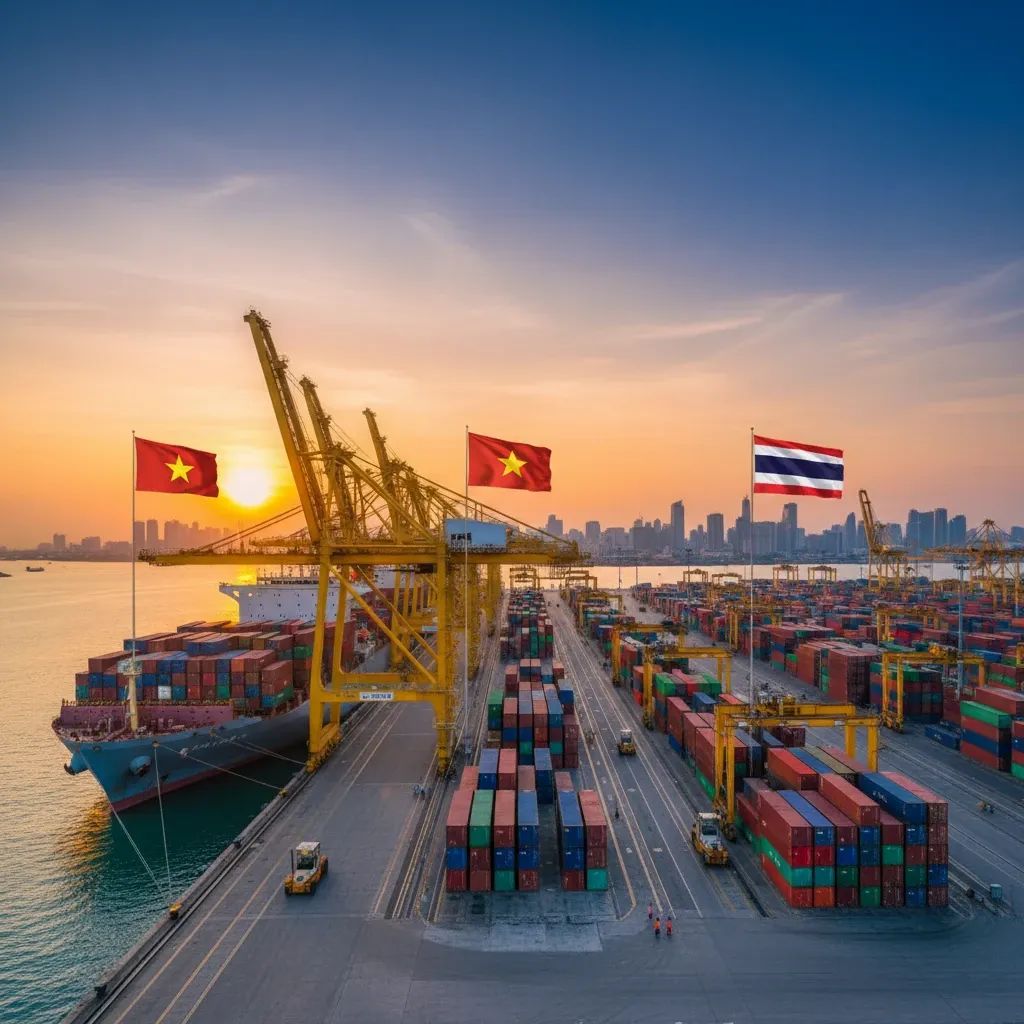
Southeast Asia's Twin Economic Powers Target Ambitious $25 Billion Trade Partnership
Thailand and Vietnam are moving to strengthen their bilateral economic relationship, with both governments committing to a $25 billion annual trade target by year-end 2026—a significant growth ambition that positions the two nations as economic anchors for mainland Southeast Asia.
During bilateral talks held at the 48th ASEAN Summit in Cebu (May 2026), leadership from Bangkok and Hanoi outlined a strategic partnership framework aimed at reshaping economic relationships across the Mekong region amid evolving regional dynamics. This commitment builds on the diplomatic relationship celebrated during the 50th anniversary of Thai-Vietnamese ties.
Why This Matters
• Trade growth target: The $25 billion annual trade goal represents substantial growth from current levels and signals mutual commitment to deeper economic integration.
• Strategic aviation expansion: VietJet has announced expansion plans in Thailand as part of its regional growth strategy, with investment interest in the Thai market.
• Mekong region framework: A coordinated approach to improving border efficiency and regional connectivity is being pursued through formal partnership agreements.
• Formal partnership framework: Vietnam's President To Lam is expected to visit Thailand to formalize the Comprehensive Strategic Partnership Action Plan, marking a milestone in bilateral relations.
The Economic Foundation
This represents a structured commitment to expanded economic cooperation. Thailand's Commerce Ministry and Vietnam's Ministry of Industry and Trade have been tasked with developing detailed implementation frameworks for the partnership. The relationship centers on enhancing connectivity across multiple sectors.
Supply Chain Coordination forms the foundation, with both nations seeking to integrate manufacturing networks in key sectors including petrochemicals, semiconductors, logistics, and renewable energy. Thai exporters gain access to Vietnam's substantial consumer market, while Vietnamese businesses benefit from improved sourcing and logistics capabilities.
Regional Development Focus, the second pillar, emphasizes improved trade efficiency across border regions. Thailand's Northeastern provinces—including Chiang Rai, Udon Thani, Nakhon Phanom, and Mukdahan—are positioned to benefit from enhanced regional connectivity and streamlined cross-border operations. This approach targets small and medium enterprises, agricultural traders, and logistics operators.
Green Growth and Digital Integration constitutes the third strategic area. Both nations have signaled intent to collaborate on renewable energy development and digital economy initiatives. Cross-border payment systems and digital trade facilitation are under consideration as part of the partnership framework.
Sectors with Growth Potential
Based on bilateral discussions, several product categories are identified as priorities for expanded trade:
Electronics, semiconductors, and machinery represent significant opportunities, with Vietnam's import requirements potentially exceeding current Thai supply capacity. Chemicals and construction materials follow, driven by regional infrastructure development.
Processed foods and consumer goods represent developing opportunities as tariff frameworks are reviewed. Thai food products, beverages, and consumer items are progressively entering Vietnamese markets. Vietnamese agricultural products, including coffee, cashews, and seafood, represent reciprocal export potential to Thailand.
Agricultural inputs and services constitute an emerging growth area, where Thai expertise in logistics, quality systems, and technology services aligns with Vietnamese market needs.
VietJet and Aviation Expansion
Vietnamese airline VietJet has announced expansion ambitions in Thailand as part of its regional growth strategy. The parent company has signaled interest in developing ground operations, maintenance facilities, and airport infrastructure collaboration with Thai partners. This represents a significant investment signal and indicates confidence in the Thai aviation market and bilateral economic momentum.
Practical Implications for Stakeholders
For exporters across Thailand, enhanced bilateral frameworks should reduce documentation requirements and streamline customs processes at shared borders. Thai manufacturers of construction materials, chemicals, and food products are positioned to benefit from improved regulatory clarity.
For import-oriented businesses, the bilateral approach aims to improve sourcing efficiency and expand product availability. Vietnamese agricultural products and textiles should become more readily accessible as trade frameworks are refined.
For tech and logistics specialists, the partnership's digital economy focus creates opportunities in supply chain digitization, cold chain development, and traceability systems aligned with international standards.
For tourism operators, enhanced connectivity between Thailand and Vietnam creates potential for improved travel linkages and coordinated promotional opportunities.
Mekong Sub-Region Leadership: The Broader Context
Thailand and Vietnam occupy a prominent position in mainland Southeast Asia's economic landscape. Both nations have acknowledged their responsibility in shaping regional development policy and promoting greater Mekong basin cooperation. The foreign ministries are tasked with developing connectivity frameworks addressing regional trade efficiency.
For businesses operating in border regions, the partnership signals movement toward more consistent and predictable trade processes. Logistics, agricultural coordination, and supply chain management are expected to benefit from improved bilateral frameworks.
The Presidential Visit and Partnership Formalization
The formal codification of this partnership will occur during President To Lam's state visit to Thailand, planned before year-end 2026. This visit, set against the backdrop of the 50th anniversary of Thai-Vietnamese diplomatic relations, will mark the signing of the Comprehensive Strategic Partnership Action Plan—a framework building on the bilateral discussions held in May 2026.
Both governments are coordinating efforts to support business engagement, with the Thailand Board of Investment and Vietnam's investment authorities working to facilitate cross-border business connections and investment opportunities.
What Matters Going Forward
The $25 billion trade target represents an ambitious but important commitment. The true measure of success lies in whether the partnership framework translates into tangible outcomes: measurable improvements in customs efficiency, clear regulatory pathways for traders, and demonstrable increases in cross-border business activity.
Residents, business owners, and investors should monitor announcements regarding President To Lam's visit as indicators of formal policy implementation. When the visit date is confirmed, expect accompanying announcements regarding trade facilitation measures and investment framework details from the Thailand Ministry of Commerce, the Thailand Board of Investment, and relevant provincial authorities.
For businesses positioning themselves to benefit from enhanced Thailand-Vietnam cooperation, attention to regulatory developments and policy timelines during the remainder of 2026 will be important for capturing opportunities as the partnership framework becomes operational.


