
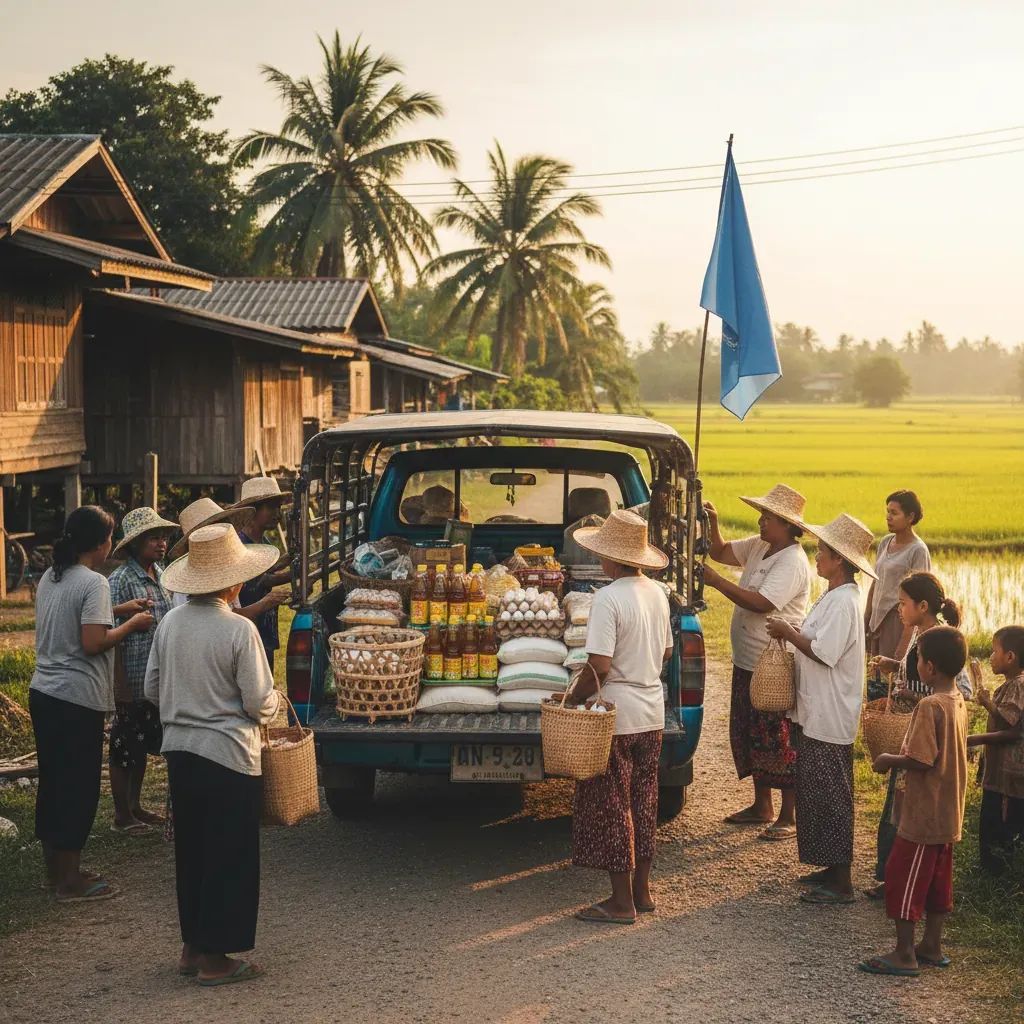
The Thailand Ministry of Commerce has rolled out a nationwide fleet of mobile grocery vendors—known locally as "rot phumphuan" (pickup-truck peddlers)—to deliver subsidized consumer staples directly to remote villages and low-income neighborhoods. The initiative, branded "Thai Help Thai: Reduce Cost of Living," officially launched its first 30-day sales phase starting May 15 and is expected to cut household expenses by at least ฿280M across 4M households nationwide.
Why This Matters
• Fuel stipends now active: Pickup vendors receive ฿3,000/month, three-wheelers ฿1,500/month, and motorbike operators ฿1,000/month in government fuel support—providing financial support for last-mile logistics into off-grid areas.
• 14 staples discounted up to 58%: Palm oil, fish sauce, instant noodles, eggs, rice, and shampoo are among the controlled-price items sold through the fleet, with savings averaging 20–40% below market rates.
• Over 10,000 vendors enrolled: As of May 9, more than 10,397 mobile sellers have registered nationwide, with 3,800 trucks operational in phase one, supported by 946 post-office hubs and 710 district offices acting as distribution nodes.
How the Program Works
Coordinated by the Ministry of Interior's Department of Provincial Administration, the Ministry of Commerce, and Thailand Post, the program supplies registered vendors with a starter kit of 14 essential goods sourced from 12 major manufacturers. Vendors then fan out to villages, selling at locked-in discount prices while recouping costs through the government's fuel card and wholesale subsidy.
Thailand Post functions as the central logistics hub, managing inventory flow and coordinating delivery routes to ensure rural areas—historically underserved by modern retail chains—receive regular shipments. The initiative also integrates 129 community stores and plans to expand product lines in later phases to include SME goods, OTOP handicrafts, and agricultural produce from local cooperatives.
To qualify, vendors must pass a provincial screening committee and agree to display transparent pricing at all sales points, a move designed to prevent markup abuse and maintain consumer confidence.
What This Means for Residents
For households in amphoe (district) centers and tambons (sub-districts) beyond the reach of 7-Eleven or Tesco Lotus, the program brings mobile vendors offering discounted staples—eliminating the need for costly trips to urban retail centers. With savings of 20–40% on essential goods like rice, eggs, and fish sauce, rural households can redirect spending to other priorities.
The fuel subsidy is delivered via Fleet Card or top-up card, allowing vendors to refuel at participating stations without upfront expense. For operators struggling with diesel prices hovering near ฿30/liter, this represents a meaningful operating margin boost—critical in sustaining the service past the initial rollout.
Scale and Timeline
Phase one runs through June 14, with the Commerce Ministry planning 518 district-level "blue flag" events between April and August, deploying more than 5,000 mobile units to saturate underserved markets. The roster of discounted goods includes:
• Palm oil, fish sauce, oyster sauce, MSG, sugar
• Jasmine rice, instant noodles, canned mussels, canned fish
• Dish soap, shampoo, conditioner, eggs, and milled rice
All items are name-brand or second-tier labels, avoiding generic substitutes that might undermine trust. Discount depth varies by item but can reach 58% on select products during promotional pushes.
Online and Offline Channels
Beyond the roving trucks, the program has digitalized access via partnerships with Grab, Shopee, Lazada, TikTok Shop, and LINE MAN, enabling provincial residents with smartphones to order subsidized goods for home delivery. This hybrid model combines traditional mobile retail with app-based ordering and logistics coordination.
Thailand's approach leans heavily on physical presence: the sight of a blue-flag pickup in the village square serves as both retail outlet and social signal of government support, a tactic with particular resonance in rural areas.
Concerns and Long-Term Viability
Some observers have raised questions about the program's long-term sustainability. The initiative's ฿280M budget estimate covers immediate subsidies but does not address structural factors such as supply-chain inefficiencies or commodity import dependency. Extended indefinitely, programs of this type could face budget constraints and impact local market dynamics, including traditional independent vendors (known as "rot kaeng" or curry-cart vendors) who lack access to wholesale subsidies.
There is also the question of competitive fairness. Independent grocery peddlers who do not qualify for the fuel card or starter kit face competition from government-backed vendors selling at discounted prices. The Ministry has argued that by enrolling thousands of existing vendors, the program enhances rather than displaces grassroots commerce—but implementation outcomes will vary by district based on enrollment levels.
Regional Context
Thailand's mobile-grocery initiative reflects a broader trend of using modular, low-cost infrastructure to serve dispersed populations. The key distinction of Thailand's approach: it is state-subsidized rather than private-equity-funded, making it more directly tied to government budget cycles and political priorities than comparable private models.
What Happens Next
Assuming phase one meets its 4M household target, the Commerce Ministry plans to expand product selection in mid-year, incorporating fresh produce, dairy, and SME-branded goods to support small manufacturers. The goal is to transform the fleet from a temporary relief measure into a permanent logistics backbone for rural commerce, potentially absorbing functions now handled by private couriers or informal traders.
For now, residents in Isan, Northern provinces, and Deep South districts can expect to see blue-flag pickups making weekly rounds, loudspeaker announcements echoing through village lanes, and queues forming for discounted essentials. Whether the program evolves into durable infrastructure or shifts with future policy will depend on budget allocations in coming fiscal cycles and sustained government commitment to institutionalize what is currently an active sales initiative.


