
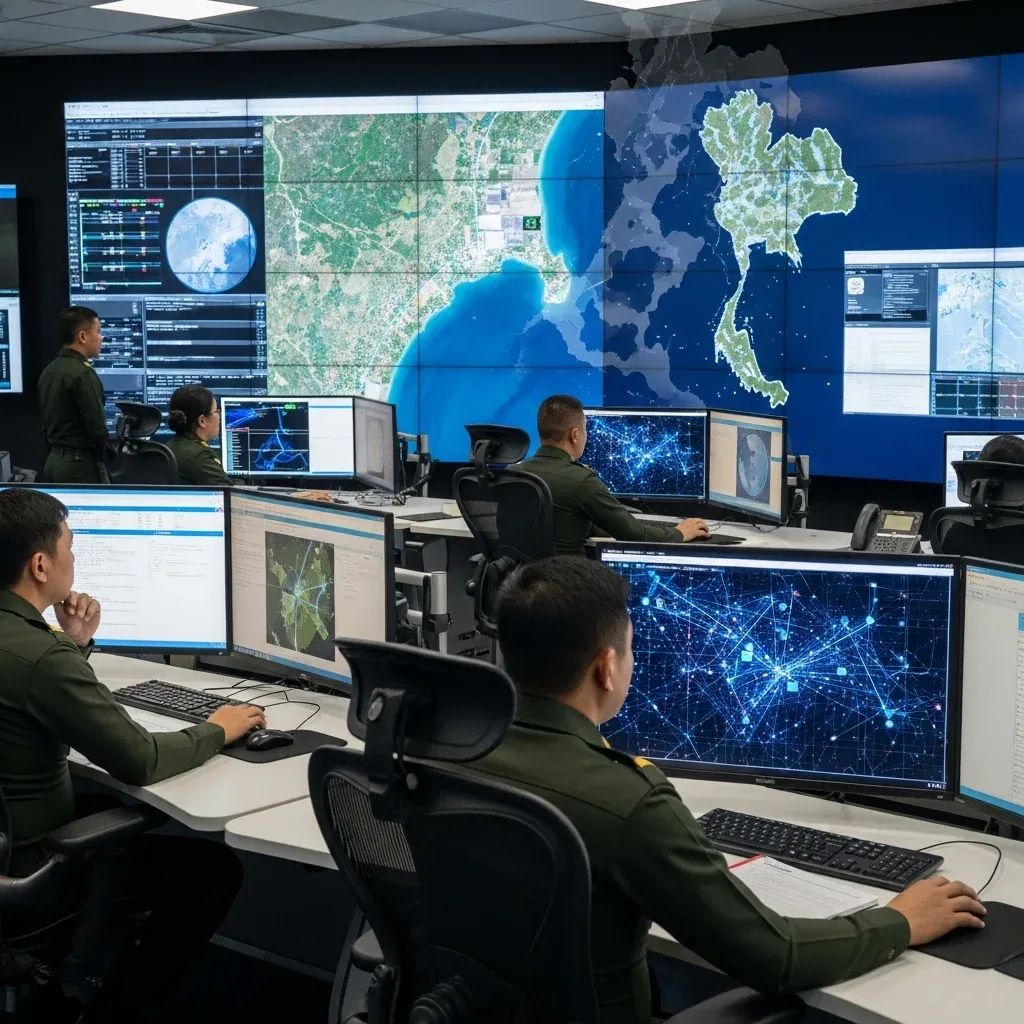
Thailand’s largest annual war game is about to leap beyond land, sea and air. Planners have quietly confirmed that Cobra Gold 2026 will fire up entirely new playbooks for space-based coordination and front-line cyber defence, ambitions that could ripple far beyond the exercise itself.
At a Glance
• Space operations enter the script for the first time – satellites, geospatial intel and a joint space command post will be rehearsed in real time.
• AI-assisted cyber drills will stress-test civilian and military networks, reflecting Bangkok’s widening digital-economy exposure.
• More than 30 partner nations are expected; troop numbers may top 8,000 personnel during the “heavy year” core phase from 24 February-6 March.
• Humanitarian aid and disaster relief (HADR) remains the diplomatic glue that keeps sceptical neighbours onboard.
Why Thais Should Care
Bangkok’s push to become a regional tech hub has made the country increasingly vulnerable to ransomware, online fraud and misinformation campaigns. Defence officials point out that the same fibre-optic cables and satellite links that power the e-commerce boom also underpin national security. Folding cyber ranges and orbital training into Cobra Gold, they argue, gives Thai engineers and officers an early look at tools normally reserved for larger militaries.
What Will Actually Change in 2026
Unlike previous editions that concentrated on amphibious landings and jungle survival, next year’s drill divides the battlefield into five interlocking domains:
Land – live-fire manoeuvres in Chanthaburi and Lop Buri.
Sea – joint carrier operations in the Gulf of Thailand.
Air – coordinated fighter sorties over the eastern seaboard.
Space – real-time satellite cueing and orbital asset protection.
Cyber – red-team attacks on simulated critical infrastructure.
Planners refer to this as a shift from “combined” to “all-domain integrated” operations, a phrase coined by the U.S. Indo-Pacific Command yet now echoed inside Thailand’s own defence white papers.
Inside the New Space Playbook
The headline addition is a multinational space component command headquartered at a newly upgraded control room in Sattahip. Participants will test:
• GEOINT-fused targeting – overlaying satellite imagery with battlefield sensors.
• Uplink protection drills designed to block jamming and spoofing.
• A compressed decision loop that moves from satellite cue to strike approval in minutes, aided by Echo C2 AI software adopted from U.S. Space Force trials.
Defence analysts in Bangkok say the exposure alone could accelerate Thailand’s own Thaichote-2 Earth-observation programme, due for launch later this decade.
Cyber Drill: Echoes of Real-World Attacks
Parallel to the orbital games, a Thai-U.S. team will unleash scripted malware, phishing waves and deep-fake news bursts against a sandbox that mirrors provincial power grids and 5G base stations. The goal is to practise swift patching, cross-agency information sharing and, critically, public-facing crisis communication in Thai and English.
Colonel Khemachart Srichana of the Army Cyber Center says the scenario borrows lessons from last year’s hack on a state hospital network that leaked thousands of patient files. “We are moving from compliance checklists to live-fire cyber defence,” he told reporters.
Regional Optics and Strategic Calculus
For Washington, the upgraded exercise underlines its pledge to remain the partner of choice in the Indo-Pacific without forcing smaller states to choose sides. For Bangkok, it is a demonstration of strategic autonomy: the kingdom receives high-end know-how while keeping diplomatic doors open to every major power—including those not invited to the drill.
Analysts at Chulalongkorn University note that emphasising HADR missions—from flood response to earthquake logistics—helps frame the space and cyber layers as humanitarian necessities rather than provocation. That nuance matters when neighbours such as Cambodia and Laos worry about creeping militarisation.
What to Watch Before February
• Final confirmation of the 30-plus country roster, likely to include Japan, South Korea and—if last-minute talks succeed—India’s Defence Space Agency.• Whether new Thai civil-military satellite stations in Rayong will be ready in time.• Outcomes of a draft National Cyber Security Amendment Bill, which could give military responders clearer authority during peacetime incidents.
The Bottom Line
Cobra Gold has long been a spectacle of beach landings and jungle survival, but 2026 will test something more abstract—and arguably more urgent for an economy racing toward 5G, fintech and autonomous logistics. By pulling spacecraft telemetry and AI-driven cyber shields into the annual exercise, Thailand positions itself not just as a host for foreign troops, but as an emerging player in the very technologies that will shape Asia’s next security era.


