
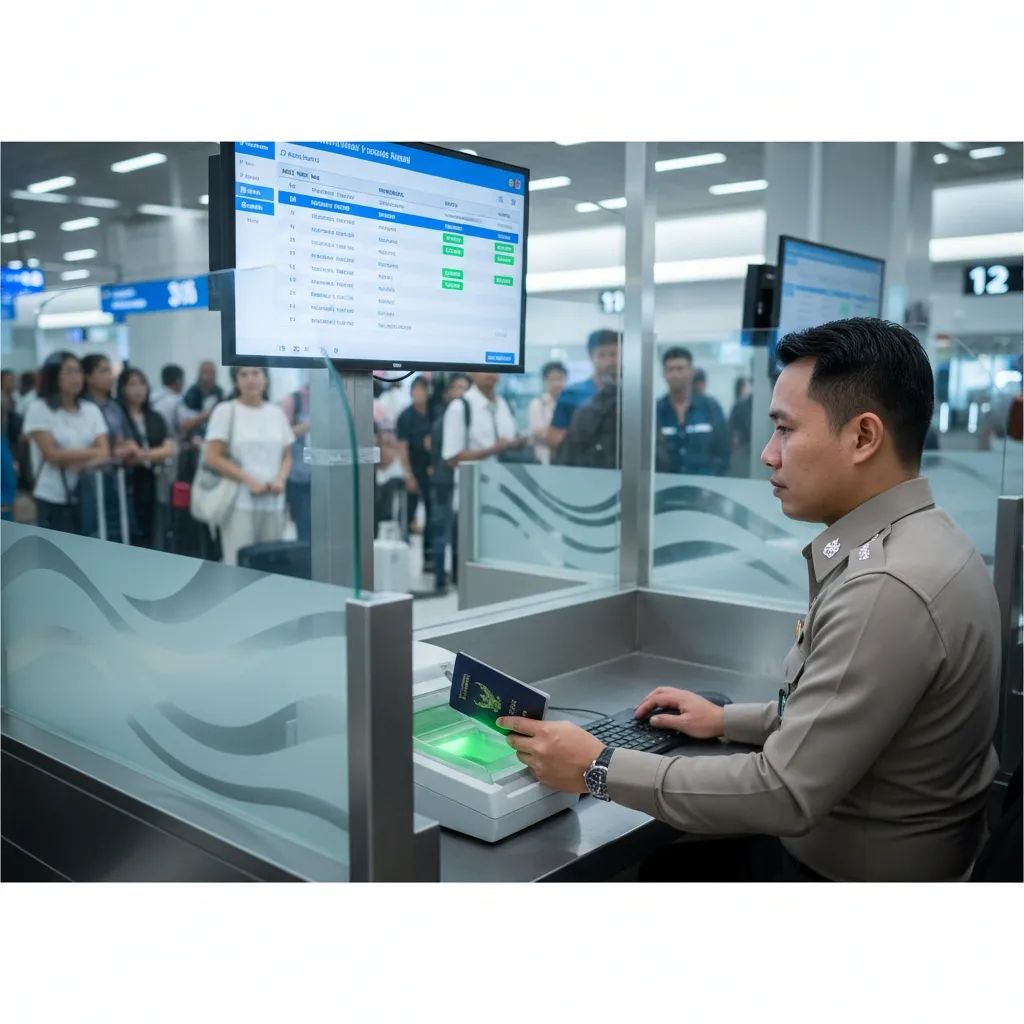
The Thailand Immigration Bureau has initiated the most comprehensive enforcement campaign in a decade, fundamentally reshaping the landscape for foreign residents who previously relied on short-term visa arrangements to maintain long-term residence in the kingdom. Between January 2025 and April 2026, authorities handled over 3,484 criminal cases involving foreign suspects in Phuket alone, while simultaneously restricting visa-exempt entries and dismantling hundreds of nominee business structures across the country.
Why This Matters
• Visa runs are effectively over: Immigration now limits visa-exempt entries to two per calendar year at land borders, with extension requests flagged after same-day re-entries. While the two-entry limit specifically applies to land borders, air arrivals also face increased scrutiny for patterns suggesting long-term residence through short-term entries.
• Business crackdowns intensify: Over 500 nominee companies were identified in a single April 2026 raid spanning three southern provinces, with prosecutions underway.
• Tax liability expands: The 180-day rule now triggers tax obligations on foreign income brought into Thailand, prompting 55% of surveyed expats to consider departure.
• Legal pathways exist: The new Destination Thailand Visa (DTV) offers remote workers a 5-year multi-entry option, while enforcement targets those circumventing proper channels.
The Enforcement Reality on the Ground
Chiang Mai and Phuket have become focal points for The Thailand Royal Police's three-phase enforcement strategy. In Chiang Mai, tourist police raided an unauthorized film production in May 2026, arresting eight Chinese nationals working without permits. The same month, authorities began investigating a "phantom birth" registration scheme in the northern districts that facilitated illegal property and company ownership through fraudulent documentation.
Phuket Provincial Police executed coordinated raids across eight locations in April 2026, targeting rental car agencies, real estate offices, and childcare centers operating under Thai nominee arrangements. The scale of enforcement is unprecedented: statistics presented by authorities reveal that between January 1, 2025, and April 30, 2026, Phuket handled 3,484 foreign suspects across various violations, with 15 prosecutions specifically addressing Foreign Business Act breaches involving 33 individuals.
The crackdown extends beyond business violations. Immigration officers at border checkpoints now scrutinize cumulative travel history rather than treating each entry in isolation. Travelers exhibiting patterns of minimal time outside Thailand, repeated extensions, and frequent border crossings face heightened questioning and potential denial of entry. The elimination of the informal "visa run" system—where individuals would briefly exit to neighboring countries and return for a fresh stamp—represents a fundamental shift in how The Thailand Immigration Bureau differentiates genuine tourists from de facto residents.
What This Means for Residents
The regulatory environment has bifurcated into two distinct pathways: formalized long-term residence with proper documentation, or increasingly uncertain short-term arrangements. Those who previously maintained residence through sequential tourist entries now face concrete barriers.
The practical constraints include extensions limited to two per calendar year—a first 30-day extension followed by a maximum 7-day extension—effectively capping visa-exempt stays well below the informal limits previously tolerated. The proposed reduction of the initial visa-free period from 60 days to 30 days, currently awaiting Cabinet approval, would further compress the timeline for those without established visa status.
For digital nomads and remote professionals, The Destination Thailand Visa provides a structured alternative, permitting stays of 180 days per entry over a 5-year validity period with multiple entries allowed. This visa category explicitly addresses the population previously operating in regulatory grey zones, though it carries tax compliance implications. Income sourced from abroad becomes subject to Thai taxation when the holder spends more than 180 days in the country during a calendar year, a provision that has prompted significant reconsideration among the foreign community.
For instance, a retiree spending 185 days in Thailand who transfers their pension into a Thai bank account would now be considered a tax resident and potentially liable for Thai income tax on those funds. This concrete implication has prompted many long-term residents to reassess their residence plans.
The discontinued Bronze Tier Elite Visa, which offered 5-year residence for a more accessible fee structure before its June 2025 termination, left a gap in mid-range long-stay options. Current alternatives require either substantial financial investment through remaining Elite tiers, qualification for specialized categories like the Long-Term Resident (LTR) visa for wealthy pensioners and highly skilled professionals, or commitment to education, employment, or marriage-based visa categories with their attendant documentation burdens.
The Tax Factor Reshaping Decisions
Beyond visa complications, The Thailand Revenue Department's enforcement of the 180-day tax residency rule has emerged as a primary departure catalyst. A Thai Examiner survey indicated 55% of respondents considered leaving specifically due to remittance tax changes. Foreign income brought into Thailand after establishing tax residency—defined as physical presence exceeding 180 days in a calendar year—now faces potential taxation under domestic rates.
This provision existed in Thai tax code previously but enforcement was inconsistent. The 2026 emphasis on compliance, coupled with enhanced information-sharing mechanisms, has transformed the calculation for retirees drawing foreign pensions and remote workers earning from overseas clients. Combined with a strengthening Thai Baht that eroded purchasing power for those earning in dollars, euros, or pounds, the economic advantage Thailand once offered has diminished considerably.
Rental costs in primary expat hubs illustrate the shift. Bangkok neighborhoods popular with foreigners have seen 30-40% increases in monthly rates over three years, while Phuket beachfront properties now command prices comparable to secondary European markets. The narrative that "Thailand isn't cheap anymore" has gained empirical support, particularly when tax obligations and visa processing costs are factored into total residence expenses.
Competing Destinations Gain Ground
The regulatory tightening has accelerated interest in alternative Southeast Asian bases. Vietnam's more straightforward visa extension processes, the Philippines' Special Resident Retiree Visa (SRRV) with minimal renewal requirements, and Malaysia's MM2H program (despite its own recent restrictions) present options for those prioritizing administrative simplicity over Thailand's specific lifestyle offerings.
The foreign population in Thailand remains substantial—estimated between 4.2M and 4.5M individuals representing roughly 6% of total population—but composition is shifting. Approximately 90% consists of migrant workers from Myanmar, Cambodia, and Laos, leaving the traditional expat community of retirees, professionals, students, and families at roughly 400,000 to 450,000 people. This latter cohort is experiencing the most pronounced policy impact.
Thailand's InterNations Expat Insider 2025 survey ranking of 4th globally for overall expat satisfaction reveals a paradox: general quality of life remains high, yet regulatory friction and cost pressures are simultaneously driving reconsideration. The divergence suggests that while daily living conditions, healthcare quality, and cultural amenities continue to attract foreigners, the administrative burden and financial calculation have deteriorated.
The Government's Stated Objectives
Prime Minister Anutin Charnvirakul's directive to review all visa categories reflects an official priority shift toward "quality" tourists and properly documented long-term residents. The Royal Thai Police's three-phase plan includes immediate enforcement measures now visible in daily operations, medium-term database consolidation for tracking foreign nationals, and long-term development of comprehensive monitoring systems.
Authorities frame the crackdown as targeting criminality, illegal employment, and visa misuse rather than legitimate foreign residents. The introduction of the Thailand Digital Arrival Card (TDAC), mandatory since May 1, 2025, for all arrivals within 72 hours prior to entry, provides enhanced tracking capability. Failure to complete this digital registration can result in entry denial, adding another procedural requirement to the arrival process.
The dismantling of nominee structures—where Thai citizens hold majority ownership on behalf of foreign beneficiaries in violation of Foreign Business Act provisions—addresses a longstanding legal ambiguity that many expat entrepreneurs navigated. The April 2026 Krabi raid uncovering over 500 such companies across three provinces demonstrates both the scale of previous tolerance and the current enforcement commitment.
Navigating the New Framework
For those committed to maintaining Thailand residence, the pathway requires formalization. Retirement visas demand meeting financial thresholds—typically 800,000 baht in a Thai bank account or monthly income of 65,000 baht—along with annual renewals and health insurance requirements. Employment visas necessitate sponsorship from Thai-registered companies with proper work permits. Education visas require enrollment in recognized institutions with attendance verification.
The DTV option suits remote workers and digital nomads willing to accept tax residency implications, while the LTR visa categories target wealthy pensioners (requiring $80,000 annual income), wealthy global citizens, work-from-Thailand professionals for foreign companies, and highly skilled professionals in targeted industries.
Each category carries documentation requirements, processing fees, and renewal procedures more intensive than the previous informal arrangements. For many long-term residents who built lives around less formal status, the transition represents a significant administrative and financial adjustment—one that some are unwilling or unable to make.
The conversation in Chiang Mai coffee shops and Phuket beachside establishments reflects this recalibration: weighing Thailand's undeniable lifestyle appeal against regulatory complexity, rising costs, and tax obligations that competitors in the region do not impose with equal rigor. The kingdom remains a premier destination, but on substantially different terms than the relatively frictionless environment that prevailed for decades.


