
The Thailand Department of Employment is working to reverse a 12-month suspension on seasonal workers from four northeastern provinces after South Korea blacklisted the entire Isan region, citing a pattern of contract violations and worker abscondment. The ban, which takes effect January 1, 2026 and runs through December 31, 2026, blocks residents of Udon Thani, Khon Kaen, Chaiyaphum, and Maha Sarakham from applying for E-8 agricultural and fisheries visas—a primary source of overseas income for families in Thailand's poorest region.
Why This Matters:
• No new placements: Residents of four provinces cannot apply for South Korea's E-8 seasonal work program until January 1, 2027.
• Quota already reduced: The worker abscondment issue has cut into Thailand's share of South Korea's 109,000 seasonal visa allocation for 2026.
• Broader screening impacts: All Thai nationals now face heightened scrutiny at South Korean immigration due to rising illegal overstay rates.
Who Is Affected:The ban applies only to new applicants from the four blacklisted provinces. Workers already employed in South Korea under valid E-8 visas are not affected and can continue their employment. However, residents of Udon Thani, Khon Kaen, Chaiyaphum, and Maha Sarakham cannot apply for new placements through any visa category administered under the government-to-government Memorandum of Understanding scheme. Alternative visa pathways, such as the Employment Permit System (EPS), remain available in principle, though they face the same heightened scrutiny affecting all Thai applicants.
What Triggered the Blacklist
South Korea imposed the provincial ban after determining that workers recruited under the government-to-government Memorandum of Understanding (MOU) scheme fled their assigned employers in rural agricultural and fishery operations. While authorities have not disclosed the exact number of absconders from these four provinces specifically, the broader picture explains South Korea's frustration: as of October 2024, approximately 139,000 Thais were working unlawfully in South Korea—far exceeding the number of legal Thai workers in the country.
Thai nationals now represent 76.3% of all foreigners illegally staying in South Korea after entering without a visa, according to immigration data compiled in late 2024. This disproportionately high rate is why South Korea has shifted from individual penalties to collective provincial bans—a blunt-instrument response to what Seoul views as a systemic compliance failure. For law-abiding workers from these provinces, this means sharing responsibility for others' violations, regardless of their own compliance record.
The scale of the problem extends beyond seasonal workers; in one incident in August 2022, 79 Thais arrived with tour groups and vanished without a trace. This pattern prompted South Korea's Ministry of Employment and Labor to implement blanket provincial bans rather than individual penalties—a tactic Thailand's Department of Employment is actively contesting. Officials in Bangkok argue that punishing compliant workers for the violations of a few undermines the livelihoods of entire communities and damages Thailand's reputation as a reliable labor exporter.
Economic Fallout for Isan Communities
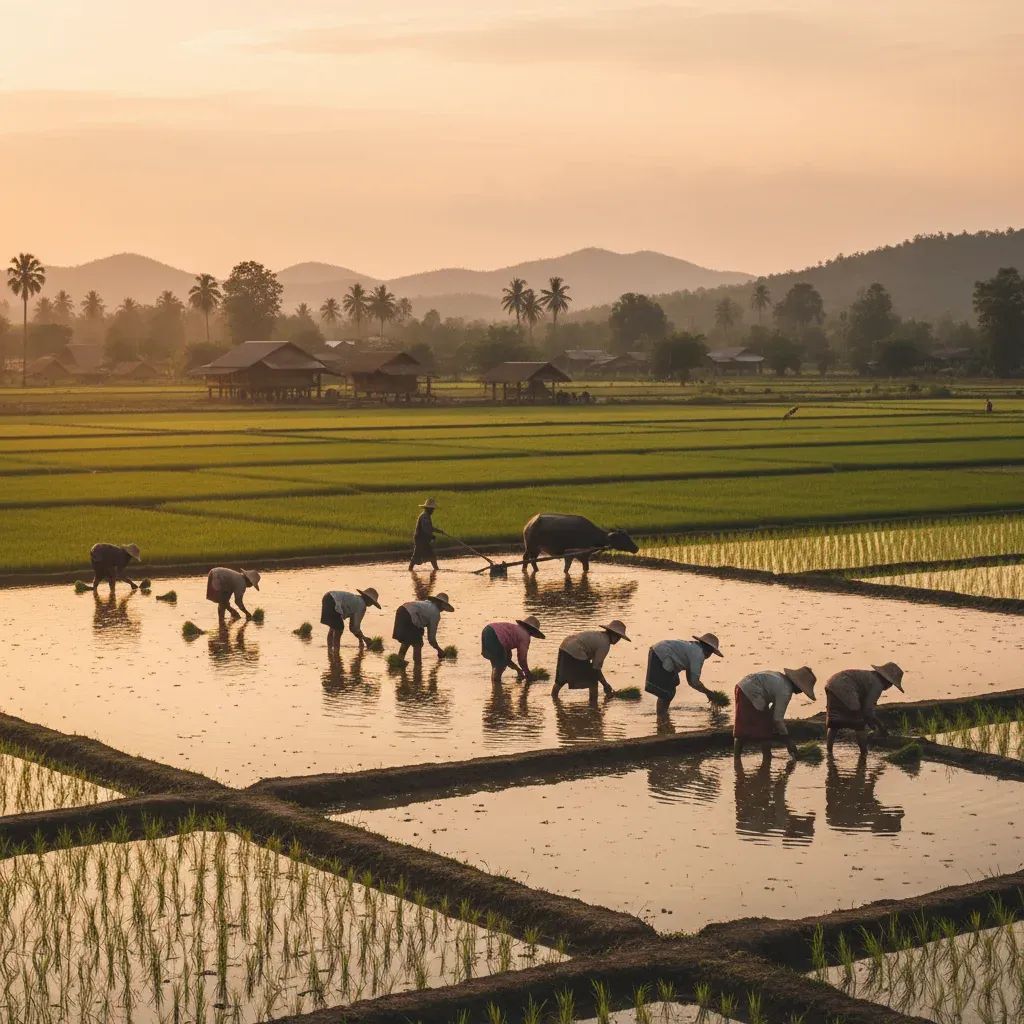
The suspension strikes at the heart of Isan's economic survival strategy. Approximately 85% of the region's residents work in agriculture, cultivating jasmine rice, cassava, and sugarcane on small plots with low yields and high input costs. Overseas work—particularly in South Korea, Taiwan, and Japan—has become a critical income supplement for families trapped in subsistence farming.
Remittances from seasonal workers abroad often fund children's education, medical care, and debt repayment. The E-8 visa program, designed to fill labor shortages in South Korea's aging rural economy, typically offers wages significantly higher than what Isan residents can earn domestically. Blocking access to these opportunities for an entire year could deepen poverty in provinces that already rank among Thailand's most economically disadvantaged.
The timing compounds the problem. South Korea plans to accept 109,000 seasonal workers in 2026 under the E-8 scheme, but Thailand's overall quota has already been reduced due to the abscondment issue. With four provinces now excluded, workers from other regions will face intensified competition for remaining slots—and residents of Udon Thani, Khon Kaen, Chaiyaphum, and Maha Sarakham are shut out entirely.
What This Means for Residents
If you live in Udon Thani, Khon Kaen, Chaiyaphum, or Maha Sarakham and were planning to apply for South Korea's seasonal work program in 2026, that option is now closed. The ban runs through December 31, 2026, with no current indication of early reinstatement.
Residents outside the blacklisted provinces can still apply, but should expect heightened scrutiny during visa processing and border control. All applicants must now demonstrate stronger ties to Thailand—such as property ownership, family obligations, or existing employment—to reassure South Korean authorities they will return home when contracts expire.
For those considering overseas work, the Thailand Department of Employment advises the following:
• Apply only through official government channels or licensed agencies registered with the department.
• Avoid brokers who promise faster processing or higher wages outside the EPS framework.
• Understand that abscondment carries severe penalties: deportation, fines up to ฿50,000, and a two-year ban on future applications.
• Recognize that violations by workers from your province can trigger collective penalties affecting entire communities.
Thailand's Countermeasure Strategy
The Thailand Department of Employment is negotiating with the South Korean embassy to replace the provincial blacklist with an individual penalty system that targets only those who violate contracts. This approach would preserve opportunities for workers who intend to comply with visa terms while still addressing South Korea's legitimate enforcement concerns.
Thai labor officials are also promoting the formal Employment Permit System (EPS) as the exclusive pathway for overseas work, emphasizing that legal channels provide wage protections, workplace safety standards, and access to South Korean labor law remedies. The government has intensified crackdowns on illegal labor brokers who promise higher wages through unofficial channels but often leave workers vulnerable to exploitation, deportation, and multi-year bans.
A dedicated task force—the Trai Thep Phithak Special Unit—now conducts workplace inspections and vets recruitment agencies to ensure compliance with bilateral labor agreements. Authorities are urging prospective workers to verify all application details through official employment offices rather than third-party intermediaries, warning that fraudulent schemes not only endanger individual migrants but also jeopardize Thailand's standing in international labor markets.
Accountability and Path Forward
The blacklist controversy has forced both governments to confront systemic failures. South Korea's blanket provincial ban punishes compliant workers for others' violations, while Thailand's struggle to prevent abscondment exposes gaps in pre-departure screening and post-arrival monitoring.
The Thailand Department of Employment is now pushing for a data-sharing agreement that would allow both countries to track workers in real time, flag absconders immediately, and impose penalties on individuals rather than entire regions. Officials are also advocating for expanded legal quotas, arguing that increasing the number of official placements would reduce the incentive to pursue illegal alternatives.
Simultaneously, Thai authorities are investing in skills development programs and agricultural technology initiatives to create viable livelihoods within Isan itself. The Alternative Agriculture Network Isan (AAN) is promoting diversified organic farming and producer cooperatives to boost local incomes and reduce reliance on overseas migration.
Whether these measures can restore South Korea's confidence—and lift the provincial blacklist before 2027—remains uncertain. For now, tens of thousands of Isan residents face a closed door to a critical income source, with no immediate alternative in sight.


