
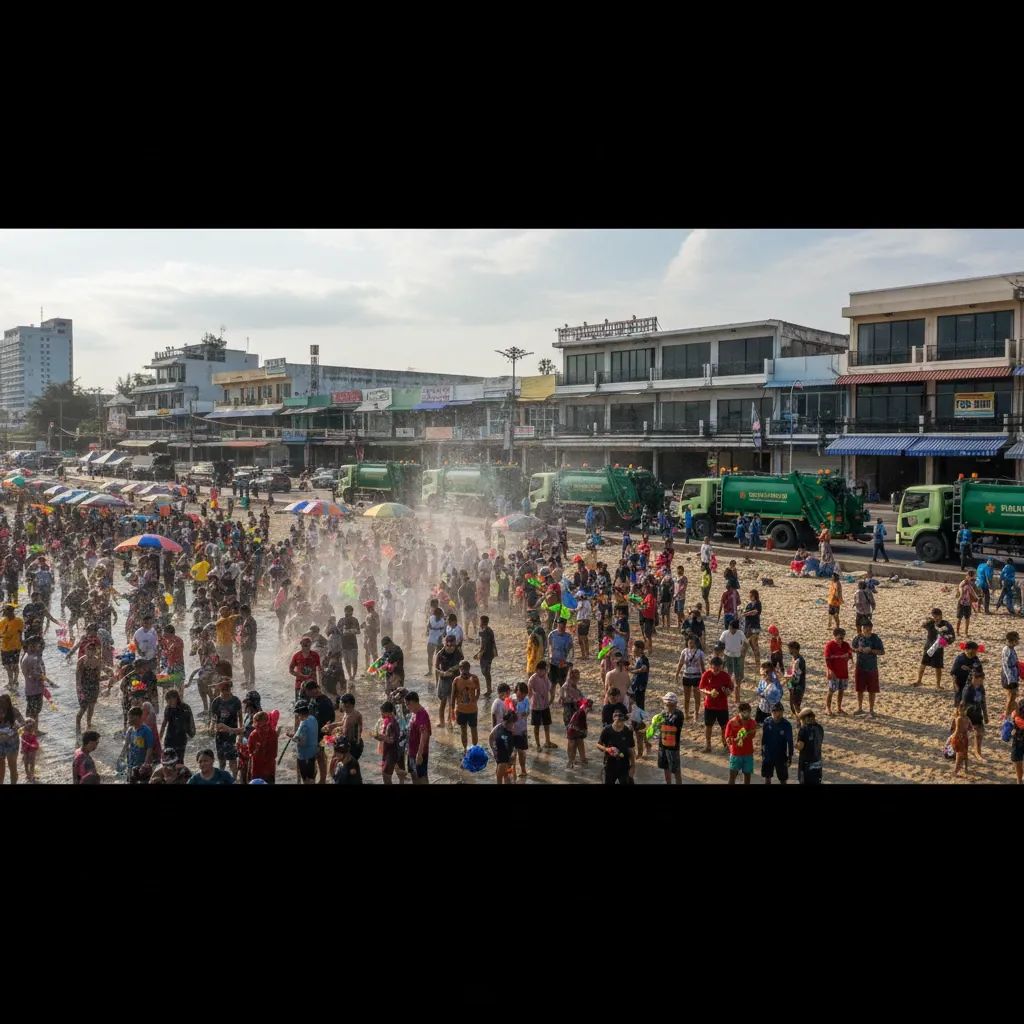
Thailand's premier beach resort city is wrapping up Songkran 2026, and early indicators tell a story that should concern anyone invested in the country's tourism economy. While the official figures show ฿6.5B circulating through Chonburi province and hotel occupancy hitting 88-92%, a closer look reveals a troubling disconnect: Pattaya is attracting record crowds but generating diminishing returns per visitor.
The Thailand Tourism Authority continues to trumpet arrival statistics, but beneath the surface, the resort city is grappling with what economists are calling "high-volume, low-yield tourism" — a phenomenon where packed streets don't translate to packed cash registers.
Why This Matters
• Revenue per guest is declining despite record occupancy, signaling a fundamental shift in how tourists spend money in Pattaya.
• Short-term apartment rentals capture a significant and growing share of accommodation spending, with property managers reporting returns 40-60% higher than long-term leases.
• Infrastructure stress tests during Songkran exposed vulnerabilities in water, waste, and traffic systems that threaten year-round livability.
• Digital nomads and long-stay residents are transforming Pattaya from a seasonal destination into a year-round economy with different support needs.
The Spending Gap Nobody's Talking About
Between April 17-19, the Wan Lai Pattaya festival alone was projected to generate ฿1,000-1,500M, with total visitor counts ranging between 380,000-420,000 people across the three-day celebration. Nationally, foreign tourists contributed approximately ฿8.1B during the Songkran period, while domestic travelers added ฿22.25B.
Yet conversations with restaurant owners, tour operators, and retail managers paint a different picture. Tables turn more slowly than expected at mid-tier and upscale dining venues. Street food vendors report brisk business, while sit-down establishments see fewer walk-ins. The 7-Eleven convenience stores are packed; the boutique shops are not.
The shift reflects a broader change in visitor behavior. Indian group tourism continues expanding, Russian long-stay visitors remain concentrated in Jomtien and Pratumnak, and Thai domestic tourists have returned with enthusiasm — but their trips are brief and budget-conscious. It's participation over indulgence, presence over profitability.
The Condo Effect: Where Tourism Revenue Goes to Die
The most significant transformation in Pattaya's accommodation landscape has happened quietly and almost entirely outside government oversight. Short-term condominium rentals have become the preferred choice for a growing segment of travelers, offering affordability, space, and kitchen facilities that allow groups and families to dramatically reduce dining expenses.
While hotels boast near-capacity booking rates, the revenue per available room (RevPAR) hasn't climbed proportionally. Occupancy statistics mask a fundamental redistribution of tourism spending away from the traditional hospitality sector and into private rental markets that generate minimal employment and limited ancillary spending.
Property management companies report that short-term rentals can generate returns 40-60% higher than long-term leases, even with occupancy rates around 50%. Prime locations near beaches or entertainment zones command daily rates that make month-long hotel stays financially impossible for budget-conscious travelers. The result: tourists are present, but the economic multiplier effect that once defined Pattaya's prosperity has weakened considerably.
The Thailand Hotel Association projects a shortage of 12,000-15,000 qualified hospitality workers across Chonburi province by mid-2026, even as approximately 2,800 new hotel rooms are scheduled to open by year's end, including developments by Marriott and Hilton. This mismatch between expanding supply and shrinking per-guest revenue creates a precarious situation for traditional accommodation providers.
Infrastructure Under Siege
The celebration leaves more than memories. As Pattaya City Hall's sanitation teams demonstrated in their overnight "clean before dawn" operation following Wan Lai on April 19, the physical toll of mass tourism is immediate and measurable. High-pressure water trucks worked through the night removing powder stains, mud, sand, and refuse from Beach Road and surrounding areas — a race against sunrise to restore normalcy.
But the deeper infrastructure challenges extend far beyond post-festival cleanup. Pattaya generates approximately 500 tons of daily waste under normal conditions, spiking to 600 tons during peak tourism periods. Collection systems strain under the load, and disposal facilities operate near capacity.
The chronic waste crisis on Koh Larn island — where accumulated garbage has reached critical levels — illustrates the long-term consequences of inadequate infrastructure investment. The city constructed two incinerators on the island, with operations now underway following trial phases in 2025, but full resolution of the existing waste backlog is projected to take an additional several years.
Water management presents perhaps the most critical vulnerability. Songkran's intensive water consumption stress-tests distribution and wastewater systems that already operate near their limits. Pattaya's two sewage treatment plants frequently receive volumes exceeding their design capacity, particularly during heavy rainfall. When overloaded, untreated or partially treated wastewater flows directly into the bay — a reality that undermines the resort city's environmental credentials and poses public health risks.
Recent incidents underscore the fragility of these systems. In February 2026, private buildings in Jomtien were found discharging wastewater directly onto public streets, creating standing pools and foul odors. Contractors were caught illegally dumping sewage into sand pits near Jomtien Beach, allowing contamination to reach the ocean. While officials claimed seawater quality remained unaffected, the episodes reveal enforcement gaps and systemic pressures that Songkran-level crowds amplify exponentially.
Traffic congestion compounds the stress. Road closures for Wan Lai forced traffic onto Sukhumvit Road and other arterial routes, creating gridlock that turned short distances into extended journeys. The narrow street network, limited parking, and inadequate pedestrian infrastructure — routinely obstructed by motorcycles, vendors, and debris — make movement difficult even under normal conditions.
What This Means for Long-Term Residents
For expatriates, retirees, and digital nomads who've made Pattaya their base, the Songkran experience offers a revealing glimpse into the city's carrying capacity. The Thailand government's new digital nomad visa — which permits tax-free remote work for up to five years — is accelerating Pattaya's transformation from a seasonal tourism hub into a year-round residential economy.
This shift fundamentally changes what success looks like. The critical question is no longer how well Pattaya performs during peak periods like Songkran, but whether the city can maintain economic stability and livability during the shoulder months that increasingly define its calendar.
Coworking spaces such as Pattaya Work Loft, BeWork Pattaya, and Grind Time Coworking Space are proliferating to serve remote workers who stay for months rather than days. These visitors spend differently — prioritizing reliable internet, comfortable long-term accommodation, and everyday services over nightlife and traditional tourist attractions.
Their presence provides economic consistency that softens seasonal volatility, but also introduces new pressures. Demand from foreign remote workers and long-stay tourists contributes to rising rental costs, pricing out local residents and creating income inequality. The influx of longer-term foreign residents requires expanded infrastructure, healthcare access, and community services that the city's current systems struggle to provide.
The Quality-Over-Quantity Pivot That Isn't Happening
The Tourism Authority of Thailand has repeatedly stated its commitment to "quality over quantity" tourism and creating premium experiences rather than chasing arrival numbers. Yet Pattaya's reality contradicts this aspiration. The city remains trapped in a high-volume, low-yield model where success is measured by headcount rather than economic impact.
This disconnect matters because the infrastructure investments required to support sustainable growth are substantial and cannot be justified by declining per-capita spending. Upgrading wastewater treatment, expanding road capacity, improving waste management, and enhancing public spaces require revenue streams that mass-market, budget-conscious tourism cannot generate.
The challenge is structural. As domestic travel grows — driven by 5.96M Thai tourists nationwide during Songkran 2026, up 7% year-over-year — the average length of stay shortens and spending patterns become more conservative. International arrivals totaled approximately 500,000 visitors, up 4%, but inflation-conscious travel behavior limits their economic contribution.
Meanwhile, the demographic shift away from Western seasonal tourists toward year-round Asian visitors changes the types of services in demand. Traditional nightlife districts see reduced foot traffic, while shopping centers, cultural experiences, and family-friendly attractions gain prominence. The transition creates winners and losers, but doesn't necessarily produce the high-margin tourism the city requires to fund necessary infrastructure improvements.
The Songkran Stress Test
Festivals like Songkran and Wan Lai serve as annual examinations of Pattaya's resilience. The extended celebration — running from April 10 through April 19 in Pattaya, far longer than in most Thai cities — concentrates demand in ways that expose system weaknesses.
Beach Road closures from noon to midnight during Wan Lai allow water fights to proceed safely, but force traffic onto alternate routes that lack capacity. The "orange-shirt knights" of Pattaya's sanitation department work overnight shifts to restore cleanliness before dawn, but the volume of waste generated during daylight hours tests collection and disposal systems to their breaking point.
Water consumption during Songkran reaches levels that challenge distribution infrastructure designed for average daily demand. Every bucket thrown, every spray gun triggered, adds incremental pressure. The question isn't whether the system functions under normal conditions — it's whether it can handle sustained peak loads without failure.
These annual stress tests provide valuable data, but also preview what Pattaya's future looks like if year-round occupancy continues rising without corresponding infrastructure investment. A city designed for seasonal surges faces very different challenges when operating near capacity continuously.
Beyond the Festival: What the Numbers Really Mean
When Beach Road dries and the music fades, the economics remain. Chonburi province recorded accommodation and restaurant spending growth of 4% during Songkran 2026 compared to the previous year — a modest increase that barely outpaces inflation and falls well short of the visitor growth rate.
This gap between volume growth and revenue growth defines Pattaya's current predicament. More people are coming, but they're spending less per day and staying for shorter periods. The traditional hotel-restaurant-tour operator ecosystem that once captured most tourism spending now competes with apartment rentals, convenience stores, and self-guided experiences that generate minimal local employment or tax revenue.
For business owners, the calculus is sobering: high occupancy no longer guarantees profitability. Operating costs have risen with inflation, labor shortages push wages higher, and competition intensifies as new supply enters the market. The pressure to discount rates to maintain bookings erodes margins, creating a race to the bottom that benefits neither operators nor the broader economy.
For residents — both Thai and foreign — the implications are equally clear. A tourism model based on volume rather than value creates congestion, environmental degradation, and infrastructure strain without generating the tax revenue needed to address these problems. The city becomes busier but not necessarily more prosperous, crowded but not vibrant.
The Path Forward: Unanswered Questions
Pattaya stands at an inflection point. The city can continue pursuing volume-driven tourism, accepting the infrastructure pressures and diminishing returns that accompany this strategy. Or it can pivot toward higher-yield visitors and longer-term residents whose spending patterns support sustainable growth and infrastructure investment.
The choice will determine whether Pattaya remains livable for the digital nomads, retirees, and long-term expatriates who increasingly call it home. It will shape whether the Thai families and local businesses that depend on tourism can thrive rather than merely survive. And it will decide whether the environmental systems that underpin the resort city's appeal can withstand the pressures being placed upon them.
When the last water droplet falls and the streets return to their baseline rhythm, the measure of success isn't how loud the celebration was — it's how strong the foundations prove to be. Songkran 2026 delivered impressive visitor counts and generated substantial revenue. But the underlying trends suggest that Thailand's premier beach resort is drawing more people while creating less value, a trajectory that cannot sustain either the city's infrastructure or its economic future.


