
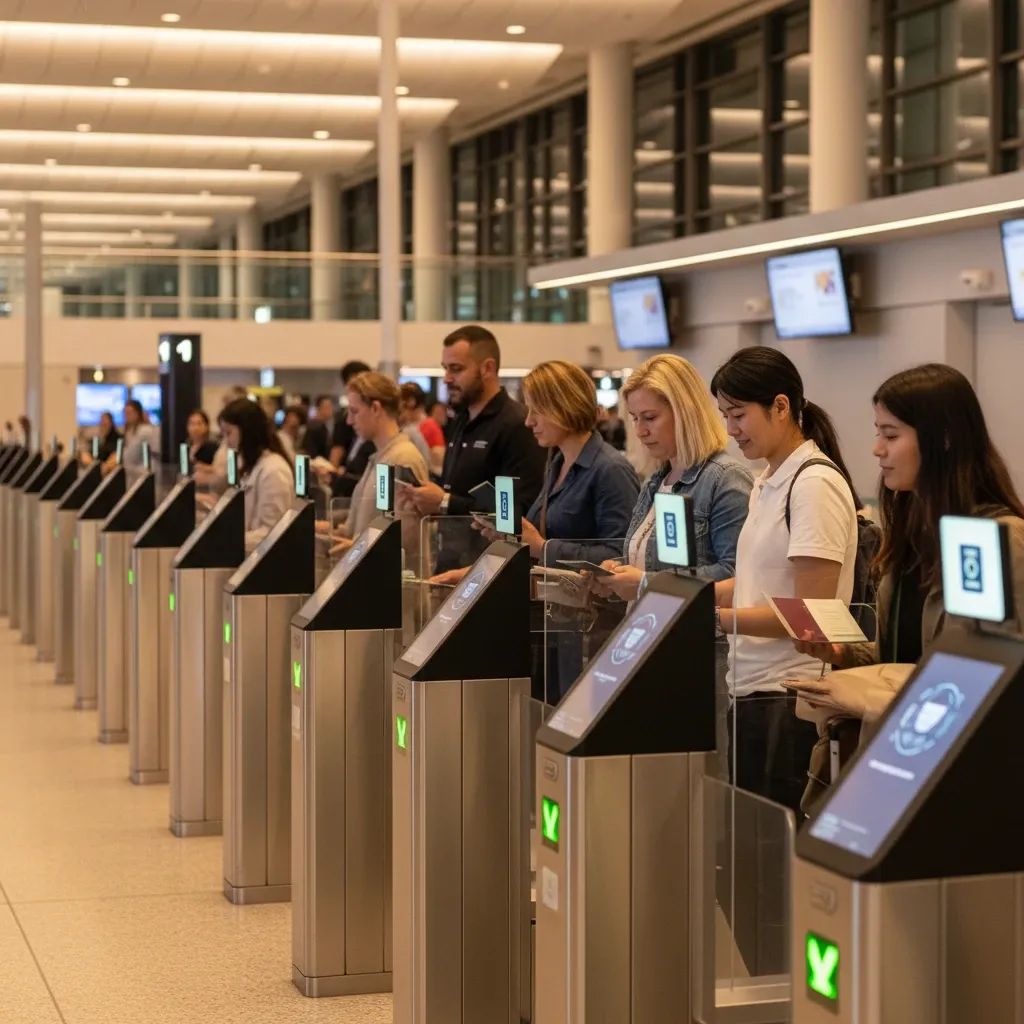
Phuket International Airport begins rolling out self-service immigration technology on June 13, replacing decades of manual passport processing with automated gates that will reshape how 12 million annual travelers clear departure checkpoints. For eligible passengers, the shift promises to substantially reduce typical 15–30 minute queues, a practical benefit that matters most during Songkran, Chinese New Year, and European summer peaks when the departure hall becomes gridlocked.
Why This Matters
• Departure queues reduced for eligible travelers: Electronic passport holders who meet height and passport requirements can process exits more efficiently instead of waiting 30+ minutes during holidays.
• Return trips stay unchanged until mid-July: The immigration arrival halls remain manually processed, creating a one-directional speed advantage that leaves incoming passengers facing traditional lines.
• Specific exclusions apply: Pregnant travelers, children under 120cm tall, and anyone needing a physical stamp must use staffed counters.
How the Gates Work and What to Expect
The Automated Border Channel (ABC) system landing at Phuket International Airport operates like automated baggage drops at most international airports—no agents, no queuing, just you and biometric technology. Passengers insert their electronic passport into a scanner, look at a camera for facial verification, and walk through. The system is designed to support smoother processing compared to 15–30 minutes at a staffed counter during busy periods.
Thailand's Immigration Bureau confirmed the June 13 launch targets departures only. Inbound ABC gates remain under construction until at least July 9. This staggered rollout reflects infrastructure priorities—the airport prioritized the bottleneck direction first. Outbound passengers number approximately 6 million annually through Phuket, while arrivals add another 6 million. The departure gates alone will ease the most visible congestion: families and tour groups queuing from 5 a.m. onward during high season.
Installation began April 22, with Phuket Airport Immigration completing hardware setup by late May. Construction crews have simultaneously cordoned off portions of the arrival immigration hall, running cabling, mounting facial recognition readers, and integrating database systems. Airport officials apologize for temporary congestion in the arrivals area and request patience while work proceeds. No firm opening date for inbound ABC gates exists, but the construction completion date of July 9 suggests a mid-to-late July launch if delays don't occur—a timeline consistent with typical infrastructure project schedules.
Eligibility Checklist: Who Can Use the Gates
Think of ABC access as a multi-step filter. Not everyone qualifies, and missing even one criterion means manual-lane diversion.
Passport and document requirements:
• Electronic passport (e-Passport) only. Older machine-readable passports with traditional paper pages will not scan. If your passport predates 2015 or lacks a biometric chip symbol on the cover, you cannot use ABC.
• At least 180 days validity remaining. Airlines already enforce this for most destinations, but the ABC scanner will reject anything tighter. Check expiration immediately before departure; if your passport expires within six months, renew now or expect manual processing.
• No protective coverings. Leather sleeves, plastic wraps, branded holders, or branded travel jackets confuse the optical reader. The scanner reads the biometric chip directly; barriers block the signal. Carry your passport loose or in a transparent pouch.
Physical criteria:
• Minimum 120 centimeters tall. Children under roughly age 7 cannot use the gates. Parents will need to split—adults and older children through ABC, younger kids with an accompanying adult through manual counters.
• Carry-on luggage under 120 centimeters height. This includes extended roller-bag handles. Oversized suitcases trigger rejection and reroute passengers back to staffed lines.
Pre-entry steps:
• Remove face masks, eyeglasses, and hats before entering the booth. Facial recognition software matches your live image against your passport photograph. Sunglasses, medical masks, and wide-brimmed hats obscure facial features and cause rejection.
• Only one passport on the reader. Mobile phones, boarding passes, hotel keycards, or other items resting on top of the document confuse the scanner.
Explicit exclusions:
• Pregnant passengers cannot use ABC gates and must proceed to staffed counters. Airport officials have not disclosed the rationale publicly, though the restriction applies regardless of visible pregnancy status.
• Travelers requiring physical passport stamps must use manual lanes. ABC transactions are digital only—no ink marks the document. This matters for visa-extension applications, which often demand visible evidence of exit stamps for administrative records.
Regional Context: How Thailand Compares
Singapore has pioneered advanced automated immigration systems in recent years. Singapore's Immigration & Checkpoints Authority reports significant adoption and efficiency improvements at Changi Airport, where foreign visitors can flow through automated lanes using facial and biometric verification. Regional reports indicate substantial reductions in average clearance times compared to traditional manual processing.
Malaysia expanded its autogate network in recent years, with Kuala Lumpur International Airport introducing hybrid systems that integrate digital boarding codes and cross-reference flight manifests. According to published reports, Malaysia's automated gate deployments have resulted in meaningful reductions in immigration wait times across the airport.
Thailand's rollout appears measured by design. The ABC system uses facial recognition and e-passport biometric chips—a straightforward approach aligned with established automated border control standards. Don Mueang International Airport launched similar ABC installations in early 2026, with full 24-hour operations beginning March 5, 2026. Suvarnabhumi Airport and regional airports like Chiang Mai International have not yet announced ABC installations, meaning Thai automation remains concentrated at Don Mueang and now Phuket. Expansion timelines remain undisclosed.
Who Benefits Most and How
Business travelers making weekly hops between Phuket, Singapore, and Bangkok will experience tangible gains from streamlined departure processing. For expats and consulting professionals based in Phuket or neighboring Phang Nga Province, the efficiency improvements compound across dozens of annual trips.
Families face workflow considerations. Parents with children under 120cm must arrange post-immigration meetup points. Adults proceed through ABC while younger children queue manually with one guardian. Tour operators and hotel concierges already advise guests to organize family groups, identify who qualifies for ABC, and plan accordingly. Some families may choose to stick together in manual lanes rather than splitting.
Long-term residents and annual visa runners benefit from smoother departure processing. Retirees on yearly elite visas or expats renewing non-immigrant certificates will experience improved exit efficiency. However, those arriving through Phuket must still use traditional immigration until the arrival gates launch, creating asymmetric advantage: exits accelerate while entries remain unchanged.
Pregnant travelers face inconvenience due to explicit exclusion from ABC gates, which means directing to staffed counters during peak periods.
Operational Continuity and Timeline Risks
No change to flight schedules has been announced. Thai Airways, Bangkok Airways, Air Asia, and international carriers continue normal operations. However, airport recommendation protocols remain: arrive three hours early for international departures during high season, two hours during shoulder periods. The ABC gates will improve processing efficiency, but the recommendation buffer ensures margin for irregular procedures (document issues, security screening, gate delays).
Construction continues in the arrival hall until July 9. Phuket Airport Immigration has apologized for partial closures and temporary congestion. Passengers should anticipate minor delays in the arrivals immigration area and allow extra time. Once inbound ABC gates launch—likely mid-to-late July if the construction schedule holds—the full loop (departure + arrival) will be automated, aligning Phuket with regional standards and potentially improving the total airport experience for eligible travelers.
Monitor official announcements from the Tourism Authority of Thailand and Phuket International Airport starting late June for inbound gate availability.
Practical Preparation Now
Check your e-passport today. Verify expiration—if it expires within the next six months, renew now. Invest in a transparent document sleeve or carry your passport loose; bulky leather covers guarantee manual-lane assignment.
If you need an exit stamp for immigration paperwork, visa extensions, or personal travel records, inform an immigration officer before attempting ABC entry. Once the gate closes, the transaction is digital, and no physical stamp appears. Similarly, if your passport shows visible wear (torn pages, water damage, or worn chip contacts), manually verify it will scan before queuing for ABC; damaged passports frequently trigger rejection.
Pregnant travelers should go directly to staffed counters to avoid being turned away mid-line. Parents with young children should identify which family members qualify, plan the post-immigration reunification point, and communicate the plan beforehand. On arrival back to Phuket (before mid-July), expect traditional queues and allow extra time; the return journey won't accelerate until the inbound ABC gates launch.
What Comes Next
The June 13 launch marks Thailand's entry into regional automated border control. Thailand's ABC approach focuses on e-passport scanning and facial matching—a practical system that will ease visible airport congestion. However, full parity with leading regional systems—universal accessibility and deployment across all major airports—remains in development.
For now, eligible Phuket travelers will experience improved departure processing. For everyone else, the departure experience improves. Returns remain traditional. Over time, as inbound gates launch and additional airports adopt ABC, the cumulative efficiency gains for frequent travelers will be substantial.


