
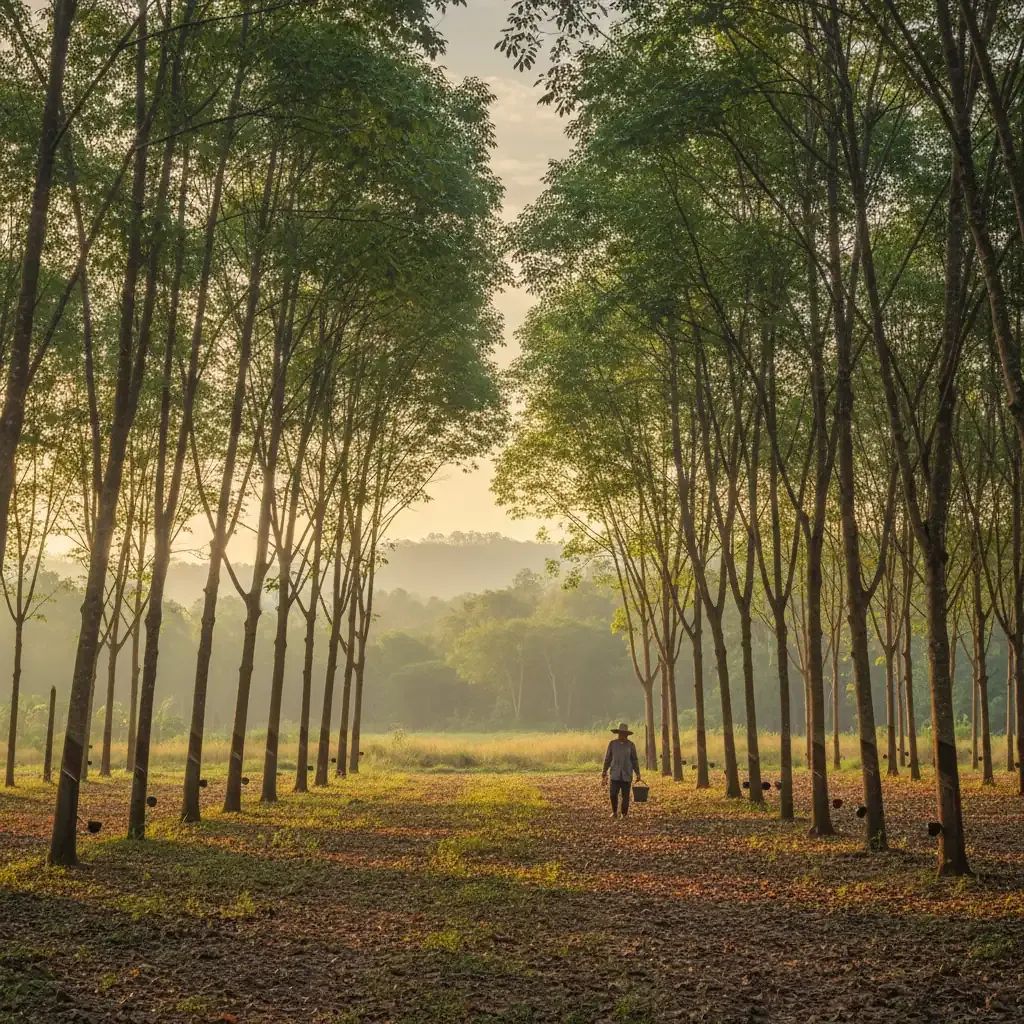
The Democrat Party has pledged to push natural-rubber prices above 80 ฿/kg, a move that could reshape household income across Southern Thailand’s farm belt.
Why This Matters
• Extra cash for smallholders – A jump from today’s 57 ฿ to 80 ฿ adds roughly 6,000–7,000 ฿ a month for a 10-rai plantation.
• Ripple effect on exports – Rubber still brings in US$5 B a year; higher prices alter Thailand’s price leadership in Asia.
• Budget question mark – Income-support schemes may require tens of billions of baht if the market fails to catch up naturally.
• Election litmus test – Competing parties will now face pressure to outline their own price guarantees.
How the 80-baht Promise Would Work
Democrat leader Abhisit Vejjajiva toured Nakhon Si Thammarat at the weekend, telling growers the party would revive a version of its income-insurance programme first used in 2011. Under the sketch shared on the campaign truck:
The state sets a reference price each month.
If the market closes below 80 ฿, the difference flows straight to farmers’ e-wallets.
To avoid accusations of subsidies, the party says it will expand domestic rubber use—road resurfacing, latex pipes, even military tyres—to soak up surplus.
The idea comes with a sweetener: a provincial lottery priced at 50 ฿ a ticket, of which 40 ฿ would be diverted into individual savings accounts. Party strategists argue this will recycle local spending back to growers.
Reality Check: Can the Market Support 80 ฿?
Today’s benchmark at Hat Yai averages 57–58 ฿. Analysts at the Thailand Development Research Institute (TDRI) say global fundamentals are improving—ANRPC projects a 700,000-tonne supply gap next year—but their base-case figure for 2026 is only 65 ฿.
Reaching 80 ฿, they warn, will require either:
• A sustained China–India demand boom, or
• A costly top-up from the Thai treasury.
Meanwhile, the Ministry of Agriculture is floating its own target of 100 ฿ by tightening imports and fast-tracking the “tree-title deed” programme that turns rubber stands into bankable collateral.
Voices from Rubber Country
Growers in Thung Song, Trang and Phatthalung told this reporter they view any figure below 80 ฿ as “survival level”. Their short list of demands:
• Ban cut-price latex imports from neighbouring countries.
• Accelerate payouts under the 16,000 ฿-per-rai replanting grant.
• Mandate that every kilometre of new highway use a rubber-modified asphalt mix.
Local cooperatives add that a clear grading standard—last updated in 2013—must be issued every four years to prevent price disputes at the buying stations.
What This Means for Residents
For rubber households:
• Debt servicing – At 80 ฿, most families can cover loan instalments without relying on micro-finance sharks.
• Consumer spending – Retailers in provincial towns historically see a 10–15 % sales bump when rubber spikes.
• Migration patterns – Fewer breadwinners leave for Bangkok factory jobs, easing pressure on urban infrastructure.
For urban Thais:
• Higher public-works costs if government absorbs the commodity premium.
• Possible uptick in inflation for rubber-based goods—gloves, tyres, mattress foam—unless manufacturers hedge.
The Broader Political Stakes
The Democrat vow forces rivals to clarify how they will:
• Fund the next phase of income insurance without breaching the 70 % public-debt ceiling.
• Encourage downstream investment so Thailand ships tyres, not just raw sheets.
• Address the looming EU anti-deforestation rules, which could curtail exports unless plantations earn sustainable certificates.
Strategists in Bangkok expect rubber to dominate the final campaign stretch far more than headline-grabbing megaprojects. “Voters can’t eat high-speed trains,” quipped one veteran pollster. The race is now about a single number—and whether any government can keep that 80-baht promise once the ballots are counted.


