
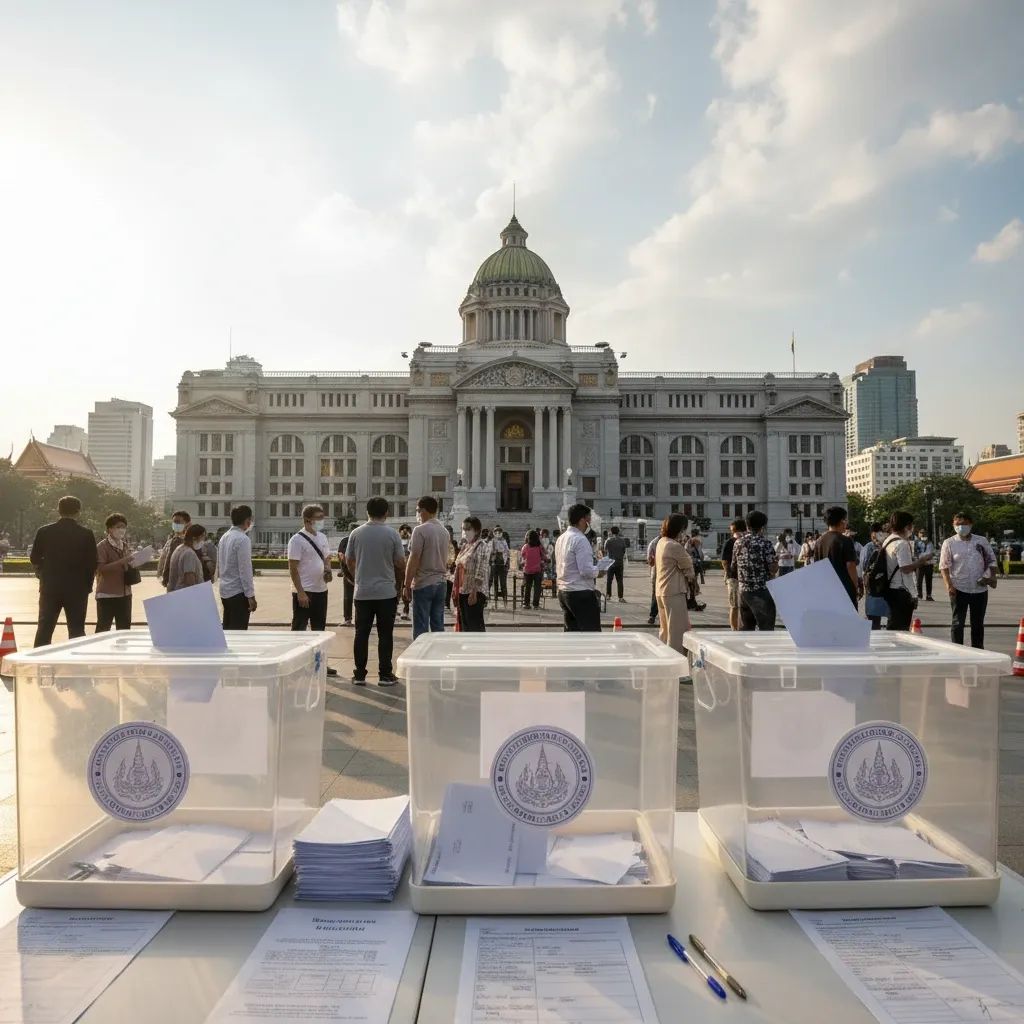
Two competing constitutional frameworks are now moving through Thailand's parliament, each backed by major coalition partners and each representing different visions of how the country should reshape its political system. This collision will test whether Thailand can finally break free from its three-decade cycle of constitutional rewrites, or whether procedural obstacles and entrenched power brokers will strangle reform once again.
Why This Matters
• The public has already spoken: In February 2026, Thai voters endorsed drafting a fresh constitution with strong democratic support—the most decisive mandate for reform in years.
• Two different designs: The Bhumjaithai Party favors a smaller, legislature-controlled assembly, while Pheu Thai is pushing for larger public participation—a philosophical clash about who gets to shape Thailand's rules.
• Timeline extends into 2027: Even if parliament agrees, three consecutive referendums are constitutionally required, meaning ordinary Thais will live with political uncertainty for at least 18 months longer.
The Bhumjaithai Approach
Prime Minister Anutin Charnvirakul's Bhumjaithai Party has filed its charter amendment proposal, signaling the coalition's intent to set the terms of debate early. The Bhumjaithai framework proposes a smaller Constitution Drafting Assembly composed primarily of provincial delegates and specialists selected by parliament. This approach avoids direct public participation, adhering to a Constitutional Court ruling that warned against allowing voters to directly elect assembly members.
The bill includes a proposal to lower the Senate approval threshold for amendments. The Senate—appointed rather than elected—has repeatedly blocked reform efforts. Softening its veto requirement acknowledges that entrenched elites currently hold outsized blocking power.
Like all serious reform proposals, the Bhumjaithai draft explicitly protects the monarchy and foundational principles from amendment.
Pheu Thai's Working Bill
Pheu Thai's working panel is developing a rival proposal that would establish a significantly larger assembly with greater public participation. Voters would be involved in a nomination phase, with parliament then selecting assembly members from that pool. Additional seats would come from nominees supplied by academic institutions, civil society organizations, and professional associations.
Deputy party leader Chousak Sirinil indicated the bill would be presented to Pheu Thai lawmakers for formal submission. Pheu Thai's strategy focuses on using procedural pathways to enable a wholesale charter replacement while including safeguards for judicial independence and the monarchy.
The Senate Remains the Central Obstacle
Both proposals face an identical hurdle: the Thailand Senate. This 250-member chamber is appointed, not elected, and historically dominated by military-affiliated conservatives who benefit from the current constitutional order. The Senate has single-handedly derailed reform before, in 2023 preventing the Move Forward Party from forming a government.
Current rules require at least one-third of Senate votes to approve any amendment. Both the Bhumjaithai proposal to lower this threshold and Pheu Thai's framework must overcome this barrier. Whether the Senate will cooperate or obstruct remains unclear.
Why History Warns Against Quick Progress
Thailand's constitutional record offers little comfort to reformers. Since 1932, the kingdom has adopted numerous charters. Only one emerges as genuinely celebrated: the 1997 "People's Constitution," born from democratic pressure and the Asian Financial Crisis. That charter introduced meaningful democratic features, reformed electoral systems, and expanded civil liberties protections.
Yet even the 1997 charter eventually became entangled in Thailand's political dysfunction. Courts expanded their powers in ways that blocked reform.
Between 2020 and 2022, reformers filed 26 separate amendments or charter proposals. Only one passed: a narrow electoral adjustment in 2021 that aligned with the ruling coalition's interests.
Multiple Referendums Mean Years of Uncertainty
The Constitutional Court has ruled that three separate public referendums are required for a complete constitutional overhaul: one before drafting begins (already held in February), one after the draft is finished, and a third if the Senate rejects the result.
This requirement stretches the timeline well into 2027 or beyond. Ordinary Thais accustomed to political volatility face prolonged uncertainty. For residents—both Thai citizens and foreign nationals—this extended timeline creates practical challenges:
• Business planning: Companies cannot commit to long-term investments when constitutional bedrock remains in flux. Startups delay expansion. Foreign investors postpone commitments.
• Property and visa decisions: Foreigners considering property purchases or long-term residency face uncertainty about future regulations. Visa policies tied to economic conditions remain unpredictable.
• Employment and labor protections: Salaried workers and independent professionals cannot plan major financial decisions when labor regulations remain subject to constitutional revision.
• Policy consistency: Tax rules, business registration procedures, and regulatory frameworks could shift significantly depending on the new constitution's structure, making long-term planning difficult for small business owners and professionals.
How the Current System Constrains Governance
The 2017 Constitution, drafted by military junta authorities, was engineered to weaken elected government. It empowered the judiciary to nullify policy decisions. It gave the Senate blocking power over legislation and appointments. It subordinated parliament to watchdog bodies designed to supervise rather than serve.
Across the past years, this architecture has prevented administrations from pursuing coherent policy. The government cannot commit to infrastructure investment because courts might reverse it. Land reform remains frozen because the Senate impedes legislation. Residents experience policy whipsaw as courts reinterpret authority.
A new constitution could restore government capacity for sustained action. Adjusted amendment processes could allow elected officials to adapt rules without perpetual deadlock. Residents would benefit from more predictable governance and clearer long-term policy frameworks for business, investment, and employment.
The Immediate Path Forward
Both bills will enter formal parliamentary procedures in the coming weeks. Committees will examine them. Floor votes will test party discipline. Senate consultations will probe whether the appointed chamber will cooperate or obstruct.
If either bill passes parliament and Senate approval looks feasible, formal review processes will proceed. Assuming voters again endorse a new charter (plausible given February's result), the chosen assembly would convene and draft for several months. Additional referendums would follow, then Senate consideration.
For Thais and residents in Thailand watching this unfold, the practical lesson is clear: procedural momentum does not equal constitutional reform. Even if a bill clears parliament, the timeline stretches years forward. Political instability will not disappear merely because a drafting process begins. Economic uncertainty will persist.
Yet the fact that two major parties are simultaneously advancing competing reform blueprints, backed by decisive voter support, suggests that defending the current system has become politically difficult. The status quo is under pressure. Whether that pressure yields meaningful reform or another stalled process depends on whether coalition partners can overcome their differences, bypass Senate obstruction, and actually complete a draft before the next political interruption.


