
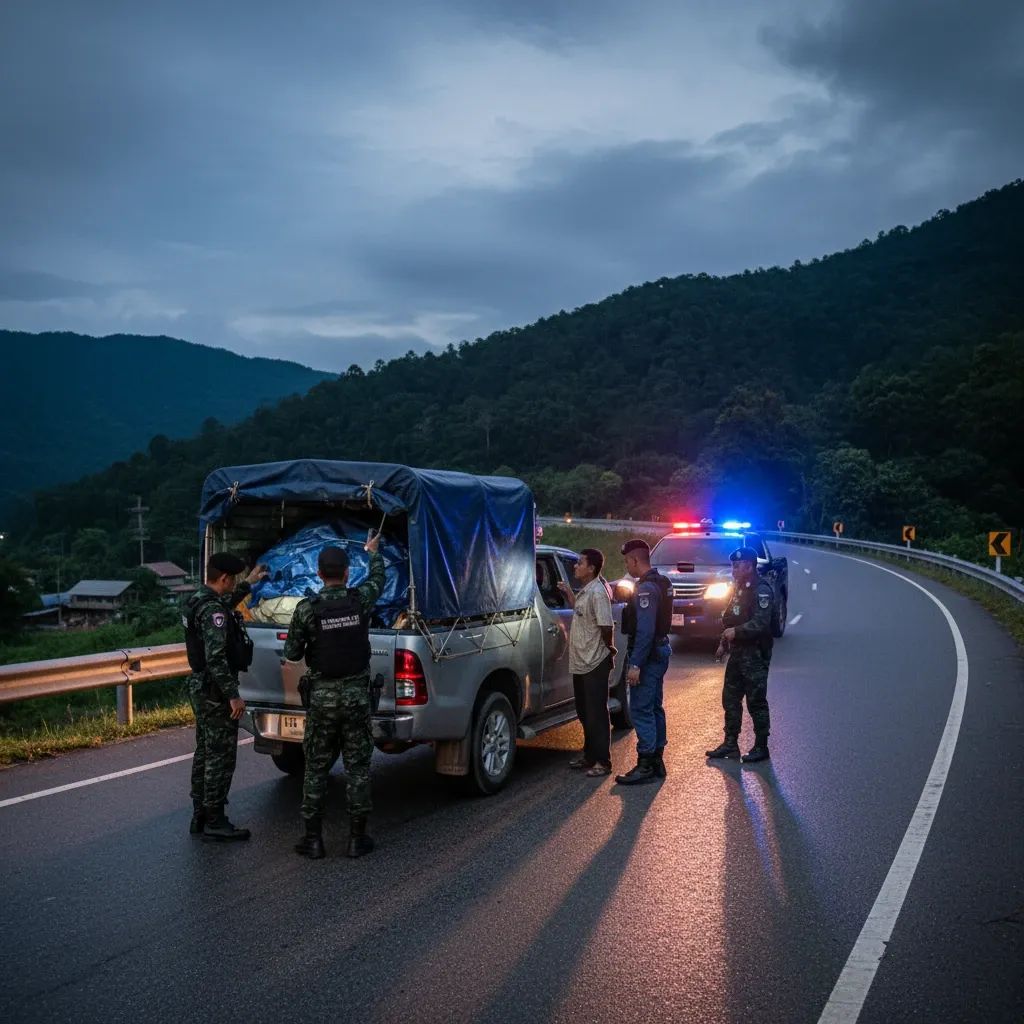
Residents across Chiang Rai should expect increased checkpoints and ID checks through September 30 as Thailand's Interior Ministry executes an intensive 90-day drug enforcement operation targeting the province's role as a Golden Triangle transit corridor. The nationwide campaign runs from July 1 through September 30, 2026, with Chiang Rai emerging as the focal point due to its border location and recent record seizures.
Why This Matters:
• Enforcement surge in Chiang Rai's 18 districts includes border "seals" and interior area sweeps
• Mandatory treatment centers opening in every district to process voluntary rehabilitation
• Prior seizures in the region include 529 kg of ketamine (May 2025) and 4.3 million meth pills (April 2026)
• Assets worth over 16M baht frozen in a recent bust that implicated a police lieutenant colonel
Border Province Under Pressure
Chiang Rai Governor Choocheep Pongchai, serving as director of the provincial anti-drug command center, activated the operation on July 6 in front of the provincial hall. Military units, Thailand Royal Police contingents, administrative officials, and security agencies mobilized in a public show of force signaling that authorities plan aggressive enforcement across the province.
The province sits at the nexus of Southeast Asia's most prolific drug production zone. Between October 2025 and May 2026, national operations dismantled 16,419 trafficking networks and arrested 203,637 suspects, a 20% year-over-year increase. Authorities seized 997 million methamphetamine pills (up 33 million) and 39.4 tonnes of crystal meth (up 3.8 tonnes), alongside substantial quantities of ecstasy and ketamine. Frozen or confiscated assets reached 7.68 billion baht nationwide.
Three-Pillar Strategy
The Thailand Ministry of Interior's operational framework mandates three simultaneous tracks, which Chiang Rai authorities are applying with particular intensity:
Prevention: Schools, workplaces, and villages are being designated drug-free zones, supported by the Queen Mother Fund mechanism and community-based monitoring. The aim is to create social immunity before substances reach end users.
Suppression: Every district now fields a dedicated anti-drug task force. Checkpoints seal border crossings while "Re X-ray" sweeps target internal distribution networks. The strategy mirrors nationwide efforts but receives additional resources in Chiang Rai due to cross-border trafficking vulnerabilities.
Rehabilitation: A district-level treatment camp network is being established under the "One District, One Treatment Center" policy. The approach emphasizes voluntary entry, distinguishing it from past enforcement waves that drew human rights criticism.
Recent Busts Signal Entrenched Networks
Chiang Rai operations have already yielded high-profile results. In late June, a coordinated sweep across Chiang Rai and Loei provinces led to the arrest of a police lieutenant colonel and nine associates, triggering asset freezes exceeding 16 million baht. That investigation began 14 months earlier with the May 2025 ketamine seizure totaling 529 kg, suggesting investigators are targeting supply chains rather than street-level dealers.
An April car chase in Mae Fah Luang district produced 4.3 million methamphetamine pills, one of the largest single hauls in the province this year. The volume underscores the industrial scale of smuggling operations, which often use remote mountain roads and riverine routes to bypass official crossings.
Echoes of 2003, With Key Differences
The 90-day campaign invites comparisons to Thailand's controversial 2003 "War on Drugs," which resulted in thousands of extrajudicial killings and widespread rights abuses. A 2007 investigation determined that more than half of those killed had no connection to narcotics. The 2003 campaign prioritized elimination over due process, and lacked systematic rehabilitation infrastructure.
By contrast, the 2026 operation explicitly incorporates public health frameworks. The National Drug Strategy (2023–2027) embeds harm reduction principles, and the Interior Ministry's guidelines require voluntary treatment enrollment rather than forced detention. That said, enforcement language remains aggressive: Prime Minister-endorsed rhetoric describes the effort as "uncompromising war on drugs," and provincial authorities have used terms like "annihilate" in public statements.
International Cooperation Intensifies
Thailand's Office of the Narcotics Control Board is coordinating parallel enforcement efforts with Vietnam, China, Laos, and Myanmar from June through September 2026. In a separate June operation, Thailand and South Korea jointly dismantled a major production network, signaling that synthetic drug manufacturing has become a transnational target requiring multilateral intelligence sharing.
The timing is strategic: summer months historically see increased trafficking as Mekong River water levels rise, easing transport. The Thai-Lao and Thai-Myanmar borders remain porous despite fortified checkpoints, and traffickers adapt routes faster than authorities can map them.
What This Means for Residents
For expats and long-term residents in Chiang Rai, the operation translates to visible security changes:
• Increased checkpoints along major highways (Routes 1, 1020, 1089) will slow travel. Expect ID checks and vehicle searches, particularly for trucks and vans. Travelers should carry passport or Thai ID at all times and allow extra travel time, particularly during evening hours when authorities may conduct vehicle searches.
• Nighttime curfews or patrols may appear in rural districts near the Myanmar and Lao borders.
• Workplace inspections could target businesses in hospitality and entertainment sectors, where authorities suspect distribution networks operate.
• School-based screening programs will expand, potentially affecting families with school-age children as part of prevention efforts.
The operation runs through September 30, with formal results unlikely until October. However, the Interior Ministry has set implicit quotas: provincial commands face pressure to match or exceed the national 20% arrest increase, creating incentives for aggressive enforcement.
Cannabis Complications
While the operation focuses on methamphetamine, heroin, and ketamine, Thailand's shifting cannabis regulations add complexity. In February 2022, the Ministry of Public Health removed cannabis flowers from the Category 5 narcotics list, effectively decriminalizing the plant. But in June 2025, new rules reclassified cannabis flowers as controlled herbs, restricting use to licensed medical and research purposes.
Enforcement guidelines for the 90-day operation do not explicitly address cannabis, but provincial officials confirmed that unlicensed sale or possession falls under suppression mandates. Residents with cannabis should verify their activity is licensed under current regulations before September 30, as enforcement may not distinguish between medical and recreational use during checkpoint inspections.
Measuring Success
The Thailand Interior Ministry will evaluate the campaign based on:
• Network dismantlement counts (targeting organized syndicates, not individual users)
• Seizure volumes (weight and street value of confiscated drugs)
• Asset forfeitures (to disrupt financial incentives)
• Treatment enrollment (voluntary entry into district-level programs)
Provincial authorities in Chiang Rai have not published interim benchmarks, but past operations suggest that success is often measured by arrest numbers rather than long-term recidivism rates or supply reduction. Critics note that enforcement surges temporarily disrupt distribution but rarely address demand drivers or production capacity in neighboring countries.
Ongoing Challenges
Despite decades of anti-drug campaigns, Thailand remains a primary transit and consumption market. The Golden Triangle—spanning Myanmar, Laos, and Thailand—continues to produce industrial quantities of synthetic drugs, often in areas beyond effective government control. Trafficking methods have evolved to include online marketplaces, encrypted communication, and drone deliveries, complicating interdiction efforts.
Methamphetamine pills remain ubiquitous due to low prices (often under 100 baht per pill in border areas) and high accessibility among younger users. The Thailand Narcotics Control Board reports that the average age of first-time users has dropped, with teenagers now representing a significant proportion of treatment admissions.
The 90-day operation represents an intensified version of ongoing enforcement rather than a paradigm shift. Whether it achieves lasting impact will depend on factors largely outside Chiang Rai's control: production capacity in Myanmar's Shan State, cooperation from Laotian border authorities, and domestic demand reduction through economic opportunity and education.
What's Next
The operation continues through September 30. Residents can expect weekly updates from provincial authorities, with final results likely published in October. Those seeking drug treatment can contact district-level centers opening under the "One District, One Treatment Center" policy. For now, residents should prepare for routine security checks and allow extra time for travel through September.


