
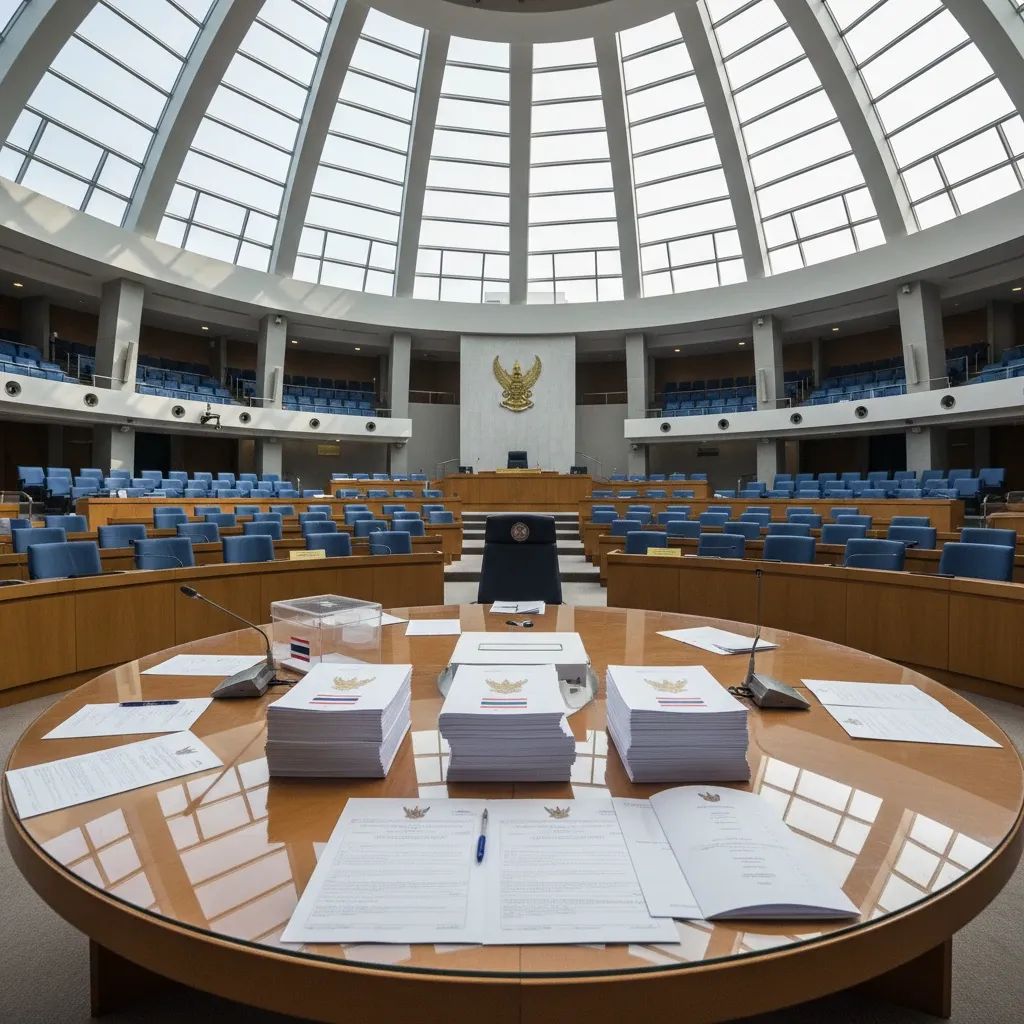
Thai voters handed the People's Party a symbolic win on February 8, approving a referendum to rewrite the country's military-era constitution, but the election results that same day installed a conservative coalition with the legislative muscle to slow or reshape the reform agenda. The outcome sets up a prolonged political standoff between a public mandate for change and entrenched institutional power.
Why This Matters
• 60% of voters endorsed drafting a new constitution, but the Bhumjaithai Party won the most parliamentary seats, giving conservatives control over implementation.
• The Constitutional Court requires three separate referendums for a full overhaul, meaning this process will stretch into 2028 or beyond.
• The appointed Senate and Constitutional Court retain veto power over the drafting framework, creating multiple choke points for obstructing reform.
A Split Decision at the Ballot Box
The dual vote produced a contradictory picture. Nearly 21.6 million Thais voted "yes" to begin replacing the 2017 Constitution, a charter drafted after a military coup and widely criticized for undermining elected government in favor of unelected bodies. Turnout for the referendum reached 69%, signaling strong engagement on the issue.
Yet the same voters delivered 193 House seats to Bhumjaithai, the incumbent Prime Minister Anutin Charnvirakul's party, which campaigned on stability and incremental adjustment rather than wholesale constitutional surgery. The People's Party, which framed the referendum as its core mission, finished second with 118 seats despite capturing 30.63% of party-list votes—the highest share nationally. Pheu Thai, the traditional populist powerhouse, recorded its worst-ever result with just 74 seats.
The divergence reveals a public appetite for constitutional reform without necessarily endorsing the parties most identified with it. For residents and investors watching Thailand's political trajectory, this creates uncertainty: the mandate for change is clear, but the roadmap will be written by a party that openly prefers caution.
The Long Road Ahead
Thailand's Constitutional Court ruled in 2025 that any complete rewrite must pass through three referendums. The February vote was merely the first, asking whether the public supports the idea of a new charter. The second referendum will approve the drafting process itself—who writes it, what sections are open for revision, and what red lines are protected. A third vote will ratify the final text.
Legal experts and political analysts estimate the entire cycle will consume at least two years, likely extending well into 2028. For residents planning their lives in Thailand, here's what to expect: active political negotiation through 2026-2027, with the second referendum likely in late 2027 or early 2028, and a potential new constitution not taking effect before 2028-2029. That timeline assumes smooth coordination between parliament, the drafting body, and the courts—an optimistic scenario given Thailand's fractious political history and the institutional resistance already signaled by conservative forces.
Between now and the second referendum, the National Assembly must agree on a framework. This is where Bhumjaithai's parliamentary dominance becomes decisive. The party has publicly insisted that Chapters 1 and 2 of the constitution—those addressing the monarchy—remain untouchable. While most major parties agree on this, disagreements over the structure of the Senate, the powers of independent bodies, and the balance between elected and appointed authority are far from resolved.
Institutional Gatekeepers
The 2017 Constitution embedded unelected power at multiple levels. The Senate, whose 200 members are chosen through an opaque selection process with minimal public input, holds sweeping authority: appointing judges to the Constitutional Court, staffing independent commissions, and blocking legislation. These bodies have historically acted as counterweights to elected governments, particularly those aligned with populist or progressive movements.
The People's Party argues this structure is the coup's lasting legacy, designed to prevent any single party from wielding the kind of power that Pheu Thai once held. Their reform agenda calls for dismantling the appointed Senate and returning sovereignty to elected representatives. But with Bhumjaithai and its coalition partners controlling the House, and the Senate intact, the reformists lack the votes to force radical change.
The Constitutional Court itself has a track record of intervening in amendment processes. Past attempts to rewrite charters have been stalled, diluted, or blocked outright by judicial rulings. The court's 2025 decision requiring three referendums was widely interpreted as a procedural barrier, not a neutral safeguard—extending the timeline and multiplying opportunities for obstruction.
What This Means for Residents
For expats, business owners, and anyone with long-term stakes in Thailand, constitutional reform is not abstract political theater. The 2017 charter has contributed to policy instability that has directly affected your daily life in concrete ways:
Visa and Immigration Policy: During previous political transitions, visa regulations have shifted unexpectedly. For example, education visa and retirement visa processing times ballooned during past constitutional crises, and investment visa categories have been suspended without warning. Constitutional instability typically triggers temporary freezes on non-essential administrative processes.
Business Environment: Small business owners and entrepreneurs have faced sudden licensing delays, bank account restrictions, and regulatory reinterpretations during political upheaval. Property developers have experienced project suspensions and title verification delays. The next 24 to 36 months of active negotiation may create similar disruptions, particularly in sectors like tourism, hospitality, and real estate development.
Financial Markets and Currency: The Thai baht typically weakens during periods of constitutional uncertainty. Remote workers earning in baht and retirees living on baht-denominated income face increased vulnerability to currency volatility around key parliamentary votes and the second referendum in late 2027 or early 2028.
A new constitution could stabilize governance by clarifying lines of authority and reducing the Senate's veto power—potentially improving long-term predictability for residents. Conversely, if conservatives successfully limit reform, expect continued policy turbulence similar to what has characterized the post-2017 period.
The Conservative Counterweight
While the People's Party claims the referendum as its victory, the election results tell a more nuanced story. Bhumjaithai performed far better than polls predicted, sweeping 170 constituency seats and consolidating support in rural provinces and among older voters. The party's coalition includes the Democrat Party and smaller conservative factions, collectively skeptical of rapid constitutional change.
The United Thai Nation Party, linked to former military junta leader Prayut Chan-o-cha, lost significant ground but retains influence within the Senate and military-aligned institutions. These ultra-conservative factions view the reform push as a threat to monarchy provisions and the political order established after the 2014 coup.
Pheu Thai's collapse complicates the picture. Once the dominant force in Thai electoral politics, the party's 74-seat result signals a fracturing of the populist coalition. Some analysts attribute the decline to voter fatigue with dynasty politics and the party's perceived accommodation with establishment forces. The People's Party absorbed much of Pheu Thai's youth support, but it remains unclear whether they can build the broad coalition needed to overcome conservative institutional power.
The Public's Patience
Thailand has rewritten its constitution 20 times since 1932, often following military coups. The 2017 charter was the latest in a series designed to limit elected governments and empower unelected elites. Youth-led protest movements in 2020 and 2021 demanded reform, framing the constitution as an obstacle to democracy and accountability.
The 60% "yes" vote reflects that sentiment, particularly among younger voters and urban constituencies. But the geographic split is stark: Bangkok and university towns overwhelmingly supported the referendum, while rural provinces in the northeast and south delivered strong majorities to Bhumjaithai.
This divide will shape the drafting process. If conservative parties successfully narrow the scope of reform—preserving Senate powers, protecting judicial independence for the Constitutional Court, and limiting changes to electoral rules—the final product may disappoint the reformist base. That could fuel a new cycle of protests or deepen public cynicism about the political system's capacity for self-correction.
Conversely, if the People's Party and its allies manage to extract meaningful concessions, such as a fully elected Senate or stricter limits on judicial intervention, it could energize progressive voters and shift Thailand's political center of gravity.
The Next 12-24 Months
Parliament will spend 2026 and into 2027 negotiating the drafting framework, a process that will test Prime Minister Anutin's coalition management skills. He must balance Bhumjaithai's conservative base, which expects restraint, with the People's Party's insistence on substantive reform. The appointed Senate will weigh in, likely proposing procedural restrictions that protect its own authority.
The second referendum, expected in late 2027 or early 2028, will ask voters to approve the drafting process and key parameters. If conservatives successfully dilute the framework, reformists may campaign for a "no" vote, resetting the process. If the framework is acceptable, the drafting body—likely a mix of elected representatives, appointed experts, and civil society members—will begin work.
The Constitutional Court remains the wildcard. Any dispute over the framework, the drafting body's composition, or the final text could trigger a judicial review, adding months or years to the timeline.
For Thailand's residents, the immediate takeaway is patient planning. The mandate for change is real, but the institutions designed to resist it remain powerful. Expats should expect continued policy uncertainty through 2028 and prepare contingency plans for potential visa delays, business licensing changes, and banking regulations adjustments. The next chapter will be written in committee rooms and courtrooms, not on the streets—unless the public decides otherwise.


