
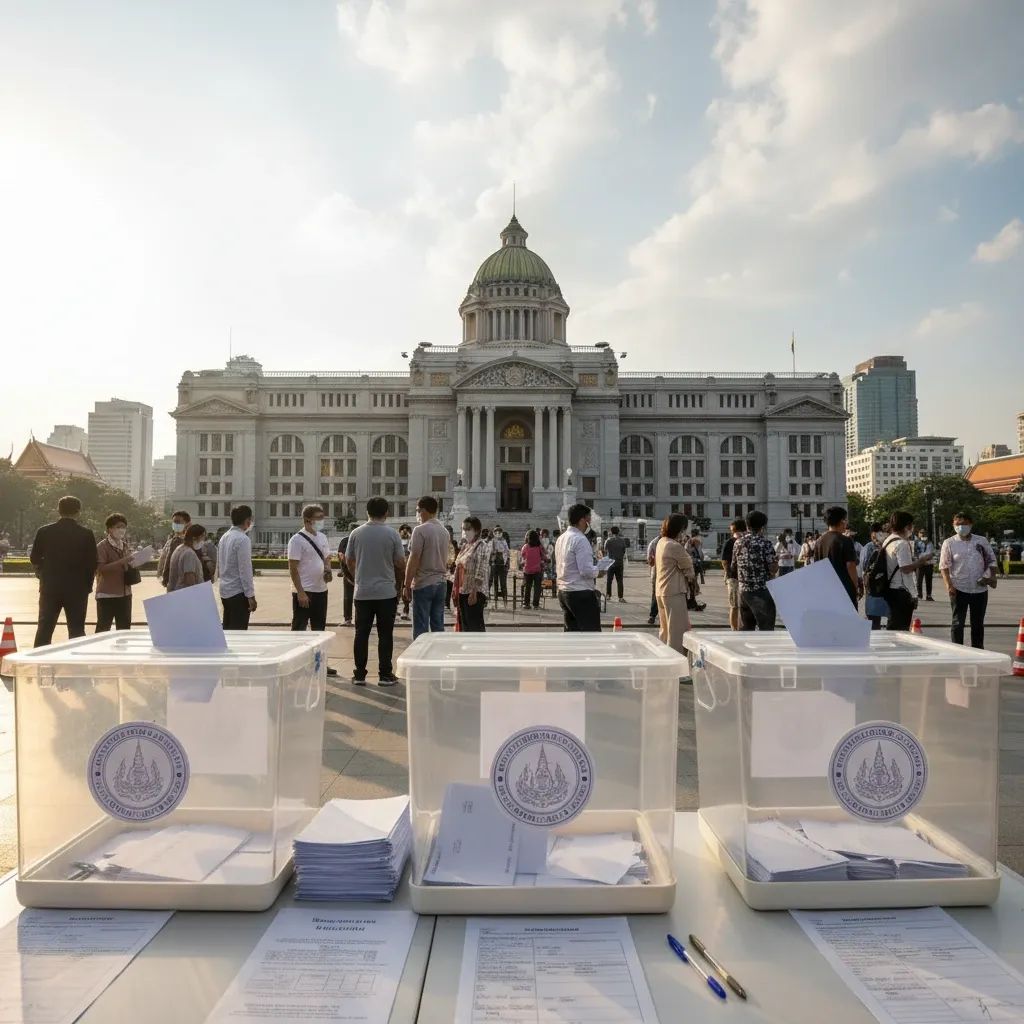
The Thailand Election Commission has officially confirmed that voters approved a path forward for replacing the country's 2017 military-backed charter, a decision that clears the first hurdle toward constitutional reform but leaves at least two years of complex political maneuvering ahead.
Why This Matters
• 58.6% of ballots cast on February 8 endorsed drafting a new constitution, delivering a mandate for change.
• The current charter — criticized for empowering unelected senators and restricting civil liberties — remains in force until a replacement is ratified by at least two more referendums.
• Timeline uncertainty: the EC delayed its formal declaration, citing legal complaint periods, adding friction to an already multi-stage process.
• Residents and investors face prolonged uncertainty over governance rules, electoral systems, and the scope of parliamentary power.
What the Numbers Reveal
Out of 52.9M eligible voters, 36.9M cast ballots, yielding a turnout of 69.65%. The question put to the public was straightforward: "Do you agree that Thailand should have a new constitution?" Final tallies showed 21.6M affirmative votes (58.64%) against 15.3M opposed, according to official EC data released this week.
Note on the vote count: The referendum recorded 36.9M total ballots cast. Of these, 21.6M votes supported the new constitution (58.64%), while approximately 15.3M votes opposed it. A small percentage of ballots were invalid or blank, which is standard in Thai referendums and explains the difference between total ballots cast and the sum of yes/no votes. These figures reflect the raw vote tally that determines the referendum outcome.
The referendum was bundled with House of Representatives elections, a strategic pairing intended to maximize participation. Turnout exceeded recent general elections, signaling strong public interest in constitutional matters despite widespread voter fatigue. Yet the EC's delay in certifying results — ostensibly to accommodate legal objections — has drawn accusations of deliberate foot-dragging from legal scholars and opposition figures, who argue the delay serves entrenched power structures eager to slow reform momentum.
The Charter Under Fire
Thailand's 2017 constitution was drafted under the supervision of the National Council for Peace and Order, the junta that seized power in 2014. Critics describe it as a "cage" for elected politicians, embedding mechanisms that dilute popular sovereignty and enshrine military influence. Key flashpoints include:
• Appointed senators: The 250-member Senate was handpicked by the junta and wields co-equal authority with the elected House on legislation, reform committees, and constitutional amendments. Senators also held the power to co-elect the prime minister through 2023, a provision exploited to install a military-aligned government despite an opposition election victory in 2019.
• Restrictive rights clauses: Civil liberties can be curtailed broadly in the name of "state security," a latitude that has enabled crackdowns on dissent and protest.
• Single-ballot electoral system: The voting mechanism introduced in 2017 distorts proportional representation, producing unstable coalitions and incentivizing party fragmentation.
• National Strategy framework: A 20-year policy blueprint sits above elected administrations, limiting the scope for platform-driven governance.
Legal experts point to these features as deliberate design choices intended to perpetuate influence by institutions insulated from the ballot box. The Bangkok-based Constitutional Court has itself become a contentious player, issuing rulings that dissolve parties, disqualify prime ministers, and block reform efforts — decisions that many jurists argue overstep judicial mandates.
What Comes Next: A Multi-Year Gauntlet
Passage of the referendum triggers a three-stage process that constitutional scholars estimate will consume at least 24 months:
1. Amendment to Authorize Drafting
Parliament must now amend Article 256 of the existing charter to insert a new Chapter 15/1, which establishes the legal framework for creating a replacement document. This procedural vote is expected within weeks, though debate over the composition and powers of the drafting body could stretch timelines.
2. Establishing a Charter Drafting Assembly
The amended constitution will authorize a Charter Drafting Assembly (CDA), a body tasked with writing the new text. Here the process hits its first major political minefield: who gets to sit in the CDA, and how are they chosen?
In 2024, the Constitutional Court ruled that directly electing CDA members violates the principle of parliamentary sovereignty, blocking a model favored by pro-reform parties. As a result, Parliament will likely appoint drafters, with allocations based on seat shares. Critics warn this formula — reportedly 20 MPs per CDA seat — hands disproportionate influence to the largest coalition partners, potentially skewing the text toward incumbent interests rather than grassroots demands.
The CDA is expected to operate under a 360-day deadline from the date it convenes. During this period, it must solicit public input, draft provisions, and reconcile competing visions from parties ranging from populist movements to conservative blocs.
3. Second and Third Referendums
Once the draft is complete, it goes back to voters for a second referendum approving the full text. If that passes, a third referendum may be required to ratify any amendments made during parliamentary review. Each vote introduces fresh opportunities for delay, legal challenges, or electoral interference.
Political Divisions on Full Display
Major parties campaigned in favor of the referendum but remain sharply divided on red lines:
• Pheu Thai, Palang Pracharath, and Bhumjaithai endorsed reform but insisted Chapters 1 and 2 — covering the monarchy and general provisions — remain off-limits. Party leaders framed this as safeguarding national unity.
• The People's Party (successor to the dissolved Move Forward Party) argued for an unrestricted rewrite, contending that selective immunity for certain chapters perpetuates the structural imbalances that produced the 2017 charter in the first place. The party's stance resonated strongly with younger, urban voters but alienated conservative blocs.
Academic opinion leans heavily toward comprehensive reform. A coalition of legal scholars issued a statement this month warning that "partial revisions will replicate the defects of the current system," particularly if the Senate's appointed composition and the National Strategy mechanism survive intact.
Why the Delay Matters
The Thailand Election Commission's decision to withhold formal certification pending a review of objections is technically lawful but politically charged. Under referendum statutes, the EC has a 30-day window to adjudicate complaints before declaring results final. However, no substantive challenges have been publicly filed, leading transparency advocates to accuse the commission of manufacturing pretexts to slow the reform clock.
The practical consequence: Parliament cannot officially begin amendment proceedings until the EC publishes a gazette notice. Each week of delay compresses the legislative calendar, increasing the risk that the CDA timeline spills into 2028 — potentially beyond the current government's term. For expats, businesses, and long-term residents, the uncertainty complicates planning around taxation rules, property rights, and regulatory stability, all of which hinge on the final charter's distribution of power between central ministries, local governments, and independent agencies.
Historical Echoes
Thailand has rewritten its constitution 20 times since abolishing absolute monarchy in 1932, a frequency unmatched in Southeast Asia. Each iteration has reflected the political settlement of its era, oscillating between civilian-led texts (1997, 2007) and military-supervised frameworks (1991, 2007 interim, 2017). The 1997 "People's Constitution" is widely regarded as the high-water mark for democratic governance, introducing direct-elected senators, independent watchdogs, and robust rights protections. It was replaced following the 2006 coup, and subsequent charters have progressively centralized authority in unelected institutions.
The February 2026 referendum result suggests a public mandate for reversing that trend, but the road ahead remains contested. No charter revision in Thai history has been completed without military acquiescence, raising the question of whether the current reform effort can break that pattern.
Impact on Expats & Investors
For the foreign community in Thailand, the constitutional overhaul carries direct implications:
• Visa and residency frameworks are governed by ministerial regulations that can shift dramatically depending on the charter's allocation of executive versus parliamentary authority. A more empowered House could press for liberalized long-term stay provisions; conversely, a Senate-heavy balance might favor restrictive immigration policies.
• Tax policy: The charter defines the scope of budgetary authority and the independence of revenue agencies. Ongoing debates over worldwide income taxation for residents hinge partly on whether Parliament can override bureaucratic rule-making — a power dynamic shaped by constitutional design.
• Land ownership and investment incentives flow from laws that require supermajority votes or Senate consent under the 2017 text. A revised charter could lower those thresholds, unlocking faster policy adjustments in response to economic headwinds or regional competition for FDI.
• Legal recourse: The jurisdiction and independence of the Constitutional Court, Administrative Court, and criminal courts are all defined by charter provisions. Changes here affect everything from contract enforcement to the ability to challenge state actions.
The two-year limbo between now and final ratification creates a planning vacuum. Multinational firms weighing expansion commitments, property buyers navigating ownership structures, and retirees assessing tax exposure all face the same question: which set of rules will govern Thailand in 2028?
Voices from the Ground
Civic groups have been vocal. The Thai Lawyers for Human Rights praised the referendum outcome as a "citizen mandate for genuine democracy" but warned that the EC's delay tactics and the Court's earlier ruling blocking elected drafters reveal "institutional resistance to relinquishing control." The group has called for international observation of the drafting process to ensure transparency.
Business lobbies, meanwhile, have urged speed. The Joint Foreign Chambers of Commerce issued a statement noting that "protracted constitutional uncertainty undermines investor confidence and complicates long-term capital allocation." The group stopped short of endorsing specific reform outcomes but emphasized the need for clarity on regulatory authority and the stability of fiscal frameworks.
The Road Ahead
Assuming the EC certifies results by mid-March, Parliament could convene amendment sessions by April. The Charter Drafting Assembly would then launch by mid-2026, placing a final draft before voters no earlier than late 2027. A third ratification referendum, if required, pushes the timeline into early 2028.
That schedule assumes smooth sailing — an optimistic projection given Thailand's fractious coalition politics, the Senate's veto power over constitutional amendments, and the judiciary's history of intervention. Any one of these actors could derail or drastically reshape the process.
For now, residents face the paradox of a public mandate for change colliding with institutional structures designed to resist it. The 58.6% "yes" vote was decisive but not overwhelming, leaving ample room for conservative forces to argue that narrow margins justify cautious, incremental reform rather than wholesale reinvention.
The next 24 months will test whether Thailand's elected Parliament can execute a popular mandate over the objections of unelected gatekeepers — a test with implications reaching far beyond constitutional text into the daily reality of governance, rights, and economic policy that shapes life for everyone under Thai jurisdiction.


