
Thailand’s next general election is turning into a showdown between the youthful People’s Party and the entrenched Bhumjaithai machine. One side promises sweeping digital-era reform, the other leans on sprawling patronage networks that still dominate much of the countryside. For voters juggling soaring living costs, climate shocks and Asia’s fast-moving economy, the choice could define the country’s direction well beyond the ballot box.
Two very different political universes
On one flank stands the People’s Party, a re-branded successor to Move Forward that emerged after the Constitutional Court dissolved its predecessor last year. Its leaders speak the language of open data, e-government and industrial up-skilling, all wrapped in the slogan “Thai-equal, Thai-modern, Thai-global.” Across the aisle sits Bhumjaithai, led by long-time power broker Anutin Charnvirakul, campaigning under the familiar banner “Say it, Do it.” The party’s strength remains its big-house clans, district bureaucrats and deep links to local commerce.
Urban pull versus rural gravity
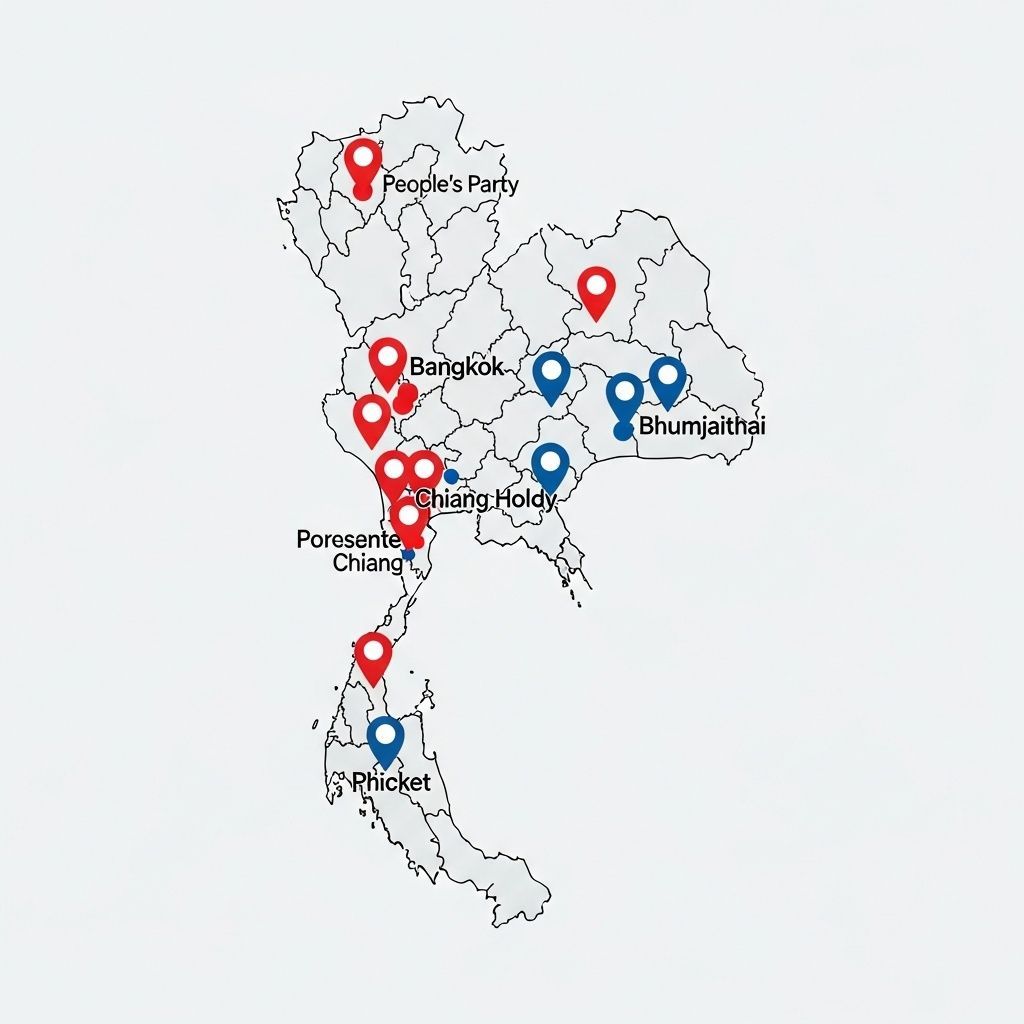
Survey after survey shows the People’s Party dominating metro centres from Bangkok to Chiang Mai, where policy detail and clean-government messaging resonate with the middle class. Yet the same polls confirm that Bhumjaithai still commands loyalty in vast stretches of the Northeast and lower South, where personal ties, quick subsidies and disaster relief carry heavy weight. Analysts describe the contest as a tug-of-war between a policy-first electorate and a patronage-first electorate, co-existing inside one national boundary.
Policy platforms on a collision course
The opposition’s flagship program vows to “revive the economy” through four new growth engines: advanced skills training, future industries, diversified agriculture and seamless global connectivity. It also stakes out hard lines on fair-trade law, state-budget transparency and an aggressive anti-corruption drive. Bhumjaithai counters with cost-of-living relief: the revived Khon La Khrueng Plus co-payment scheme, ฿50,000 emergency loans without collateral, an electric-bus network capped at ten baht starting fare, plus three-year debt holidays for small borrowers. Both parties tout disaster resilience after the recent record floods that battered southern rice belts and tourist towns.
The faces competing for Government House
Pollsters say Sirikanya Tansakun, an economist turned legislator, now tops popularity charts among premier hopefuls. Her rise—alongside fellow academic Veerayooth Kanchoochat—gives the opposition a sharp, technocratic image. Bhumjaithai’s front man remains Finance Minister Ekniti Nitithanprapas, praised for experience yet tagged with a bureaucratic mindset critics call risk-averse. Cabinet ally Suphajee Suthumpun, a veteran corporate executive, pushes the party’s business credibility but has shown reluctance to fully plunge into retail politics.
Door-knocking data versus dynastic muscle
The opposition is banking on its new Election Intelligence application, a cloud platform mapping every household and past voting pattern. Campaigners claim it pinpoints “swing lanes” down to village blocks, replacing the old-school headman system with AI-driven outreach. Bhumjaithai dismisses the software as urban gadgetry, insisting that personal visits, funeral contributions and community fundraisers still move ballots where asphalt ends. The ground war will reveal whether digital micro-targeting can outflank decades of tangible favours.
Poll numbers and regional chessboards
Latest Suan Dusit figures put the People’s Party at 26.25 % on the party-list ballot, a nose ahead of Bhumjaithai’s 22.02 %. Regionally the opposition is first in the North, Central Plains and Isan, while Bhumjaithai eyes gains in the East—especially Chon Buri, where it has stitched alliances between “old houses” and “new houses.” Both camps are bracing for a possible early dissolution of parliament; if that happens, seat projections swing from 200-plus for the People’s Party down to 150, and from 150 for Bhumjaithai up to 180, depending on turnout.
Why it matters to daily life
For Bangkok commuters, the election could decide whether a ten-baht electric bus arrives before next year’s energy price hike. For rubber tappers in Phatthalung, it might mean faster flood compensation or another season spent patching roads themselves. University graduates weighing job prospects in EV manufacturing or clean-tech startups are watching which manifesto secures the next wave of foreign investment. Even staple rice prices—currently hovering at ฿14-15 per kilo after a surprise surge—are caught in the crossfire of competing subsidy blueprints.
The road ahead
Both parties recognise that Thai voters no longer fit neat categories. Rural provinces now stream the same election clips on TikTok that city residents analyse on Clubhouse; urbanites value immediate welfare almost as much as visionary policy. The side that best blends modern governance with on-the-ground empathy will likely capture the swing districts. With just months until ballot day, the contest has become less about slogans and more about proving whose model—digital participation or traditional reciprocity—can deliver in a country hungry for stability and progress.


