
When Thailand's Heat Collision Strikes: The Week Ahead Demands Real Preparation
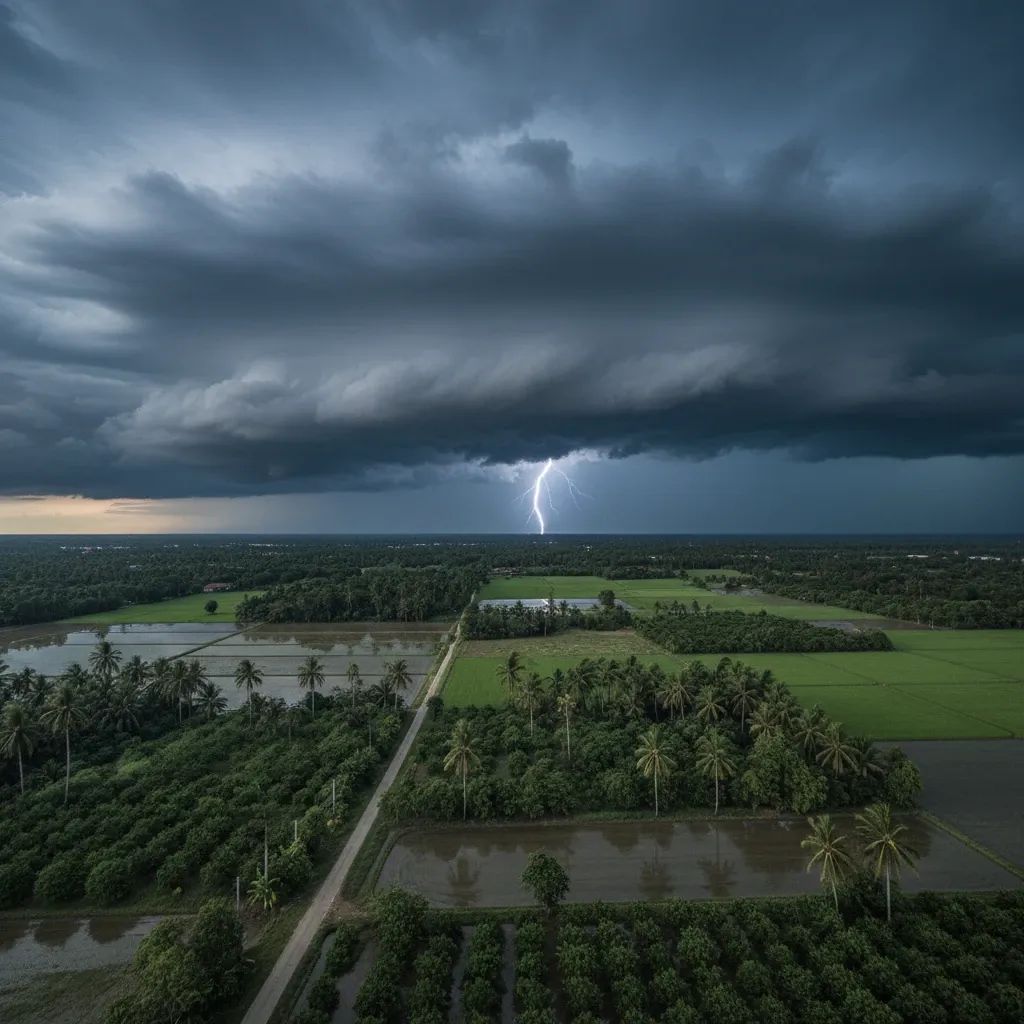
The Thailand Meteorological Department has forecasted a critical atmospheric collision set to unfold from April 23-26, 2026. A southward-moving cold air mass originating from China will crash against searing heat already suffocating the nation's upper regions. The result won't be gradual—it will be violent and concentrated. Severe thunderstorms, hail, lightning, and winds exceeding 60 km/h will reshape the week ahead for anyone living across northern, northeastern, central, or eastern Thailand. This isn't background weather noise. This is consequential.
Why This Matters
• Peak danger window is April 23-26: Storm cells will cover 40-60% of the Northeast and 20-40% of other upper regions; infrastructure damage is virtually guaranteed in affected zones.
• Agricultural losses compound instantly: Hail destroys mango, longan, and durian harvests mid-season; fruit quality drops 80% or more after impact.
• Infrastructure collapse becomes real: Unstable billboards, inadequate drainage, and poorly grounded structures will fail; power outages and localized flooding are near-certain.
• Marine operations halt: Waves will exceed 2 meters in thunderstorm zones; fishing vessels face capsizing risk and should remain moored through April 26.
Recent Reality: Mae Sai's Warning
Four days ago, the threat transitioned from forecast to lived experience. On April 18 at approximately 8:00 p.m., Mae Sai district in Chiang Rai was struck by a violent thunderstorm generating winds strong enough to tear through restaurant glass doors and overturn outdoor furniture. The system persisted for roughly 45 minutes before dissipating. Diners fled for safety. Debris scattered across streets. It marked the second significant severe weather event in Mae Sai within recent weeks—a pattern indicating that the atmospheric setup for intense convection was already primed.
That Mae Sai event provides a concrete preview of what regional-scale severe convection looks like. The April 23-26 window will deliver similar destructive potential across a vastly larger geographic footprint—encompassing the entire northern region, the entire Northeast, portions of the Central Plains, and eastern coastal areas.
The Atmospheric Setup Explained
Thailand's weather follows a predictable pattern: extreme heat builds through March and April as the sun intensifies overhead. Moisture from the Gulf of Thailand and South China Sea accumulates inland. When cold air from China crashes into this hot, wet air mass, the collision creates violent storms. This is what's happening April 23-26.
When cool upper-level air encounters warm, moisture-laden surface air, convection becomes violent. Updrafts strengthen. Hail forms. Wind shears multiply. This is the meteorological mechanics behind the coming storm surge.
The Northeast region—historically vulnerable to severe convection—will experience the most intense activity, with thunderstorm coverage reaching 40-60% of Nakhon Ratchasima, Khon Kaen, and surrounding provinces. The North, particularly Mae Hong Son, Lampang, and Tak districts, will see 20-40% coverage with hail in scattered locations. The Eastern seaboard and Central Plains will experience lighter but still significant activity. Bangkok and its vicinity will see isolated to scattered storms (10-30% coverage) between April 24-26, with the greatest risk concentrated in low-lying northern and eastern neighborhoods where drainage systems routinely overwhelm during heavy rain.
The transition to severe weather occurs as the dry-season heating cycle gives way to early monsoon influence. By late April, the Southwest Monsoon begins to assert itself over Southeast Asia. The collision between the old heat-dominated pattern and the emerging monsoon pattern creates a window of severe convection—a window that typically lasts 3-5 days and then resolves as the monsoon stabilizes conditions.
Heat Spike Before Relief: April 21-22
Before the storms arrive, upper Thailand will experience a final scorching push. Temperatures across northern provinces will reach 35-42°C on April 21-22, with Mae Hong Son, Tak, and Lampang potentially hitting 42-43°C. For context, the highest temperature recorded so far this 2026 summer was 39.3°C at Bua Chum in Lopburi on March 3. Last year's seasonal peak was 42.3°C in Mae Hong Son during April 2025. The current trajectory suggests 2026 will match or slightly exceed 2025's intensity.
This heat spike carries real health consequences. Heat stress increases exponentially above 40°C, particularly for outdoor workers, elderly residents, and young children. Construction sites, agricultural fields, and open-air markets will become dangerous zones. Hospitals report elevated admission rates for heat exhaustion and heat stroke during these peaks.
The practical response: avoid prolonged outdoor activity between 11 a.m. and 3 p.m. on April 21-22. Drink water constantly—not occasionally. Seek shade aggressively. If you work outdoors, negotiate earlier or later shifts with your employer or organize work schedules around mid-day heat. For vulnerable populations, consider temporary relocation to air-conditioned facilities or malls during peak hours.
Agricultural Impact: Where Real Economic Loss Concentrates
Farmers across upper Thailand are currently harvesting late-season fruit crops—mangoes, longans, and durians destined for both domestic markets and international export. These are high-value commodities. A single mango tree in prime production can generate 100,000–200,000 baht in annual revenue for a farm household. Hail destroys 60-80% of exposed fruit through direct impact and subsequent fungal infection.
The economic math is unforgiving. A mango scarred by hail is unsaleable at premium prices—export markets reject cosmetic damage. Domestic buyers downgrade the price 30-50% or refuse purchase entirely. For farmers operating on thin margins, a single hail event during peak harvest can erase seasonal profit entirely, forcing debt accumulation or distress sales of land.
The Thailand Meteorological Department has issued specific mitigation guidance:
For orchards: Install horizontal support netting or reinforce weak branches with guy-wires before April 23. Consider tarping lower-value fruit to reduce hail exposure. Prune dead wood now to reduce projectile risk during high winds.
For vegetable crops: Accelerate harvest of market-ready produce before April 23 if buyers accept early timing and quality. Move seedlings or tender transplants into protected structures. Secure irrigation infrastructure against wind damage.
For livestock: Move animals into reinforced shelters or enclosed barns before April 23. Stock supplemental feed indoors—storm flooding may isolate grazing areas. Secure roofing on animal structures; torn corrugated metal becomes lethal shrapnel in 60+ km/h winds.
Secondary considerations: Heavy rainfall post-storm promotes root rot and fungal disease in waterlogged fields. Damaged foliage becomes entry points for insects. Post-harvest drying becomes difficult if rain persists. Budget contingency costs for pest management and disease mitigation extending 2-3 weeks beyond the storm event.
Urban and Infrastructure Vulnerability
Unstable billboards dominate the visible hazard landscape, but the actual damage footprint is broader. Temporary construction scaffolding, poorly installed air conditioning units, unsecured roofing materials, and corrugated metal fencing will fail catastrophically in 60+ km/h wind gusts. Drainage systems in Bangkok and other cities will overwhelm if rainfall intensity exceeds design specifications—which is likely during convective cells producing 40-60 mm of rain in 30-60 minute windows.
Low-lying neighborhoods in Bangkok's northern and eastern districts—Lat Krabang, Prakhanong, and Bang Khun Thian districts particularly—face flash flooding risk. Soi drainage systems reverse flow when main canal levels exceed capacity. Streets become temporary waterways. Residents in ground-floor apartments face water ingress. Vehicles submerged in standing water suffer catastrophic electrical and engine damage.
The Thailand Ministry of Interior has issued explicit readiness directives to all provinces. Disaster prevention offices are pre-positioning rescue teams, water pumps, generators, and emergency supplies. This deployment reflects genuine institutional risk assessment, not routine procedural theater.
What Residents Need to Do Immediately (April 21-22)
Structural preparation:
• Inspect roof fasteners, tile or metal sheet attachment points. Loose roofing materials become missiles.
• Clear gutters and downspouts completely. Remove leaves, debris, and sediment. Test water flow into drainage systems.
• Trim branches overhanging buildings, parked vehicles, or power lines. Cut dead wood first—it's weakest.
• Inspect window seals and caulking. Water intrusion damages electrical systems and promotes mold.
• Secure outdoor items: flower pots, chairs, signage, tarps. Anchoring takes 15 minutes; debris cleanup takes hours.
Supply stockpiling:
• Potable water: minimum 6 liters per household member (3 days' supply). Tap water post-flood becomes contaminated.
• Non-perishable food: canned goods, dried noodles, peanut butter, powdered milk. Gas stoves may become unusable if fuel lines are damaged.
• Medications: at least 7-day supply of regular prescriptions. Pharmacies may close or stock-out post-event.
• First-aid supplies: bandages, antiseptic, pain relievers, antihistamines for allergic responses to mold after water damage.
• Power banks and flashlights: fully charged. Regional outages lasting 6-48 hours are common post-storm.
• Battery-powered radio: updates on power restoration, water safety, and traffic conditions.
Documentation preparation:
• Photograph all property—interior and exterior—before April 23. Video walkthroughs of valuable items strengthen insurance claims post-damage.
• Locate insurance policy documents. Verify coverage limits for wind, hail, and water damage.
• Compile list of irreplaceable items and their estimated value.
• Save critical documents (deeds, titles, passport photos) in waterproof containers.
During the Storm Window (April 23-26)
Active storm behavior:
• Stay indoors in interior rooms free of windows. Avoid rooms with external walls—wind pressure can fail windows and door frames.
• Do not use landline or mobile phones during active lightning. Wait until 30 minutes after the last visible lightning before resuming use.
• Avoid elevators during outages; use stairs. Stairwells have fewer windows and external exposure points.
• Avoid bathing or shower use during active thunderstorms. Lightning can follow plumbing conductors into structures.
• Do not touch metal-framed structures, appliances, or metal piping during lightning activity.
• Keep pets indoors. Animals become disoriented and may be struck by lightning or struck by debris.
Vehicle safety:
• Park away from large trees, drainage culverts, and power lines. Falling branches and downed wires create hazards.
• Do not attempt to drive through flooded streets or intersections. "Turn around, don't drown" is accurate—water depth and current strength are invisible and often fatal.
• Avoid driving under overpasses during heavy rain. Flash flooding occurs rapidly in low-lying areas.
• If trapped in a vehicle during flooding, exit and move to higher ground. Vehicle flotation occurs suddenly with chest-deep water, and escape becomes impossible from a submerged cabin.
Post-storm assessment:
• Wait for official all-clear before venturing outdoors. Downed power lines, unstable structures, and contaminated water pose ongoing hazards.
• Document damage with photographs and video. Insurance claims require visual evidence.
• Avoid standing water. Post-flood water contains sewage, chemicals, and contaminants. Waterborne illness outbreaks occur 5-7 days post-event.
• Boil tap water or use bottled water until authorities confirm supply safety. Bacterial and chemical contamination is common post-flooding.
• Check for visible structural damage before entering buildings. Roof leaks, wall cracks, and foundation shifting create collapse risk.
Emergency contacts:
• National emergency hotline: 1784 (operates 24/7)
• Thailand Meteorological Department: 1182 or 0-2399-4012-13 (24-hour updates)
• Provincial disaster prevention office: save local numbers now (posted on municipal websites)
• Nearest hospital emergency department: record name, address, phone number
Marine Traffic Restrictions
The Gulf of Thailand and Andaman Sea will experience baseline wave heights of approximately 1 meter under normal conditions. However, thunderstorm cells generate localized wave heights exceeding 2 meters with minimal warning. Fishing vessels, ferries, and recreational craft operating in these zones face genuine capsizing risk during April 23-26.
The Thailand Meteorological Department has issued an explicit advisory: do not sail in areas with visible thundershowers through April 26. Fishing communities will experience short-term economic loss as boats remain moored—typically 2-3 days of lost catch income—but the safety trade-off is non-negotiable. Capsize survival in deep water with 2+ meter swells and low visibility is statistically poor.
Domestic ferry operators should anticipate service disruptions or cancellations April 24-25. If you have travel scheduled to islands or coastal destinations, confirm departure status 24 hours in advance. Regional airports, particularly in the North and Northeast, are prone to temporary closure during active convection—flights departing Chiang Mai or Khon Kaen may experience delays.
Bangkok's Lower But Non-Zero Risk
The capital will experience less intense convection than northern and northeastern regions—10-30% storm coverage expected April 24-26—but intensity variation doesn't equal absence. Isolated thunderstorms in Bangkok can still produce localized flash flooding in neighborhoods with chronically poor drainage.
Bangkok's eastern and northern districts (Lat Krabang, Bangkapi, Sai Mai) sit in topographic low zones where soi drainage reverses during canal overflow events. Streets can accumulate 20-30 cm of standing water in 60 minutes during heavy convective rainfall. This water persists for 4-12 hours, depending on drainage system capacity and upstream rainfall patterns.
Temperatures will moderate slightly during the storm window—dropping from 34-40°C on April 23 to 33-38°C by April 26 as cooler air aloft enters. For Bangkok residents, this 2-3°C shift will feel noticeable but won't eliminate heat stress. Humidity will increase as storm moisture arrives, offsetting the temperature decline.
Contextualizing 2026's Heat Intensity
The 2026 summer officially commenced February 22 and has tracked notably aggressive. The seasonal peak typically occurs late March through mid-April—a reliable climate pattern across 40-year records. However, 2026's progression suggests intensity above typical ranges.
The highest reading recorded so far this season was 39.3°C at Bua Chum in Lopburi on March 3. By April 20, multiple northern stations reported 41-42°C readings. For comparison, 2025's seasonal peak was 42.3°C in Mae Hong Son during April. Current modeling suggests 2026 will match or slightly exceed that benchmark.
Climate researchers attribute some intensity to global patterns, though causation analysis remains preliminary. El Niño conditions are expected to intensify from mid-2026 onward, potentially suppressing rainfall regionally later this year. However, monsoon systems crossing the Indian Ocean can override El Niño suppression—so no one should assume a dry summer is guaranteed. The meteorological situation remains dynamic through May.
Improving Thailand's Disaster Response
Thailand's approach to severe weather remains predominantly reactive: issue warnings, respond emergently, assess damage afterward. Countries like Japan use multi-tier warning systems with explicit action guidelines at each level, accessible to all literacy levels through colors and symbols. Taiwan and the Philippines conduct pre-event evacuations from high-risk zones and pre-position relief supplies before severe weather arrives.
More immediately practical for Thailand residents: demand that your local disaster prevention office shares updated contact numbers, evacuation routes, and shelter locations before the storm window. These resources should already exist—confirming they're accessible is your responsibility before April 23.
The Critical Window: April 21-22 Is Preparation Time
The Thailand Meteorological Department message is unambiguous: prepare now. Waiting until storms are visible on radar is too late for structural reinforcement or supply gathering.
Farmers in the North, Northeast, Central, and Eastern regions should complete orchard reinforcement and livestock shelter preparation within 24 hours of April 21. Urban residents should secure outdoor items, stock emergency supplies, and identify interior safe rooms. Mariners should move vessels to protected anchorages or confirm mooring security.
The Thailand Meteorological Department will issue updated advisories every 12 hours through April 26. Real-time satellite imagery and radar data are available via its website (www.tmd.go.th), mobile app, and 24-hour hotline. Check forecasts at minimum twice daily during this window—once in morning, once in afternoon. Conditions can shift rapidly.
By April 27, the worst will have passed. The cold air will settle. Convection will diminish. The transition toward the Southwest Monsoon season will accelerate. Temperatures will moderate. But between now and then, the next 5-6 days demand concrete preparation and situational awareness. That distinction—between prepared and unprepared—often determines whether disruption remains manageable or becomes hardship.


