
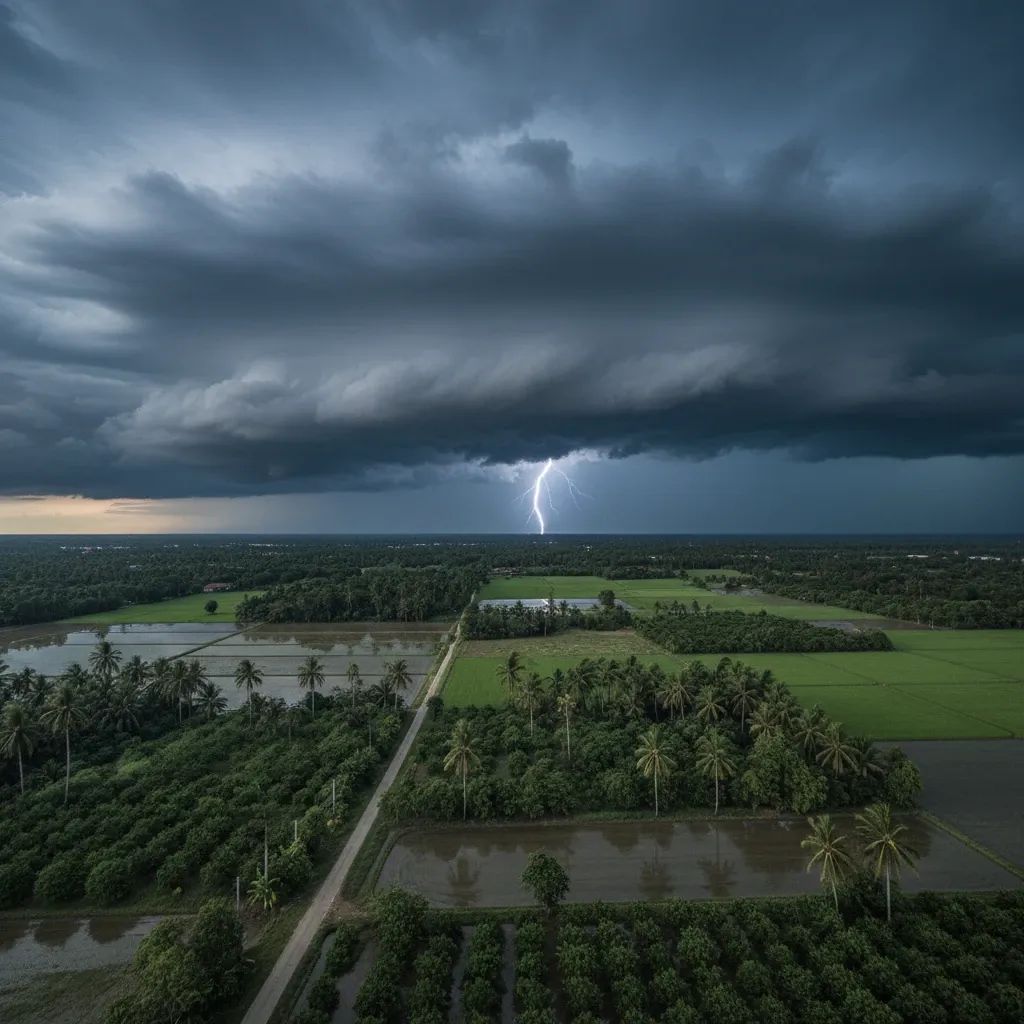
The Thailand Meteorological Department has issued a summer storm warning through April 20, casting uncertainty over Wan Lai festival celebrations in Pattaya—the city's signature outdoor water festival that draws tens of thousands to streets and beaches during peak Songkran. Authorities are now monitoring conditions closely as the potential for sudden thunderstorms, strong gusts, and lightning strikes threatens what is traditionally one of the busiest and most exposed public events of the year.
Why This Matters
• Storm window coincides with peak celebrations: Wan Lai festivities (April 17–19) fall squarely within the meteorological alert period, with the highest storm probability during late afternoon and evening hours.
• Outdoor exposure amplified: Unlike Bangkok's street parties, Pattaya's festival sprawls across beaches, open roads, and waterfront zones with minimal shelter infrastructure.
• Past damage documented: Over the past three years, summer storms in Thailand caused 44 deaths, damaged more than 217,000 homes, and affected over 210,000 households nationwide.
• Safety guidance issued: Residents and tourists are urged to avoid open areas, large trees, unstable structures, and billboards when storms approach.
The Meteorological Setup
A high-pressure system originating in China is expanding toward the South China Sea, intensifying southwesterly and southeasterly winds over the Gulf of Thailand and eastern provinces, including Chonburi—home to Pattaya. This pattern is typical for mid-April, when Thailand receives direct solar radiation, heating the land surface to extreme levels and creating the atmospheric instability necessary for explosive convective storms.
According to the Thai Meteorological Department's April 17 bulletin, thunderstorms with strong wind gusts and possible hail are expected to initially affect the northeast and east before spreading to central regions, including Bangkok, and the northern provinces. Daytime conditions remain hot to very hot with hazy skies, but storm probability spikes sharply after 4 p.m., precisely when Wan Lai crowds peak.
April in Pattaya is historically the hottest month, with average daily highs around 32°C, rarely dipping below 31°C or exceeding 34°C. Minimum temperatures hover near 27°C. The combination of extreme heat and high humidity creates the volatile fuel for summer storms—locally called phayufah khanong—characterized by sudden onset, intense rainfall, and dangerous wind shear.
What This Means for Residents
For anyone planning to attend Wan Lai celebrations or conduct outdoor business in the Pattaya area, the implications are immediate:
Timing is critical. Storm formation tends to occur in late afternoon and evening, meaning morning and early afternoon activities carry lower risk. Event organizers and beachfront vendors should monitor real-time updates and be prepared to suspend operations quickly if conditions deteriorate.
Shelter is scarce. Unlike indoor venues, Pattaya's beachfront and Beach Road offer limited refuge. Temporary stages, open-air sound systems, and vendor tents may themselves become hazards in high winds. Tourists unfamiliar with the speed at which these storms develop face elevated risk.
Lightning danger is real. The open beaches and waterfront zones where Wan Lai takes place are among the most exposed environments during electrical storms. The Thailand Department of Disaster Prevention and Mitigation (DDPM) has repeatedly emphasized avoiding open spaces, tall trees, and large metal structures—categories that describe much of Pattaya's festival geography.
Agricultural and property owners should act now. Farmers in Chonburi Province are advised to secure crops and livestock, while property managers should inspect roofs, doors, windows, and outdoor fixtures. Loose objects should be stored or tied down, and drainage channels cleared to prevent flash flooding.
Historical Context: Summer Storms During Songkran
Thailand's April weather is notoriously volatile. Summer storms occur when cool air masses from China collide with the hot, moisture-laden air blanketing the country. The result is rapid atmospheric destabilization—storms can form within minutes and unleash destructive winds, torrential rain, and hail.
During the 2023 Songkran period, similar storm warnings covered eastern provinces, including Chonburi. While no major disruptions to Pattaya's events were reported that year, the broader national toll from April storms between 2022 and 2024 underscores the risk: over 200,000 households affected, billions of baht in agricultural and structural damage, and dozens of fatalities, many linked to lightning strikes and wind-related trauma.
Weather agencies note that storm frequency and intensity have been increasing in recent years, a trend attributed to both natural variability and broader climatic shifts. The 2026 season appears consistent with this pattern, with multiple provinces already reporting damage on Friday as storms swept through central and northern Thailand.
Official Safety Protocols
The Thailand Ministry of Interior, through the DDPM, has instructed provincial governors nationwide to activate storm preparedness measures, including:
• Real-time monitoring and public alerts via TMD channels (website, hotline 0-2399-4012-13, and the 24-hour service number 1182).
• Infrastructure inspections of billboards, power lines, large roadside trees, and public structures in high-traffic festival zones.
• Emergency response teams (ERT) on standby with equipment and personnel ready to deploy.
• Public advisories disseminated through social media, including the DDPM's Facebook page and X account (@DDPMNews), as well as the Line channel @1784DDPM.
For emergencies, the national disaster hotline 1784 operates around the clock.
Practical Guidance for Festival-Goers
If you plan to attend Wan Lai or are living in the Pattaya area during the alert period, follow these protocols:
Monitor forecasts obsessively. Download the TMD app or bookmark their website. Set alerts for Chonburi Province. Conditions can shift within hours.
Plan your day around the storm window. Engage in outdoor activities before 3 p.m. Have an exit strategy if skies darken or winds pick up. Do not wait for rain to start moving indoors.
Identify solid shelter in advance. Know the nearest reinforced building, shopping mall, or hotel lobby along your route. Tents, umbrellas, and open pavilions are not adequate shelter.
Avoid electronics and metal during storms. Do not use mobile phones outdoors during lightning. Unplug appliances at home. Motorcycles and bicycles parked in open areas should be moved or secured.
Stay hydrated but stay alert. The daytime heat will be punishing—drink plenty of water, but avoid alcohol in excess, which impairs judgment during sudden weather changes.
Farmers and property managers: Secure roofs, tie down livestock shelters, clear gutters, and move vehicles under cover. Crop damage from hail and wind can be catastrophic; protective netting and temporary covers can mitigate loss.
Broader Regional Impact
Pattaya is not alone. The storm system is expected to affect most of upper Thailand, including Bangkok (where scattered thunderstorms carry roughly 20% probability), the northeast, and northern provinces. By Monday, April 20, the system should begin to weaken, but localized heavy rain and gusty conditions may persist into the early part of next week.
The convergence of peak tourism, extreme heat, and unstable weather creates a compounded risk profile rarely seen outside the Songkran period. Authorities are balancing the economic importance of Wan Lai—an event critical to Pattaya's tourism economy—with public safety imperatives.
The Verdict
For now, Wan Lai proceeds as scheduled, but with an asterisk. The Thailand Meteorological Department's warning is not speculative—it is grounded in observable atmospheric conditions and historical precedent. Anyone in the Pattaya area should treat the alert seriously, adjust plans accordingly, and prioritize safety over spectacle. The festival will return next year; lives lost to preventable storm exposure will not.


