
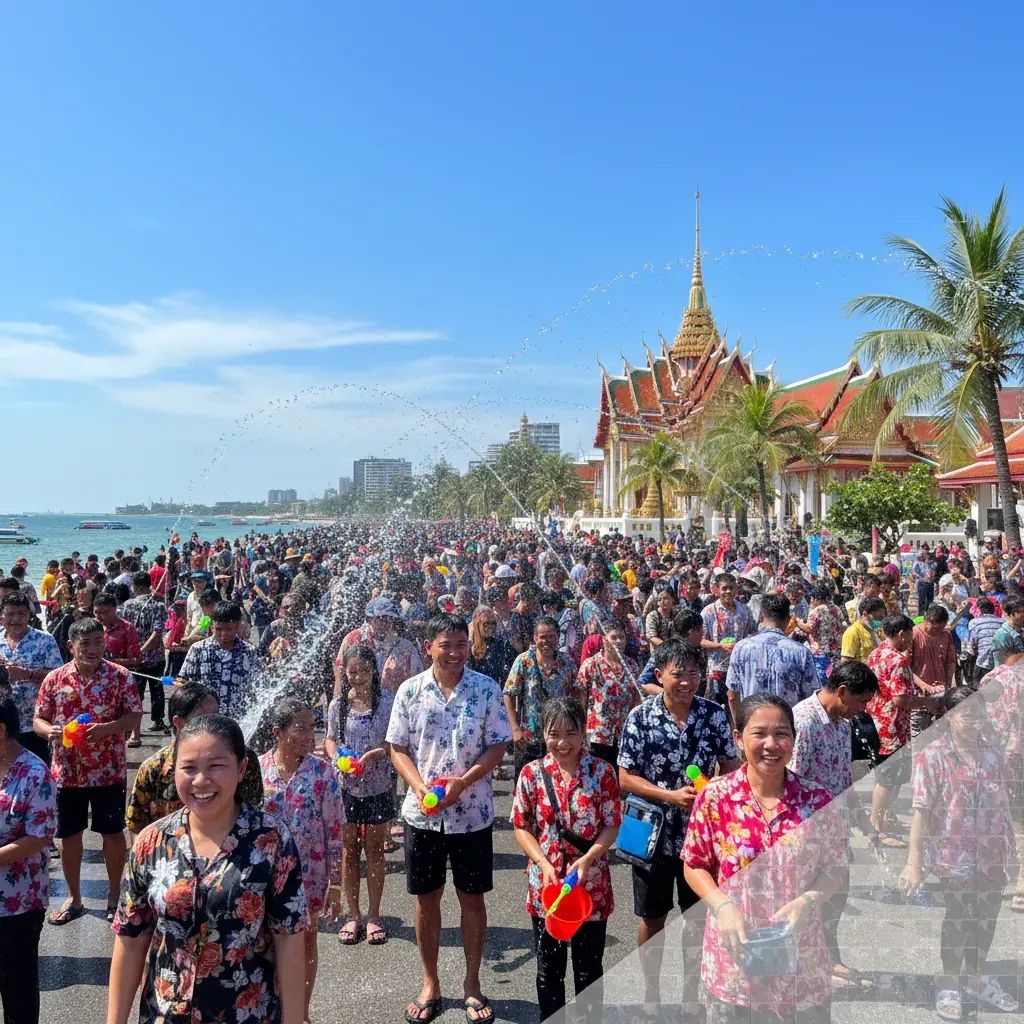
Pattaya's Water Festival Expands Yet Again—But At What Cost to Residents?
Thailand's Pattaya is gearing up for its annual Wan Lai water celebrations April 17-19, 2026, with officials implementing enhanced safety measures for what's become one of Southeast Asia's largest water festivals. The coastal city has transformed what once was a modest, temple-centered merit-making ceremony into a multi-day spectacle—now featuring international entertainment, water activities, and crowds exceeding 100,000. For residents who stayed through previous years, the familiar challenge resurfaces: how to navigate three days of festival activity while their city operates under suspended normal conditions.
Why This Matters
• Road closures lock down central areas: Beachfront routes and main thoroughfares shut April 17–19; Highway 331 and Motorway 7 offer alternative escape routes, though expect significant delays either way.
• Safety measures in place: Over 300 police officers deployed with AI surveillance; organizers enforce water safety guidelines and coordinate medical stations. Enforcement consistency remains a concern for residents.
• Festival spans multiple weeks: While the official celebration runs April 17-19, informal events and commercial tie-ins extend throughout early April across multiple venues—affecting traffic and daily routines.
From Temple Blessing to Festival Juggernaut
Historical accounts describe how Songkran in past decades bore little resemblance to today's spectacle. Five decades ago, the Thailand province of Chon Buri observed "Tam Bun Wan Lai"—literally, merit-making during water's outflow—as a sincere religious observance. Families gathered at temples, particularly at Wat Chai Mongkol Pattaya and regional shrines, to construct sand pagodas in numbers matching Buddhist scripture sections, perform water blessings on elders' hands, and finish by dusk.
The water itself was ceremonial, applied with respect rather than force.
The shift began subtly. Thailand's Tourism Authority first promoted Pattaya as a Songkran destination in the 1990s, recognizing that the extended calendar—Wan Lai falls April 18–19, after the national April 13–15 Songkran—allowed multiple festival cycles for visitors and locals alike. Enterprising event organizers saw opportunity. By the early 2010s, commercial entertainment stages appeared along Pattaya Beach Road. By 2020, organized water activities and all-night entertainment had become standard fixtures.
Today, Thailand's Office of Culture, Chon Buri sponsors competing events that underscore the cultural tension. "Splashing Art by the Sea" attempts to preserve traditional elements—including processions of sacred Buddha relics from all four Thai regions, sand sculpture contests, and classical dance performances. Attendance remains modest. Most attendees prefer beer gardens and entertainment venues elsewhere along the shore.
The Expanding Festival Calendar—And Resident Backlash
What officials describe as "extended celebrations" residents experience as prolonged displacement. The official 2026 Pattaya Songkran schedule runs April 17–19 from noon to midnight daily, but surrounding areas host related events. Central Pattaya Shopping Mall hosts its own "Songkran-Wan Lai Festival 2026" from April 1–21, using water-festival momentum to drive retail traffic. Koh Larn island hosts community celebrations (April 16–19) blending merit-making with beach activities. Collectively, these events transform the region into an active festival zone for three weeks.
Online forums frequented by Pattaya's long-term community reveal mounting frustration. Common complaints cluster around unpredictability and loss of personal autonomy. Residents report being sprayed with water while commuting to work, knocked off balance by tanker-truck spray while grocery shopping, and sprayed directly in the face without consent. Several residents described encounters with unwanted physical contact, which can constitute harassment under Thai law but rarely faces prosecution during festival atmosphere.
Road closures trap residents in neighborhoods. One permanent resident described being unable to reach his doctor's office for three days. Another noted her elderly mother's medicine delivery couldn't arrive. These aren't trivial inconveniences—they're systemic disruptions imposed on a city's functioning infrastructure.
The Economic Logic That Silences Criticism
Scaling back Wan Lai Pattaya would represent significant pressure on local officials. The festival is promoted as generating substantial economic activity through hotel occupancy, restaurant and bar sales, vendor revenue, and increased retail spending. Central Pattaya Shopping Centers report April as one of their highest-revenue months. Retailers, hospitality operators, and vendors collectively benefit from extended festival activity.
The economic model is transparent: extended celebration promotes higher spending; extended hours support bars and venues; international promotion attracts paying visitors. From a revenue standpoint, tradition increasingly yields to commerce.
Yet this calculus carries hidden costs officials rarely quantify. Drunk driving is widely recognized as a major concern during Songkran-period nationwide. Pattaya's festival atmosphere creates a zone of different traffic enforcement patterns—with breathalyzer checkpoints focusing selectively while other vehicles circulate. One long-term resident reported witnessing multiple minor collisions in a single evening, with police arriving delayed after initial calls.
Medical clinics report seasonal spikes. Increased cases of conjunctivitis, ear infections, and gastroenteritis are correlated with water festival activity each April. Though organizers are technically required to use clean water per regulations, enforcement proves challenging when individuals use various water sources and high-pressure systems recirculate water.
Water quality standards are monitored sporadically. Medical professionals note that seasonal infection spikes coincide with the festival period annually.
Safety Theater vs. Lived Reality
Pattaya City Police outlined comprehensive safety measures: over 300 uniformed officers, AI-enabled CCTV monitoring, mobile medical stations, designated rest zones, and multi-language information signage. On paper, this reads as serious preparedness.
On the ground, enforcement remains inconsistent. Water safety devices are sold openly on street corners. Confiscation is rare. One resident described the vendor experience as straightforward commercial transaction; when asking about regulations, vendors indicated availability during Songkran.
Traffic enforcement patterns vary, with some routes experiencing disproportionate checkpoints while others receive minimal scrutiny. Several residents described witnessing Thai motorists operating water-delivery vehicles experience minimal traffic enforcement compared to other vehicles.
The Generational Divide: Thais Mourning Their Own Tradition
Interestingly, critiques of the festival's current form aren't exclusively from foreign expatriates. Thai nationals—particularly those over 50—frequently lament what they describe as cultural change. A reoccurring refrain: "Songkran used to mean something different."
Those elders remember water carrying spiritual significance. Poured over a grandparent's hands, it represented a benediction—an exchange of youth's physical energy for elder blessing. Today it functions differently in the festival context. The ritualistic dignity that once anchored the observance has shifted with commercialization.
Cultural preservation advocates have raised concerns about balancing contemporary celebration with ceremonial integrity. The challenge remains reconciling international promotion with residents' lived experience.
How Other Cities Manage Water Festivals—Lessons Pattaya Hasn't Adopted
Global precedent exists for managing large-scale water celebrations while maintaining community livability. Spain's La Tomatina (Valencia) limits participation to designated zones and caps daily attendance. Brazil's Carnival (Rio) designates quiet neighborhoods as low-impact zones. Thailand's own Chiang Mai maintains stricter ceremonial protocols with enforcement against aggressive conduct.
Pattaya could implement comparable measures: time-limited water zones (noon–18:00 only), designated residential neighborhoods with no water activities, mandatory water-quality testing with published results, transparent enforcement patterns. None of these exist formally.
Environmental management proposals have included reducing single-use plastic waste during festivals, but implementation remains voluntary. The Public Health Ministry distributed guidance about heat safety—sound advice rendered challenging when pedestrians navigate crowded festival zones.
Quieter Alternatives Gain Currency
Recognizing varied preferences, nearby areas market different observance styles. Naklua's April 18 celebration (Wan Lai Naklua) maintains slower pacing and welcomes families. The atmosphere approximates a neighborhood celebration rather than large-scale entertainment event.
Koh Larn hosts community celebrations blending merit-making with beachside activities. Expat forums increasingly recommend these alternatives, alongside practical options: travel to Chiang Mai for different-paced celebrations; book resort properties with preferred participation levels; or adjust schedules during the festival period.
One long-term resident described his annual April approach: "I've learned to adjust my schedule. On April 17-19, I work remotely when possible and minimize unnecessary travel. It's become the most straightforward solution for managing those three days."
Questions About Festival Direction
As Pattaya's festival approaches, residents continue evaluating how the celebration serves community interests. The official 2026 Pattaya Songkran schedule provides April 17-19 as the focus dates, with detailed planning essential for those navigating the period.
Practical Information for Residents:
• Plan essential errands before April 17 or after April 19
• Allow extra travel time; use alternative routes (Highway 331, Motorway 7)
• Monitor official announcements for specific road closure details
• Contact local authorities for neighborhood-specific information
For those living in Pattaya year-round, April 17-19 requires advance planning and adjustment. Understanding the festival's scope helps residents prepare appropriately for three days of significant activity affecting their daily routines.


