
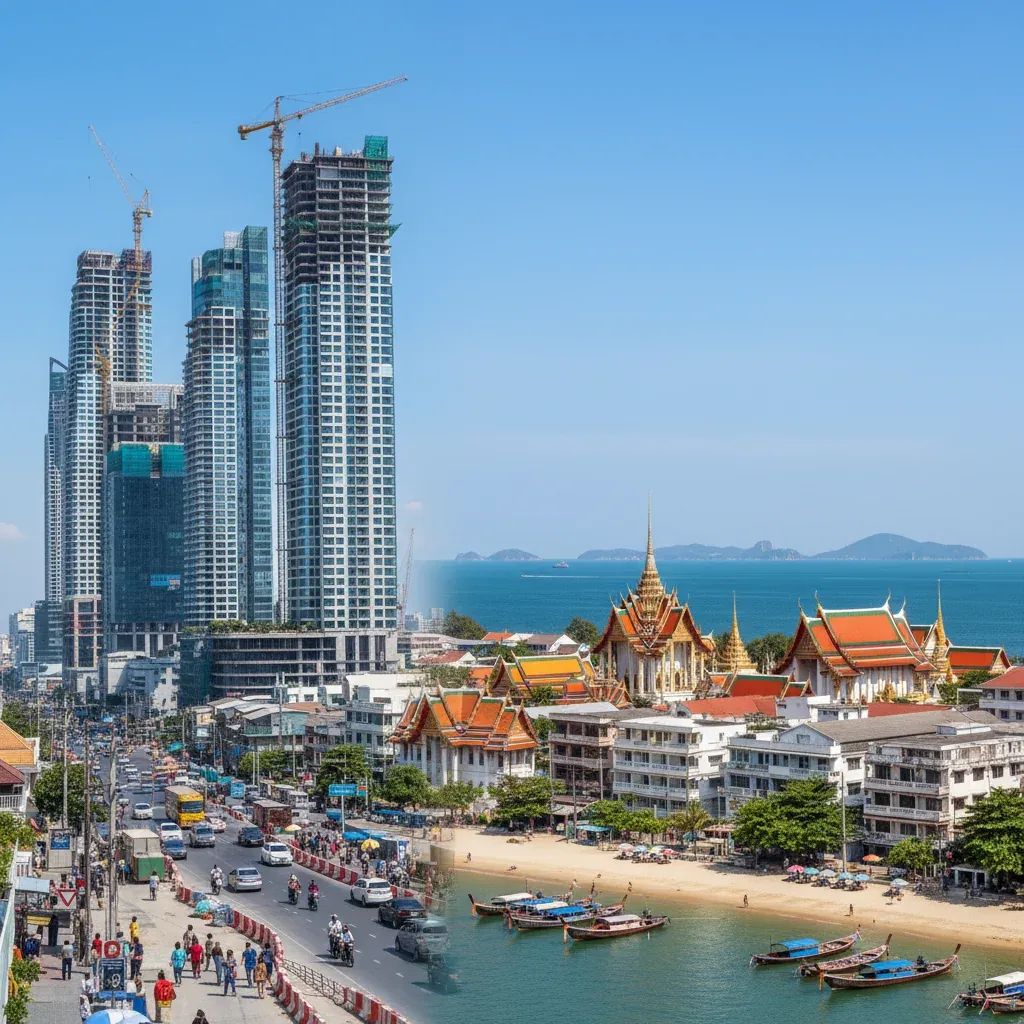
The Pattaya City administration has completed its fourth year under Mayor Poramet Ngampichet—known locally as "Beer"—with a portfolio of infrastructure work that promises to reshape the coastal hub's role within the Eastern Economic Corridor (EEC) while confronting persistent challenges that critics say demand more than incremental fixes.
Why This Matters
• Infrastructure gains: Pattaya has finished 324 km of drainage upgrades, cutting flood risk zones from 24 to three, with water clearance now under two hours in problem areas.
• Economic shift underway: The city is pivoting from mass tourism to high-value sectors including MICE, premium wellness, and digital economy services tied to the EEC.
• Unfinished business: Despite progress, residents and observers point to traffic gridlock, environmental degradation, and rising living costs as obstacles that still threaten livability.
Mayor Poramet's tenure, which began in May 2022 and runs through 2026, has prioritized a "work speaks for itself" philosophy—eschewing headline-grabbing announcements in favor of methodical project delivery. The approach has produced tangible outcomes in water supply, road connectivity, and public safety technology, yet the city's reputation as a construction site and its struggle with overtourism continue to divide opinion among long-term residents and newcomers alike.
Completed Projects Anchor the Record
Between 2023 and early 2026, Pattaya City Hall finished all planned water supply expansions, a critical achievement for a municipality that draws workers and visitors far beyond its official population. The administration also installed more than 2,500 AI-enabled CCTV cameras linked directly to the Thailand Central Investigation Bureau (CIB) database, a move aimed at deterring petty crime and scams that have long plagued foreign tourists.
The most visible accomplishment is the 16 km Railway Road project, sections of which opened ahead of Songkran in early April 2026. A stretch from Nongprue Waterworks junction to Nongket Yai junction now handles traffic, while another segment around Soi Khao Talo also went live. The full route is slated for completion by May 15, 2026, promising smoother north-south flow through a city notorious for bottlenecks.
Drainage improvements stand out: the doubling of system efficiency has transformed Pattaya's monsoon response, with floodwaters now receding in two hours instead of lingering for days. The reduction of high-risk flood zones from 24 to three represents a measurable quality-of-life gain for residents who previously faced property damage and impassable roads each rainy season.
Tourism Recovery Outpaces Pre-Pandemic Levels—On Paper
Official statistics paint a robust picture. Pattaya welcomed over 25 million visitors in 2024, up from 12.69 million in the first half alone—a 9.32% increase year-on-year. Chonburi Province, which encompasses the resort city, recorded 24.78 million tourists between January and November 2024, generating ฿264.3 billion in revenue, a 26.54% jump over 2023, according to provincial tourism data. Hotel occupancy averaged 71% throughout 2024.
Yet beneath the headline figures, a different narrative emerges. Long-term expatriates and independent business owners report that streets feel quieter than the numbers suggest. The shift reflects a changing visitor mix: domestic Thai tourists now outnumber international arrivals, and while Chinese groups remain the largest foreign contingent, they often follow tightly scripted itineraries that bypass smaller establishments. A high-profile kidnapping case involving a Chinese actor in 2025 further dented confidence among mainland visitors, even as overall tallies climbed.
Average spending per head has also declined. Inbound tours arriving by coach contribute to national statistics but spend less at street-level vendors and family-run restaurants, concentrating their baht in chain malls and pre-booked attractions. This dissonance between official growth and on-the-ground sentiment underscores the challenge of measuring tourism success by volume alone.
What This Means for Residents
For those living in Pattaya full-time—whether Thai nationals, foreign retirees, or remote workers—the fourth year of Mayor Poramet's term delivers a mixed ledger. Improved drainage and expanded water supply ease daily frustrations, and the CCTV rollout offers a modest boost to personal security. The opening of Railway Road segments will relieve commute times once the entire corridor is operational.
However, cost of living continues to climb. Residents report rising electricity tariffs, increased rental rates for residential units, and higher prices for imported goods—pressures that squeeze both households and small businesses. Traffic congestion persists despite new road capacity, as narrow side streets, limited parking, and aggressive motorcycle riders clog arteries during peak hours and festival periods. The Pattaya Monorail (Purple Line) remains in the proposal stage, offering no near-term relief.
Environmental quality lags infrastructure gains. Beaches remain littered with plastic waste, and the burning season from February to April sends air quality into hazardous territory, a recurring problem that city hall has yet to address with enforceable policy. Experts note that rapid hotel and condominium construction encroaches on green space, contributing to a claustrophobic urban feel that contrasts sharply with branding campaigns promoting "Better Pattaya."
On April 8, 2026, the administration launched a vocational skills and financial literacy program for fiscal 2026, designed to improve cost management among residents and connect them to formal credit sources—a bid to reduce household debt traps. Whether this initiative scales effectively will test the mayor's claim that inclusive growth remains central to his vision.
Economic Pivot Toward High-Value Sectors
Mayor Poramet's longer-term strategy hinges on repositioning Pattaya within the Eastern Economic Corridor, a Thailand government flagship program linking the provinces of Chonburi, Rayong, and Chachoengsao into a logistics and innovation hub. The city aims to shed its "sin city" image and attract investors in premium wellness tourism, MICE events, digital services, and sports hospitality.
Major projects in the pipeline include:
• Aquatique Pattaya: A mixed-use development near Pattaya Beach combining luxury hotels, shopping, residences, convention halls, and entertainment.
• Wongamat Beach Village: A beachfront lifestyle mall and natural park concept.
• High-speed rail: A line connecting three international airports, with construction kickoff planned for late 2025.
• U-Tapao International Airport expansion: Phase 1 began in June 2025, targeting capacity of 60 million passengers to become Thailand's third-largest gateway.
• Koh Larn Na Ban Pier upgrade: Scheduled for completion in August 2027 to ease tourist access to the island.
These ventures promise jobs and revenue, yet their success depends on factors beyond city hall's control—global economic headwinds, competition from Vietnam and Malaysia, and the willingness of central government to sustain EEC funding.
Criticism Mounts Over Piecemeal Approach
Despite the project roster, residents and urban planning experts argue that Mayor Poramet's administration favors short-term fixes over systemic reform. Drainage and road work address symptoms without tackling root causes: haphazard zoning, weak enforcement of building codes, and a lack of coherent master planning. Developers continue to erect high-rises with minimal oversight, and power lines remain above ground, creating visual clutter and maintenance headaches.
Traffic enforcement is inconsistent. Motorbikes routinely use sidewalks, parking regulations go unenforced, and pedestrian safety receives lip service in press releases but little action on the street. The city's campaign to reduce homelessness and drug abuse has yielded limited results, with visible populations persisting in public spaces due to gaps in legal frameworks and social services.
Critics also note that the city's development model prioritizes hotel chains and large developers over independent businesses and ordinary residents. Land reclamation projects in areas such as Soi Sukhumvit 19, Soi Phrompraphanimit 2, and Soi Phothisarn 6 have cleared encroachments, but the recovered parcels often serve commercial interests rather than parks or community facilities.
The perception that city hall caters to tourism operators at the expense of livability feeds frustration among expatriates and Thai families who moved to Pattaya for affordability and beach access, only to find themselves navigating a construction zone with deteriorating air quality and escalating costs.
Balancing Ambition and Execution
Mayor Poramet's "Better Pattaya" vision rests on the premise that a rising tide lifts all boats—that infrastructure upgrades, international investment, and tourism diversification will eventually yield broad-based prosperity. The completion of water, drainage, and road projects suggests the administration can execute on technical fronts when resources align.
Yet the unresolved tension between growth and sustainability threatens to undermine those gains. A city that quadruples its visitor count without commensurate investment in public transport, green space, and environmental enforcement risks pricing out the middle class and alienating the expatriate community that anchors its service economy.
The next two years of Mayor Poramet's term will test whether incremental delivery can evolve into transformative policy. The high-speed rail and airport expansion offer catalysts for reinvention, but they also raise the stakes: a city that cannot manage its current traffic, waste, and air quality may find that new infrastructure simply amplifies existing dysfunction.
For residents weighing Pattaya's trajectory, the mayor's fourth-year report card reads as "work in progress"—tangible improvements in drainage and connectivity offset by stubborn challenges in planning coherence, environmental stewardship, and cost control. Whether the administration's methodical tempo proves sufficient to realize the Eastern Economic Corridor's promise, or whether deeper structural reforms become unavoidable, will define Pattaya's next chapter as much as any ribbon-cutting ceremony.


