
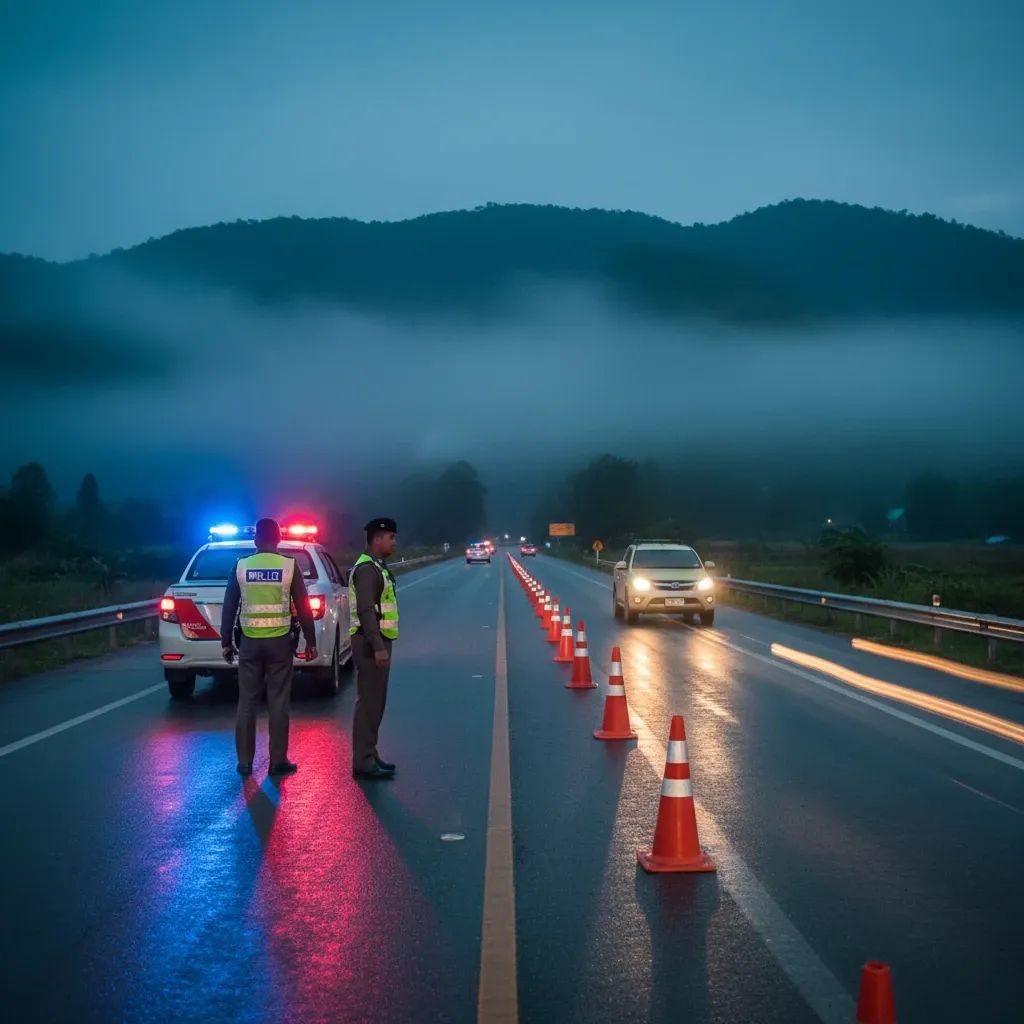
The Thailand Royal Police have charged a 54-year-old deputy inspector with murder after an off-duty shooting left a cannabis shop owner dead on Pattaya's bustling Walking Street during the final hours of the Songkran festival. The incident, which unfolded at 1:06 AM on April 19, has reignited sharp questions about alcohol-fueled misconduct within the force and whether existing disciplinary mechanisms can restore public trust.
Why This Matters:
• Immediate consequence: Police Sub-Lieutenant Jirasak Srikhathanam, known as "Sergeant Joe," has been suspended from duty and faces murder charges plus weapons violations, signaling a rare public accountability moment.
• Tourism sensitivity: The shooting occurred in South Pattaya's entertainment zone during peak Songkran celebrations, a period when over 800 officers were deployed specifically to ensure visitor safety.
• Systemic pattern: This case follows ongoing criticism of Thailand police ethics, including bribery scandals and abuse-of-power allegations that surfaced throughout 2025 and early 2026.
What Happened on Walking Street
Witnesses at the scene described a chaotic confrontation behind a cannabis retail outlet in the Walking Street entertainment district, a magnet for both Thai nationals and foreign visitors. According to eyeaccount testimony, the deputy inspector arrived heavily intoxicated and brandished an 11 mm handgun, firing at least one shot toward a nearby establishment without striking anyone.
Pattaratorn Jirachokchaikul, the 41-year-old shop proprietor, attempted to defuse the situation using the traditional "wai" gesture of respect while asking the officer to holster his weapon. Instead, the officer discharged two rounds into Pattaratorn's torso below the left side of his chest. Medics transported the victim to hospital, but he was pronounced dead shortly after arrival.
Bystanders intervened to restrain the suspect until uniformed Thailand Royal Police officers arrived. Investigators recovered the handgun and have since confirmed they are reviewing closed-circuit television footage that reportedly captures the victim's de-escalation attempt moments before the fatal shots.
The Officer and His Role
Jirasak Srikhathanam held the rank of Police Sub-Lieutenant and served as deputy inspector in the investigative division at Pattaya City Police Station. His position gave him significant authority in criminal casework, making the alleged conduct all the more troubling for residents and business operators who rely on law enforcement credibility.
According to witness statements compiled by investigators, the officer also seized Pattaratorn's mobile phone after the shooting and threw it into the sea—an action that prosecutors may cite as evidence of consciousness of guilt or an effort to destroy potential video evidence.
Charges and Immediate Fallout
Thailand Royal Police leadership moved swiftly to announce three formal charges: murder, unlawful discharge of a firearm in a public place, and carrying a weapon without lawful reason. Pattaya City Police Commander Police Colonel Enak Srathong-yu confirmed that a disciplinary board has been convened to examine the officer's conduct, a step that typically precedes permanent dismissal in cases of serious criminal allegations.
Under Thailand police regulations, officers who consume alcohol while on duty, on standby, or who become intoxicated to the point of damaging public confidence face penalties ranging from demotion to outright termination. In cases involving violent crimes committed under the influence, dismissal is standard protocol. The Royal Thai Police have codified these rules in internal disciplinary manuals, yet enforcement has historically been inconsistent, with politically connected officers sometimes escaping severe punishment.
Songkran 2026 and the Security Paradox
The shooting occurred at the tail end of Wan Lai Pattaya, the city's extended Songkran water festival that ran from April 17 through 19. More than 800 uniformed personnel had been mobilized to manage crowds, direct traffic, and respond to emergencies—an operation designed to reassure the estimated tens of thousands of revelers who flock to Pattaya's beachfront and entertainment zones each year.
Nationwide, Thailand road safety authorities reported 242 fatalities and 1,200 injuries during the official seven-day "dangerous period" from April 10 to 16, a slight improvement over 2025 figures. Speeding and drunk driving remained the leading causes. Yet the irony was not lost on observers: while rank-and-file officers staffed sobriety checkpoints and enforced the "Don't drink and drive" campaign, an investigator within their own ranks allegedly used his service weapon in a drunken rampage.
What This Means for Residents and Business Owners
For expatriates, investors, and Thai nationals living in Pattaya and greater Chonburi Province, this incident underscores three practical realities:
Legal recourse exists but requires persistence. Victims' families can file civil wrongful-death claims independently of criminal proceedings. Thailand law permits compensation suits even when the defendant is a state employee, though navigating the court system often demands legal representation fluent in both Thai administrative procedure and criminal law.
Police misconduct complaints should be documented immediately. Witnesses to officer misbehavior—especially involving alcohol or weapons—are advised to capture video evidence, record badge numbers, and file reports with both the station commander and the Office of the Inspector General of the Royal Thai Police, which maintains a separate complaints hotline. Anonymous tips can be submitted via the Thai Police Public Relations Division website.
Insurance and venue liability considerations. Business owners in entertainment districts may face increased scrutiny from insurers if their premises become the scene of violence involving off-duty law enforcement. Reviewing liability coverage and installing high-definition surveillance systems are now common risk-management steps for operators on Walking Street and similar zones.
The Broader Ethics Crisis
This shooting is the latest flashpoint in a years-long confidence crisis surrounding Thailand police integrity. In January 2026, reports emerged of officers allegedly accepting bribes to release detained Chinese nationals. Throughout 2025, social media campaigns highlighted cases of evidence tampering, bail-fund embezzlement, and rank-buying schemes.
Reform advocates have long argued that the Royal Thai Police suffer from a structural flaw: investigative authority is concentrated in senior commanders, making independent oversight nearly impossible. A legislative proposal passed by Parliament in October 2025 aimed to grant provincial governors greater supervisory powers over local stations, reducing political interference. Implementation remains uneven, however, and critics contend that meaningful change will require constitutional amendments to separate police administration from the executive branch.
The Thailand National Police Commissioner inaugurated a policy framework for the 2026 fiscal year under the slogan "1 Commitment, 6 Accelerations, 9 Advances," with one pillar explicitly dedicated to "Transparency: Accountable and Verifiable." Whether that rhetoric translates into disciplinary action against high-ranking offenders will determine whether the public perceives this case as a turning point or simply another headline.
Cannabis Commerce and the Walking Street Ecosystem
Pattaratorn's shop was one of dozens of cannabis retailers that have proliferated in Pattaya since Thailand decriminalized certain cannabis products in 2022. The regulatory environment remains fluid, with the government periodically issuing new guidelines on THC content, packaging, and marketing. Business owners in the sector occupy a legal gray zone—permitted to operate but subject to sudden enforcement shifts.
The victim's attempt to intervene peacefully, using culturally ingrained gestures of respect, has resonated widely on Thai social media. Many commentators framed his actions as emblematic of the "service mindset" common among small-business proprietors who depend on neighborhood goodwill and tourist confidence. His death has prompted calls for enhanced protections against arbitrary violence, whether from criminals or uniformed personnel.
Next Steps in the Case
Prosecutors from the Chonburi Provincial Court are expected to file formal charges within the next two weeks. Under Thai criminal procedure, the suspect can be detained for up to 84 days during the investigation phase if a judge deems him a flight risk or a danger to witnesses. Given the severity of the allegations and the public profile of the case, bail is considered unlikely.
If convicted of premeditated murder—defined under Section 288 of the Thailand Criminal Code as intentionally causing death—Jirasak faces a sentence ranging from 15 years to life imprisonment, or the death penalty if aggravating factors are proven. Weapons charges carry additional prison terms of up to 10 years.
The disciplinary board's findings will proceed on a parallel track. A guilty verdict in criminal court typically triggers automatic dismissal, but the board can also recommend sanctions—including forfeiture of pension benefits—even if the criminal case results in acquittal.
Tourism and Reputation Management
Thailand tourism authorities have worked aggressively to position Pattaya as a safe, family-friendly destination while preserving its reputation for vibrant nightlife. The city welcomed an estimated 9 million visitors in 2025, contributing roughly 180 billion baht to the regional economy. High-profile violence, especially when a law-enforcement officer is the alleged perpetrator, threatens that economic engine.
Local hotel and restaurant associations have already begun crisis-communication efforts, emphasizing that the incident was isolated and that security presence has been reinforced. The Tourism Authority of Thailand's Pattaya office issued a statement reaffirming the city's commitment to visitor safety and noting that crime rates in entertainment zones have declined 12% year-over-year when adjusted for increased tourist volume.
Final Observations
Residents of Thailand—whether long-term expatriates, retirees, or Thai nationals—understand that isolated incidents do not define an entire institution. Yet this shooting arrives at a moment when systemic police-ethics concerns have already eroded public confidence. The speed and transparency of the official response will serve as a litmus test for whether reform rhetoric can yield tangible accountability.
For those living in Pattaya and surrounding areas, the practical takeaway is straightforward: document interactions with law enforcement, know your legal rights, and consider whether additional private security measures are warranted for your residence or business. The legal framework exists to hold officers accountable, but enforcement depends on civic vigilance and a judiciary willing to prosecute without fear or favor.


