
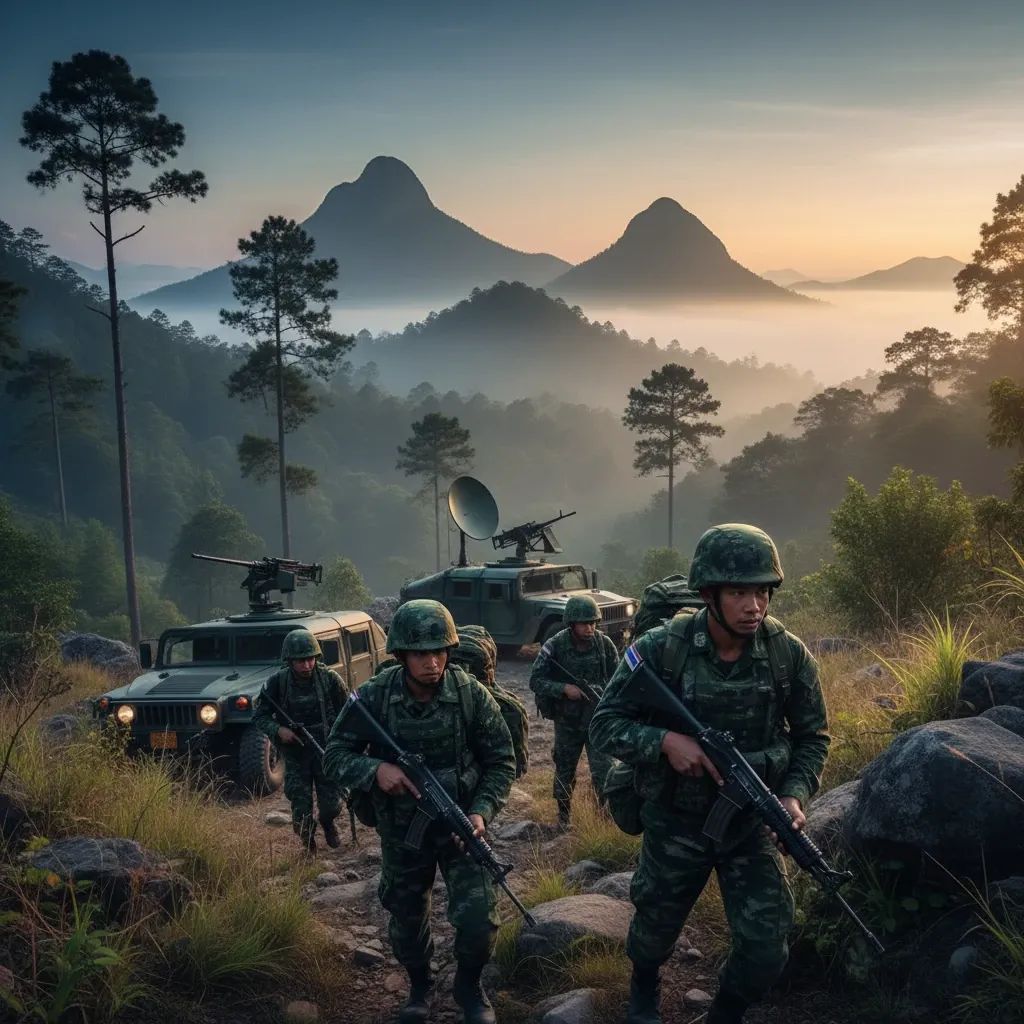
The Thailand Border Patrol Police Unit 35 has intercepted approximately 1 million methamphetamine tablets in Chiang Mai as part of an escalating crackdown that has now seized over 15.64 million pills and 254 kilograms of crystal meth across northern Thailand in just the first days of June 2026. The operation reflects an intensified enforcement posture as the Thai-Myanmar border faces what authorities describe as an unprecedented surge in drug trafficking fueled by conflict-driven production in Myanmar's Shan State.
Why This Matters
• Scale of the Crisis: Northern Thailand is now a frontline in what has become one of the world's largest synthetic drug corridors, with over 268 million methamphetamine pills seized between October 2025 and March 2026 in Provincial Police Region 5 alone.
• Resident Safety: Armed clashes between traffickers and security forces have increased, with 34 confrontations resulting in 25 suspects killed in just six months.
• Economic Impact: Assets worth over 535 million baht linked to drug offenses were frozen during the same period, signaling deep criminal infiltration into legitimate business.
The June 2026 Crackdown
Region 5 Police, working alongside Border Patrol Police Unit 35 and the Office of the Narcotics Control Board (ONCB) Region 5, announced the results of their coordinated operation on June 2. The multi-agency effort targeted trafficking routes between Myanmar and Thailand's urban centers, focusing on the mountainous border districts where criminal networks have historically exploited limited infrastructure and dense forest cover.
The 1 million methamphetamine pill seizure in Chiang Mai was one of several major incidents that week. On June 1, authorities chased a pickup truck through the Kalayaniwattana and Samoeng districts, ending when the vehicle crashed and killed its driver. Inside, police discovered 5 million methamphetamine pills—one of the largest single-vehicle hauls in recent memory. Later the same day, officers intercepted a sedan on Nimmanhemin Road, a popular commercial and tourist strip in downtown Chiang Mai, and arrested the driver with 1.544 million pills concealed inside.
Just before the start of June, on May 31, another 3.34 million pills were confiscated in the Chai Prakan district, bringing the regional total for early June operations to a staggering figure. These incidents are not isolated. On May 24, Border Patrol Police Unit 335 seized 2 million pills in Chiang Dao District, and on May 10, units under Border Patrol Police Region 3 confiscated 1.9 million pills in Mae Taeng.
Myanmar's Chaos Fuels the Pipeline
The surge is directly linked to instability across the border. Myanmar's Shan State has become the epicenter of methamphetamine production, with armed ethnic groups and criminal organizations operating synthetic drug laboratories largely unchallenged since the 2021 military coup. Producers have adapted their methods, sourcing a broad spectrum of pre-precursor chemicals—many from China—to evade international controls. The result is a long-term upward trajectory in meth output that has flooded regional markets.
Chiang Mai functions as a critical transit hub, with traffickers concealing drugs in agricultural shipments—ginger, corn, rice—and moving them in pickup trucks, fuel tankers, and modified vehicles. Land-based operations dominate, but criminal networks are diversifying, increasingly exploiting maritime routes and new infrastructure, including projects tied to China's Belt and Road Initiative, to reach markets across Southeast Asia and beyond.
Experts predict the intensity will persist throughout 2026. Ethnic minority groups in Myanmar are reportedly increasing drug production to finance their conflicts, creating a self-reinforcing cycle that Thai authorities struggle to disrupt at the source.
What This Means for Residents
For those living in Chiang Mai and surrounding provinces, the escalation carries tangible consequences. Drug usage rates in Thailand's northernmost provinces more than tripled between 2019 and 2024, fueled by the surge in supply and plummeting prices. Methamphetamine has become increasingly accessible, with purity remaining stable even as street prices drop.
Vulnerable communities, particularly hill tribe populations like the Lahu, face limited economic opportunities and are sometimes drawn into low-level smuggling, exposing them to criminal exploitation and legal risk. The increased police and military presence—while necessary for interdiction—also means more frequent checkpoints, roadblocks, and heightened scrutiny on rural transit routes.
The Thai government has designated Chiang Mai as a key pilot province in its "No Drugs, No Dealers: Toward Zero Drugs Thailand" campaign, launched in August 2025. The initiative emphasizes comprehensive coordination among the Ministry of Interior, Ministry of National Defence, Royal Thai Police, and local authorities. In January 2026, the Royal Thai Army Commander visited Chiang Mai to review operations, approving the establishment of an additional military base in Wiang Haeng to fortify border security.
Between October 2025 and March 2026, authorities handled 14,200 drug-related cases in Region 5 alone, resulting in hundreds of arrests and the confiscation of assets valued at over 535 million baht. The crackdown has been aggressive: 34 armed clashes occurred during this period, leaving 25 suspects dead. In February, soldiers killed five traffickers in Fang district after a confrontation that yielded 1.4 million pills. In March, security forces in Mae Ai killed four couriers and seized 600,000 pills.
Technology and Tactics
Thai authorities are not relying solely on boots on the ground. They are deploying mobile X-ray vehicles at checkpoints to detect concealed narcotics and using artificial intelligence to analyze trafficking patterns and track networks. The focus has shifted from isolated interdictions to dismantling entire infrastructures—targeting producers, financiers, and distribution nodes simultaneously.
Provincial police report that traffickers are adapting in kind, employing detour routes to evade checkpoints and, in some cases, ramming roadblocks. The sophistication of the networks—backed by transnational criminal organizations—poses significant challenges to regional stability and international counter-narcotics efforts.
Broader National and Regional Context
Thailand's northern border is part of a regional crisis. Between October 2025 and mid-January 2026, a four-month intensive crackdown across all of Thailand resulted in the seizure of over 330 million methamphetamine tablets, 11,008 kg of crystal meth, 1,960 kg of ketamine, and 269 kg of heroin. Over 88,000 suspects were arrested, and assets worth more than 3.39 billion baht were frozen.
In May 2026, Thai authorities dismantled a major trafficking operation, seizing 1.74 tonnes of crystal methamphetamine and 50 kg of ketamine with an estimated street value exceeding 200 million baht. The drugs had been smuggled from Chiang Rai province, underscoring the northern border's role as a primary entry point.
Thailand continues to collaborate with regional neighbors and international organizations like the UN Office on Drugs and Crime (UNODC) as part of the 2022–2026 South East Asia Regional Programme. The challenge remains formidable: the sheer volume of narcotics, the adaptability of traffickers, and the persistent instability in Myanmar ensure that the situation along the Thai-Myanmar border will remain intense for the foreseeable future.
The Road Ahead
The 1 million pill seizure in Chiang Mai is a testament to the determination of Thai law enforcement, but it is also a reminder of the scale of the problem. For residents, the crackdown offers both reassurance and disruption—protection from the scourge of addiction and crime, but also the friction of increased security measures and the sobering reality that the flow of drugs shows no signs of abating.
As production in Myanmar continues to surge and trafficking networks grow more sophisticated, the northern provinces will remain on the front lines. The Thai government's response—rooted in inter-agency coordination, technological innovation, and regional cooperation—represents a serious commitment to combating the crisis. Whether these efforts can turn the tide in 2026 and beyond will depend not only on enforcement but on addressing the root causes across the border and within vulnerable communities at home.


