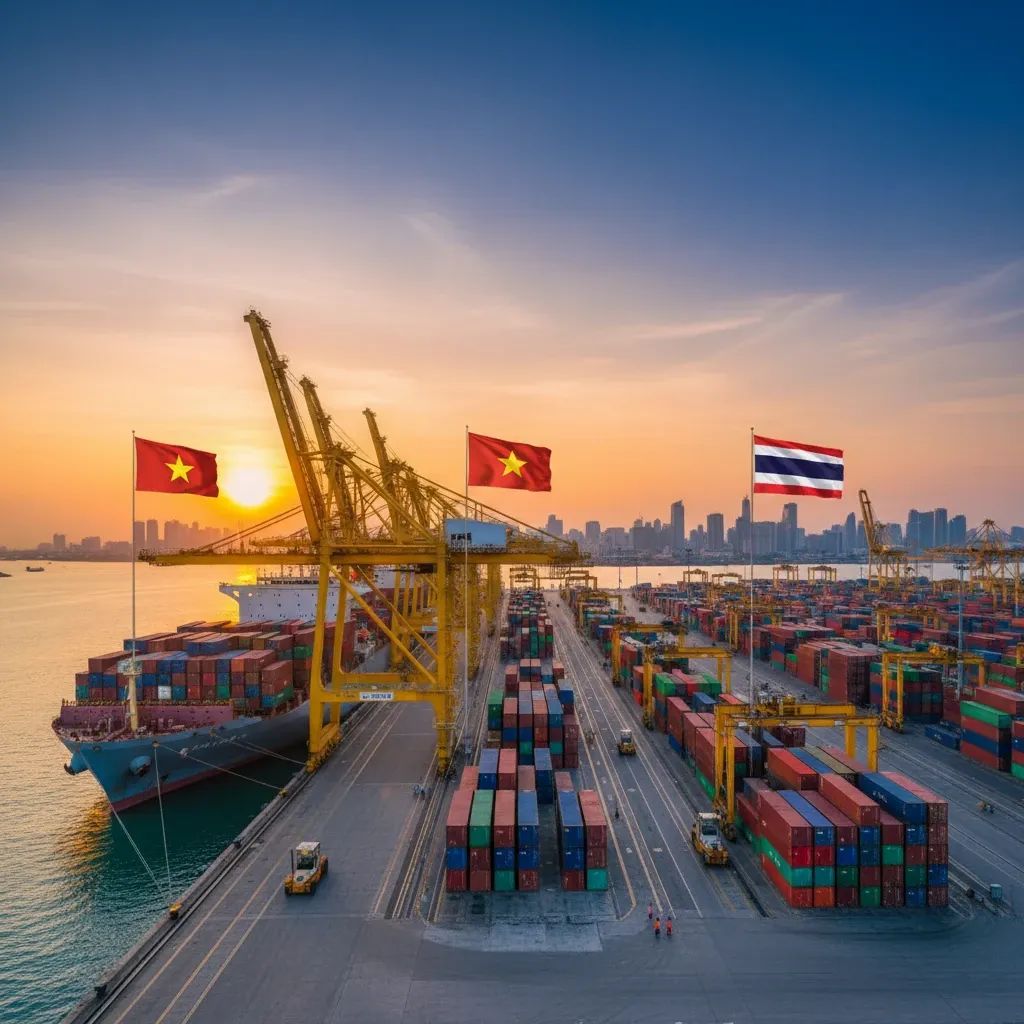
Thailand's Shrimp Sector at a Crossroads: Recovery Plans Amid Trade Turbulence and Systemic Strain
Thailand's aquaculture backbone faces a reckoning. After Malaysia blocked five shrimp species from Thai ports on June 1, the immediate export disruption threatens 4 billion baht in annual revenue, but the real story runs far deeper—a sector wrestled by disease, environmental cost, and labor standards that have constrained production growth for over a decade.
Why This Matters
• Immediate market loss: 6,000-8,000 tonnes of Thai shrimp annually (~5% of exports) now sit without a buyer; joint inspections scheduled for late July could restore trade by August if facilities pass review
• Production stagnation costs money: Output hovers around 270,000 tonnes when the sector targets 400,000 tonnes by end of 2026—a gap that costs the economy an estimated 40 billion baht annually in forgone export revenue
• Disease overhead remains brutal: Vibrio infections, white spot virus, and other pathogens force farmers to absorb higher medication and biosecurity costs, eroding price advantage against Ecuadorian and Indian competitors
• Labor and environmental verification gaps: US FDA and Malaysian authorities continue flagging antibiotic residues in certified facilities, exposing audit failures that risk premium market access
The Malaysian Suspension: Context and Timeline
The Malaysian Department of Fisheries halted imports citing food safety concerns—framed as reciprocal to Thailand's earlier restrictions on Malaysian sea bass. The five affected species (brown tiger prawn, banana prawn, whiteleg shrimp, giant tiger prawn, blue shrimp) historically account for roughly 400 tonnes monthly flowing across the border.
Officials describe this as a technical dispute, not political theater. Thai exporters must complete a comprehensive food-safety standards questionnaire, and both nations have scheduled bilateral facility inspections for late July. If production sites meet Malaysian biosecurity standards, trade is expected to resume without quota limits by month's end. The stakes are contained—the Malaysian market represents roughly 5% of Thailand's total shrimp exports—but the timing compounds existing pressures. Domestic oversupply risks triggering price collapses in Trang, Surat Thani, and other farming provinces dependent on regional sales.
Structural Rot: The Decade-Long Disease Crisis
Beyond border disputes lies the persistent challenge that has hollowed out Thailand's shrimp dominance. Early Mortality Syndrome (EMS), which ravaged farms starting in 2011, knocked production from historical peaks and handed market share to competitors who could scale faster. While the sector stabilized after 2015, emerging pathogens continue inflicting damage.
Hepatopancreatic microsporidiosis, white spot syndrome virus, yellowhead virus, and white feces syndrome force Thai farmers to spend heavily on prophylactic treatment, biosecurity infrastructure, and lost harvests. Production costs climb while export prices compress. A farmer managing disease-prone ponds operates at fundamentally different economics than one in Ecuador or India, where disease pressure and input costs skew more favorable.
The antibiotic controversy adds another layer. The US Food and Drug Administration prohibits antibiotic use in shrimp farming, yet Thai shipments refused entry to American buyers in the first half of 2026 included product from Best Aquaculture Practices (BAP)-certified facilities—raising uncomfortable questions about certification rigor. Malaysia's June suspension explicitly cited chemical residues and antibiotic contamination, signaling that international buyers are tightening tolerance for quality shortcuts.
Reorienting Export Strategy: From Regional Dependence to Global Reach
Thailand's Commerce Ministry has mobilized to offset the Malaysian loss through deliberate market repositioning. The immediate playbook targets China, Japan, and the United States, with participation in trade expos throughout late 2026. China represents particular opportunity given its massive frozen seafood appetite and current friction between US and Indian suppliers.
The European Union features prominently in medium-term planning, especially as Thailand-EU trade negotiations advance. Historically, Europe represented premium market access for Thai shrimp; recapturing that position depends on consistent quality documentation and sustainability credentials.
Domestically, the government's "Thais Help Thais Plus" initiative redirects surplus volume to local consumption channels. Retail chains in tourism-dependent provinces—Phuket, Krabi, Trang—face incentives to stock Thai shrimp, while direct purchasing hubs in major farming areas bypass middlemen who typically extract margins during supply crunches. This domestic absorption strategy buys time while export redirections materialize.
Technology and Carbon Footprints: The Modernization Imperative
Shrimp farming in Thailand is undergoing technological transition. Intensive Farming 2.0 incorporates IoT water-quality sensors, automated feeding, AI-driven disease detection, microbubble aeration, and probiotics—all aimed at lowering unit costs while maintaining herd health and reducing antimicrobial dependency. Farms adopting these systems report better survival rates and lower per-kilo production expenses.
Decarbonization has moved from compliance checklist to competitive necessity. Thai Union's lower carbon shrimp program (launched 2024) supports farms in emissions baseline assessment and adoption of low-carbon operational models. Thailand is developing a National Innovation and Investment Plan (NIIP) for aquaculture targeting climate-smart growth and resource efficiency through 2030. Innovations like ShrimpGuard—a phage-based Vibrio management tool—promise disease control without antimicrobials, addressing both sustainability and trade regulation concerns.
These investments require capital. A 5.5 billion baht National Action Plan for 2026-2030 is under government development, with a 25 million baht commitment already approved for farmer market linkages and domestic demand stimulation.
Environmental and Labor Progress, With Caveats
Thailand has made measurable headway on issues that once shadowed the sector. Mangrove conversion for shrimp farming has dropped to nearly zero, according to 2025 geospatial monitoring—a victory reflecting coordinated pressure from retailers, the Seafood Task Force, and government enforcement. Gone are the days of widespread coastal wetland destruction.
Labor reforms have similarly advanced. Processing facilities documented significant improvements by 2024 in worker wages, employment formality, and reduction of forced labor—driven by retailer pressure and Thai government action. Thailand ratified the Work in Fishing Convention (No. 188) and the Protocol of 2014 to the Forced Labour Convention, signaling institutional commitment.
Yet gaps persist. The US Department of Labor's 2026 report flags ongoing adult forced labor in Thailand's seafood sector, particularly among migrant workers. Undocumented laborers still face wage arrears, restricted mobility tied to single-employer permits, and limited access to social protection. Industry observers stress that sustaining reform requires purchasing practices that prioritize compliance over cost-cutting—a discipline that isn't universal across all buyer relationships.
What This Means for Residents and Investors
For foreign investors and business operators in Thailand, the sector's trajectory carries clear implications. If Malaysia lifts the suspension as expected by August, short-term market stability returns. But the underlying production challenge—maintaining export growth while disease and competition compress margins—will shape investment returns for aquaculture enterprises through 2026 and beyond.
Southern provinces dependent on shrimp farming (particularly those bordering Malaysia) face immediate economic pressure from export disruption. Price collapses due to oversupply would cascade through local supply chains—feed mills, ice production, equipment suppliers, transport operators. Communities built on aquaculture income absorb the shock first.
Restaurant, hospitality, and retail operators in tourism zones may benefit from domestic supply redirection. The "Thais Help Thais Plus" program could translate to lower wholesale shrimp costs in Phuket and Krabi, improving food cost margins. However, quality assurance remains a concern given antibiotic flagging—sourcing from certified, verified facilities becomes increasingly important.
For remote-work expats and investors considering aquaculture ventures, the sector offers recovery potential but demands operational rigor. Farms adopting modern disease management, biosecurity protocols, and transparent quality documentation position themselves for margin stability. Buyers increasingly scrutinize supply chain transparency; farms that can't demonstrate clean practices face relegation to commodity pricing.
The Responsible Seafood Summit in September 2026 in Bangkok will signal industry direction. Global seafood procurement leaders attending this forum will shape 2027-2028 buying criteria, determining which Thai suppliers ascend to premium access and which compete primarily on volume and price.
The Path Forward: Ambition Tempered by Reality
The Malaysian suspension may resolve quickly if joint inspections proceed as planned. But even with that market restored, Thailand's shrimp industry confronts choices that will determine its competitive position through 2030. The 400,000-tonne production target for 2026 remains ambitious—current disease burdens, production cost structures, and aging farm infrastructure make hitting that number a stretch.
Success hinges on parallel execution across three domains: managing disease through biosecurity and innovation, expanding export reach beyond traditional markets, and demonstrating labor and environmental compliance that commands premium pricing. Failure on any front compounds the others. A farm that modernizes technology but continues antibiotic shortcuts loses market access. An exporter that captures new buyers but can't maintain volume loses contract renewals.
Thailand's shrimp industry remains a significant economic asset—40 billion baht in annual exports still matters to national growth. But the days of competing primarily on low cost and geographical advantage have passed. The next phase demands precision, transparency, and sustained investment in the systems and practices that global buyers increasingly demand. The sector stands ready to move forward, but the path requires discipline alongside ambition.