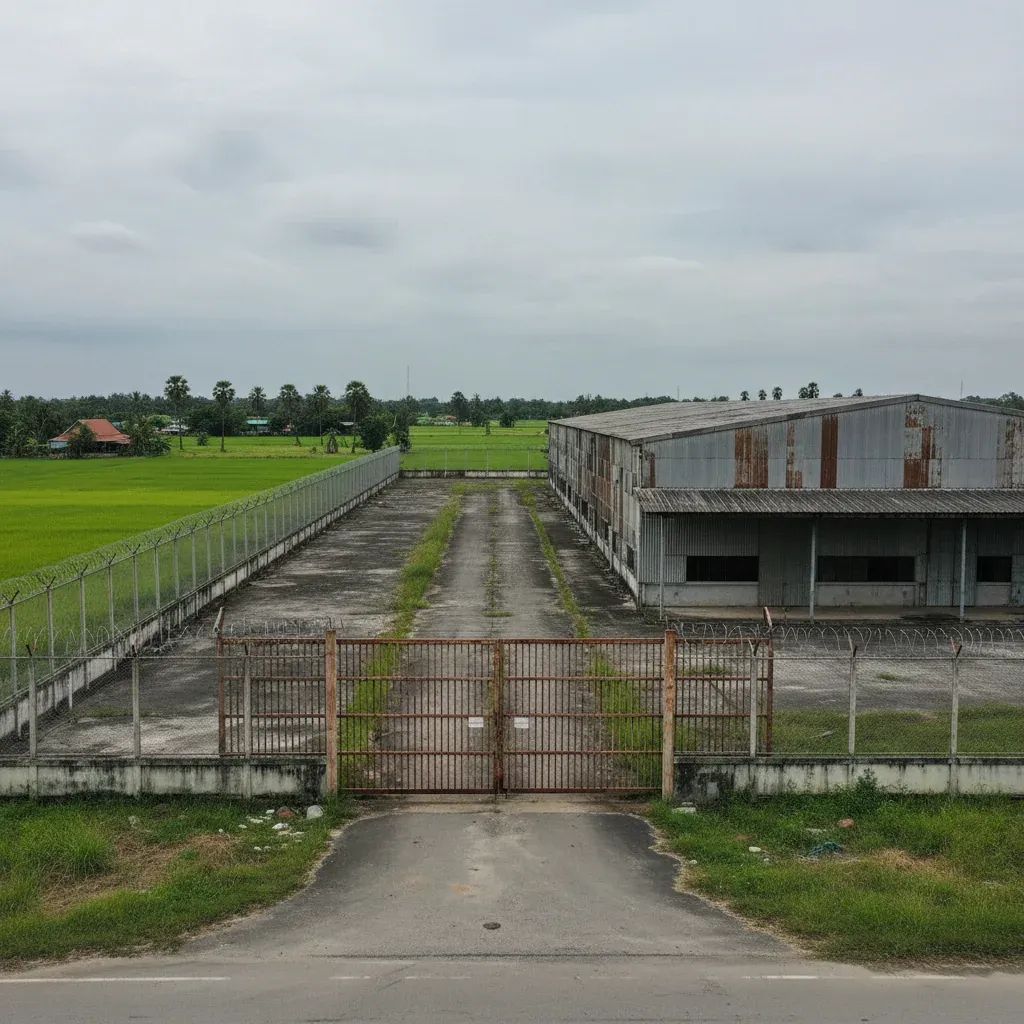
The Thailand Royal Army's Second Army Region has confirmed that two infantry soldiers suffered minor leg and ankle injuries on July 17 after triggering a degraded PMN-1 anti-personnel mine during a routine ground-clearing operation at the Phu Pha military base in Kantharalak district, Si Sa Ket province—a stark reminder that the country's northeastern frontier remains a minefield nearly five decades after regional conflicts ended.
Why This Matters:
• Unfinished business: Thailand still has 17M square meters of contaminated border territory across 6 provinces—equivalent to more than 2,300 football fields—and Thailand initially committed to complete clearance by the end of 2026 under the Ottawa Convention and has submitted an extension request.
• Two incidents in mid-July: This marks the second reported mine accident involving Thailand military personnel along the Cambodia border in mid-July of consecutive years, highlighting seasonal risks during dry-season land-clearing activity.
• New mines alleged: Thai authorities accuse Cambodia of planting fresh PMN-2 mines in disputed zones, allegations Phnom Penh denies—complicating demining efforts and bilateral trust.
What Happened at Phu Pha Base
Around 10:30 a.m. on July 17, Sergeant Major Chakkrit Buakaew and Sergeant Major Sathit Pongkaew were preparing a new firing position inside the secure perimeter of the Phu Pha installation when Chakkrit stepped on a buried explosive. The resulting blast was relatively weak—military engineers attribute the reduced force to decades of soil moisture degrading the device's chemical propellant. Chakkrit sustained compression bruising and swelling to his foot and ankle; Sathit was struck by flying soil and rock fragments. Both were evacuated to Kantharalak district hospital and discharged in stable condition the same day.
Immediately after the blast, Thailand Mine Action Center (TMAC) specialists from Humanitarian Mine Action Unit 3 swept the immediate area and recovered 19 additional PMN-1 mines scattered within a 50-meter radius—all Soviet-era designs likely emplaced during the 1980s, when Thai forces fortified border outposts against Khmer Rouge infiltration and Vietnamese troop movements.
The Scale of the Problem
The Thai-Cambodian frontier is one of Southeast Asia's most heavily mined stretches, a legacy of three overlapping conflicts: the Vietnam War spillover, the Cambodian civil war, and sporadic border skirmishes over temple sites and resource zones. According to Thailand's National Mine Action Center, the country retains approximately 2.74 square kilometers of officially designated contaminated land as of late 2025, but unofficial estimates—factoring in uncharted minefields and buffer zones—push the figure closer to 17M square meters across 15 districts in six northeastern and eastern provinces.
Across the border, Cambodia's Mine Action Center (CMAC) reported an estimated 6M unexploded mines and ordnance items nationwide as of January 2025, with the heaviest concentrations in the northwest provinces abutting Thailand. In the first quarter of 2026 alone, CMAC teams destroyed nearly 12,000 explosive remnants of war—a pace that still leaves decades of work ahead.
Combined, demining authorities estimate that millions of mines and unexploded ordnance (UXO) remain buried along the 2,557-square-kilometer Thai-Cambodian border corridor, turning routine land development, infrastructure upgrades, and even agricultural expansion into high-risk activities.
Why Clearance Has Stalled
Thailand is a signatory to the 1997 Ottawa Convention (Anti-Personnel Mine Ban Treaty), which obligates member states to clear all anti-personnel mines from their territory within a decade. Bangkok initially aimed to complete clearance by the end of 2026 and submitted an extension request earlier this year—but diplomatic friction, overlapping territorial claims, and allegations of fresh mine-laying have repeatedly derailed joint demining protocols.
Key obstacles include:
• Territorial disputes: Many mined zones lie within contested border parcels, where neither side will permit unilateral clearance without a boundary settlement.
• Fresh-mine allegations: The Thailand Royal Army claims Cambodian forces have deployed new PMN-2 mines in Thai-claimed territory since 2025—a charge Cambodia rejects, calling instead for independent expert reviews and working together professionally.
• Terrain and access: Dense jungle, monsoon flooding, and the presence of active military installations complicate survey and disposal operations.
• Funding and capacity: While international partners including Norwegian People's Aid, the Geneva International Centre for Humanitarian Demining (GICHD), and the U.S. Marine Corps Forces, Pacific have provided technical support and training, TMAC remains under-resourced for the scale of contamination.
In September 2025, the Thailand and Cambodia defense ministries agreed in principle to withdraw heavy weaponry from border flashpoints and accelerate joint demining—committees were to convene within one week to designate pilot zones. As of mid-2026, however, progress remains opaque, and ground-level coordination is fitful at best.
Impact on Residents and Development
The persistence of mines and UXO carries real economic and safety costs for communities near the border. Farmers risk injury or death when clearing land; infrastructure projects—roads, power lines, telecommunications towers—require costly pre-clearance surveys; and tourism ventures near heritage sites like Preah Vihear temple face liability and insurance hurdles. Since 2021, at least two documented military accidents have occurred in the Thai border zone, both in mid-July—a coincidence that highlights the seasonal uptick in land-clearing activity ahead of the dry season.
For expatriates, investors, and long-term residents in northeastern Thailand, the takeaway is simple: any activity involving ground disturbance in border provinces—Si Sa Ket, Surin, Ubon Ratchathani, Bueng Kan, Nong Khai, and Sa Kaeo—requires advance consultation with local military authorities and TMAC field offices. Unauthorized land clearing, even on titled property near former conflict zones, can trigger criminal liability under Thailand's Explosive Materials Act.
What the Military Is Doing Now
Following the Phu Pha incident, the Second Army Region issued fresh guidance to all border-area units, mandating comprehensive pre-activity surveys for any ground preparation, construction, or maneuver training. TMAC's Humanitarian Mine Action Units are prioritizing five pilot clearance zones within undisputed Thai territory, with plans to expand to 13 zones as resources allow. The Thai defense establishment has also submitted formal statements to GICHD, the Humanitarian Demining Research and Development program (U.S. Department of Defense), and the ASEAN Regional Mine Action Center (ARMAC), seeking independent expert reviews and technical collaboration on cross-border clearance.
On the Cambodian side, Prime Minister Hun Manet's government has endorsed a National Mine Action Policy 2026–2035, aiming to eliminate all known contaminated areas by 2030 for mines and 2035 for UXO. CMAC teams continue systematic clearance in northwestern provinces, but funding gaps and the political sensitivities of border zones slow progress.
Lessons and Next Steps
The July 17 incident underscores an uncomfortable truth: even within ostensibly secure military installations, the explosive residue of Cold War-era proxy conflicts remains a lethal threat. The fact that 19 additional mines were found in a supposedly cleared base perimeter raises questions about survey rigor and on-the-ground knowledge from that era—many current-generation officers and engineers lack firsthand experience with 1980s minefield layouts, and paper records are incomplete or lost.
For Thailand to meet its Ottawa Convention obligations—and for border communities to reclaim productive land—three steps are essential:
Diplomatic breakthrough: Bangkok and Phnom Penh must finalize a technical protocol for joint survey and clearance in disputed zones, setting aside sovereignty claims long enough to map and neutralize hazards.
Increased funding: Demining is labor-intensive and expensive. Thailand's defense budget allocates a fraction of 1% to mine action; scaling up TMAC's operational capacity will require either redirected military spending or expanded international donor support.
Public awareness: Residents, developers, and local officials in the six affected provinces need accessible, up-to-date hazard maps and clear protocols for reporting suspect ordnance—many injuries occur because villagers lack knowledge or fear bureaucratic entanglement.
The soldiers injured at Phu Pha were fortunate; the mine's age and moisture exposure had sapped its lethality. But as long as millions of explosive devices remain buried along the border, luck will run out. The only durable solution is methodical, transparent, and cooperative clearance—a goal that remains, for now, aspirations rather than action on the ground.