
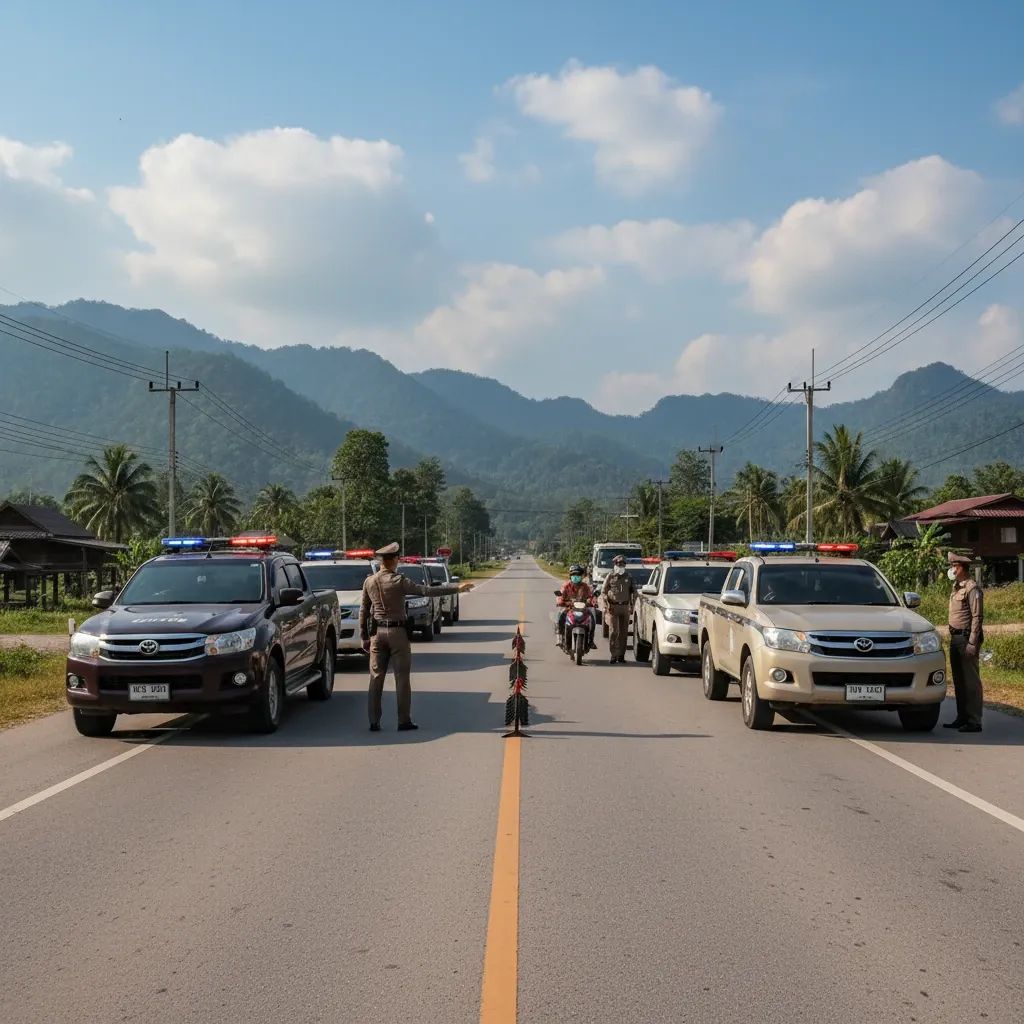
The Thailand Royal Police in Chiang Rai Province have arrested 3 suspects and seized 1.6 million methamphetamine pills during a late-night interdiction operation in late April 2026, underscoring the province's enduring role as a critical transit corridor for narcotics flowing from the Golden Triangle into Southeast Asia's distribution networks.
Why This Matters:
• Volume escalation: Drug seizures in northern Thailand have surged significantly year-over-year, with the Border Command for Drugs, Precursors, and Chemicals (NBC 35) reporting over 319 million meth pills confiscated in the first half of 2026.
• Local impact: Chiang Rai's border districts—Mae Sai, Mae Fah Luang, Chiang Saen—remain primary entry points for traffickers exploiting terrain and cross-border ties.
• Regional enforcement: Authorities intercepted the suspects as they attempted to transport the narcotics from Mae Chan district to neighboring Phayao province, part of a broader southern distribution route.
The Interdiction
Officers from Mueang Chiang Rai Police Station stopped a pickup truck in the early hours following intelligence that the vehicle was carrying contraband from a northern border zone. Inside the cargo bed, investigators discovered 7 large sacks containing approximately 1.64 million meth tablets, valued at tens of millions of baht on domestic and regional black markets.
The three detainees—identified as Phaibun (male), Kanchanaa (female), and Nam-Oi (female)—claimed they had been hired to move the cargo but professed ignorance of its contents. Subsequent drug screening revealed both women tested positive for recent methamphetamine use, complicating their defense. All three face charges under Thailand's Narcotics Act, which prescribes severe penalties for trafficking offenses involving quantities above commercial thresholds.
Chiang Rai's Place in the Trafficking Ecosystem
Chiang Rai sits at the apex of the Golden Triangle, where Thailand, Myanmar, and Laos converge—a region historically synonymous with opium but now dominated by industrial-scale methamphetamine production. According to Thailand's Office of the Narcotics Control Board (ONCB), more than half of all meth seized across East and Southeast Asia in 2024 was intercepted within Thailand alone, with the lion's share entering via northern checkpoints.
In recent months, Chiang Rai has witnessed a cascade of major busts, according to regional police reports:
• January 12: Pha Muang Task Force seized 500,000 pills in Chiang Saen district following a firefight with smugglers.
• January 24: Border Patrol Police confiscated 6 million pills in Wiang Chiang Rung after a high-speed chase ended with suspects' vehicle plunging into a canal.
• February 10: Authorities recovered 240 kg of crystal methamphetamine ("ice") in Mae Sai after a truck fled a checkpoint.
• February 18: Naval riverine units found 9 million pills abandoned in a pickup along the Mekong River in Chiang Saen.
• March 23: Regional Police Bureau 5 announced a coordinated northern operation netting 21 million pills and 320 kg of ice, with significant cases linked to Chiang Khong and Wiang Chai districts.
• April 4: A firefight in Mae Fah Luang yielded 4.3 million pills, though suspects escaped into jungle terrain.
What This Means for Residents
For those living in northern Thailand, the escalation reflects both heightened enforcement pressure and significant narcotics flow from clandestine labs across the Myanmar border. The Thai government has responded with layered countermeasures:
Enhanced border surveillance: Deputy governors have ordered round-the-clock checkpoints along frontier roads, particularly during holiday periods when smuggling activity spikes.
Technology integration: Police Bureau 5 has deployed artificial intelligence analytics to map trafficking networks and predict movement patterns, contributing to increased seizure activity.
Community screening: Stations like Ban Du in Chiang Rai continue "Sustainable Village X-ray" programs to identify and rehabilitate local users, disrupting demand at the grassroots level.
International cooperation: Thailand's ONCB and the U.S. Drug Enforcement Administration co-hosted the Regional IDEC 2026 conference in Chiang Rai from March 30 to April 3, convening intelligence officers from across the Mekong region to share tactical data on transnational syndicates.
The Broader Enforcement Picture
Nationwide, Thai police have reported coordinated enforcement efforts in the recent period, with the northern theater accounting for a disproportionate share of interdictions. The Border Command for Drugs, Precursors, and Chemicals (NBC 35) reported significant confiscations in its first half-year tally, alongside multiple seizures of ice, ketamine, and heroin across the region.
Traffickers have adapted by diversifying routes—using forest trails, riverine drop points, and decoy convoys—but authorities have countered with multi-agency task forces. The Pha Muang Force, Border Patrol Police (BPP 327), and regular provincial officers now operate in overlapping grids, reducing the window for smugglers to exploit gaps.
Suspect Profiles and Network Dynamics
Interrogation of recent arrestees reveals a tiered hierarchy:
Low-level couriers: The trio captured in this latest bust typify hired drivers with minimal criminal records, often recruited from economically marginal communities. Compensation ranges from 50,000 to 100,000 baht per run, deposited via cash drops to evade financial surveillance.
Mid-level brokers: Police have arrested traffickers coordinating bulk shipments from northern staging areas to southern provinces. Investigators have linked such individuals to significant consignments and traced cash transfers through informal channels.
Cross-border facilitators: Myanmar authorities have extradited Thai nationals connected to major trafficking operations, including individuals supplying substantial quantities per shipment to lower northern provinces. Some specialized in sourcing from Myanmar labs for distribution around Chiang Mai.
Tactical Realities
Recent operations underscore the armed resistance traffickers are willing to deploy. Encounters between authorities and smuggling convoys have resulted in gunfire exchanges, with police recovering significant quantities of narcotics and precursor chemicals. Such clashes pose risks not only to law enforcement but to civilian bystanders in rural areas where jungle trails intersect farming villages. Provincial authorities have issued public advisories urging residents to report suspicious nighttime vehicle movements and to avoid interference if armed encounters occur.
Economic and Social Ripple Effects
The methamphetamine trade imposes tangible costs on northern communities:
Public health burden: Emergency rooms in Chiang Rai, Chiang Mai, and Phayao report sustained caseloads of overdose patients and chronic users seeking detox, straining provincial healthcare budgets.
Agricultural labor disruption: Addiction among seasonal workers reduces farm productivity, particularly during harvest cycles for rice, tea, and longan crops.
Property and safety concerns: Villages near known transit routes experience elevated theft rates as users seek funds, while law enforcement operations in remote areas occasionally create disruptions for nearby residents.
Forward Outlook
Chiang Rai's role as a narcotics gateway is unlikely to diminish absent significant political change in Myanmar's Shan State, where militia-controlled lab complexes churn out tablets by the millions. Thai officials acknowledge the challenge is less about domestic production—virtually nonexistent—than about interdicting cross-border flows before they disperse into the country's interior.
Recent regional forums have yielded commitments to synchronize patrol schedules along shared waterways and to harmonize legal frameworks for asset forfeiture, though implementation remains uneven. The enforcement operations have demonstrably tightened supply chains at certain points, but the volume of seizures confirms that traffickers retain substantial reserves and logistical flexibility.
Ultimately, the latest 1.6 million-pill bust represents a significant enforcement success and reflects the ongoing intensity of drug trafficking interdiction operations in the region, shaped by Chiang Rai's geographic position within striking distance of the Golden Triangle's northern frontier.


