
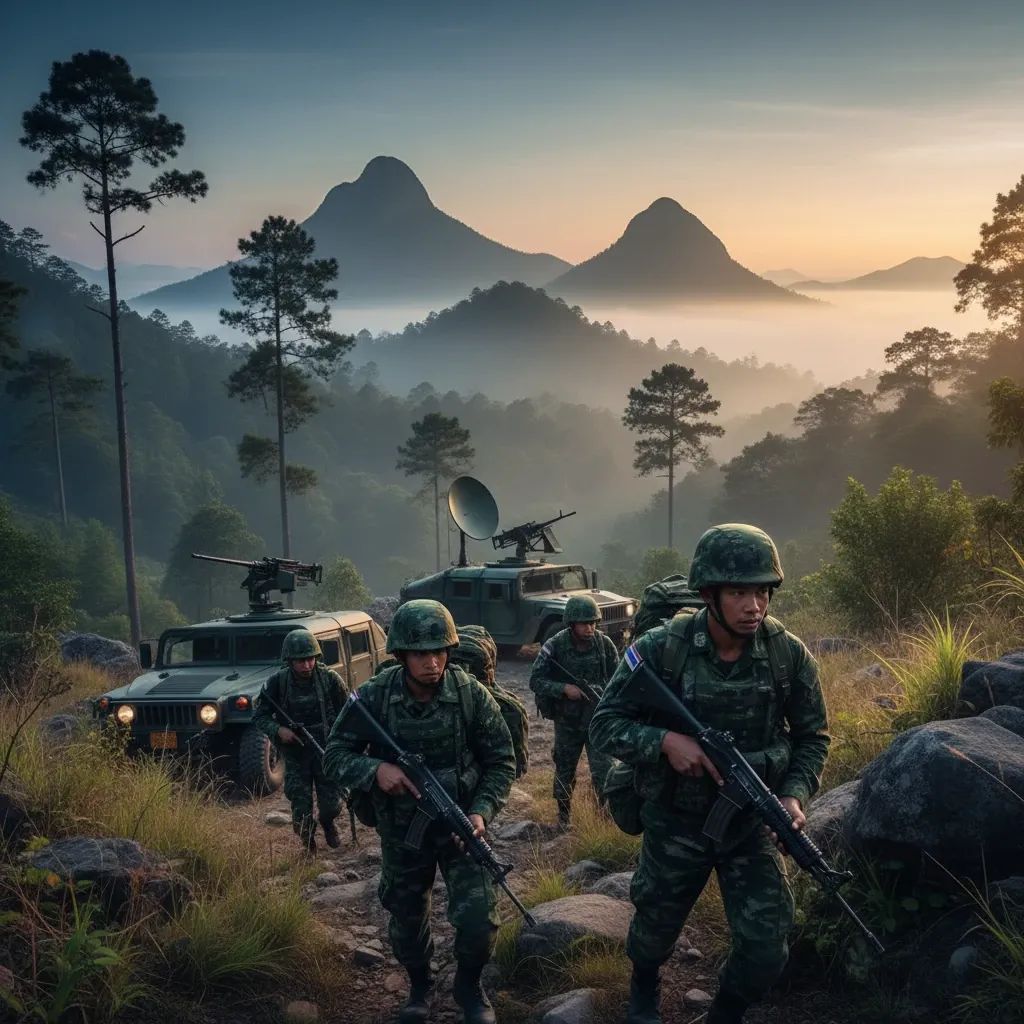
The Thailand Royal Army's Pha Muang Task Force has intercepted nearly 4 M methamphetamine pills and close to 5 kg of raw opium stashed in a remote jungle hut near the Myanmar border in Chiang Mai province. The seizure, executed overnight between April 11 and 12, 2026, underscores the accelerating cat-and-mouse game between Thai security forces and transnational narcotics syndicates exploiting the porous northern frontier.
Why This Matters
• Border vulnerability exposed: The hut, located at the tail end of Piang Luang village in Wiang Haeng district, served as a temporary narcotics waystation—a pattern increasingly common along the Thai-Myanmar border.
• Suspects escaped: Two individuals guarding the stash fled into the jungle before troops arrived, highlighting the logistical sophistication of these networks.
• Record seizure trend: This bust is one of dozens this year; authorities have confiscated over 182 M meth pills and 3,282 kg of crystal meth in the north since October 2025.
• Economic damage averted: Had the drugs reached Bangkok, estimated street value would exceed 31 billion baht in economic harm, according to military estimates.
The Jungle Hut Operation
Acting on intelligence that traffickers were staging narcotics near the Thai-Myanmar borderline, soldiers from the Pha Muang Task Force raided a makeshift shelter in Piang Luang subdistrict. The location is a known corridor for cross-border smuggling, where syndicates exploit dense forest cover and minimal surveillance infrastructure.
Inside the hut, troops discovered 3.96 M methamphetamine tablets bundled in sacks alongside 4.8 kg of unprocessed opium. The drugs were arranged for onward transport, likely destined for distribution hubs in Bangkok and the Northeast. Two suspects—one male, one female—were reportedly stationed at the site but vanished into the surrounding jungle before troops could secure the perimeter.
The Thailand Army has not released names or nationalities but confirmed the investigation is ongoing with border patrols intensified in adjacent areas.
Northern Thailand's Drug War Intensifies
This seizure is far from an isolated event. Since October 2025, the Thailand Border Patrol Command and affiliated units have recorded 299 narcotics interdictions across the northern provinces, resulting in 302 arrests and 35 suspected traffickers killed in armed clashes. The volume of seized drugs has surged 86.67% year-on-year, reflecting both increased enforcement capacity and an uptick in smuggling attempts.
Recent Major Busts in Chiang Mai and Chiang Rai
• March 31, 2026: A firefight in Fang district, Chiang Mai, left 8 traffickers dead and yielded 289 kg of crystal meth and over 1 M meth pills.
• March 20, 2026: Troops intercepted 5.7 M pills in Chiang Dao district, one of the largest single hauls this year.
• February 2026: Police in Chiang Rai seized 9 M pills abandoned in a pickup truck near the Mekong River, part of a network smuggling via Laos.
• March 16, 2026: A coordinated operation in Mae Rim district dismantled a packaging facility, seizing 13 M pills and arresting 7 suspects with assets worth 30 M baht frozen.
The Thailand Office of the Narcotics Control Board (ONCB) estimates that between October 2025 and April 2026, northern interdiction units confiscated 319.6 M meth pills, 6,709 kg of crystal meth, 659 kg of ketamine, and 60 kg of heroin. Meanwhile, the Northeast border command reported parallel seizures of 100 M pills and 7 tons of ice over the same period, indicating traffickers are diversifying routes to avoid northern checkpoints.
What This Means for Residents
For anyone living in or traveling through northern Thailand, the surge in narcotics trafficking carries tangible risks beyond law enforcement headlines:
Increased Military Presence
• Expect more roadblocks, random vehicle searches, and military patrols in Chiang Mai, Chiang Rai, Mae Hong Son, and adjacent border districts. Residents should carry ID and vehicle registration at all times.
Safety Warnings
• Armed clashes between soldiers and traffickers occur regularly in remote areas. Hikers, adventure travelers, and rural residents in Wiang Haeng, Fang, Mae Ai, and Chiang Dao should avoid unmarked trails and report suspicious activity to local authorities.
Legal Risks for Property Owners
• Landlords renting homes, warehouses, or agricultural land near the border face legal liability if tenants use premises for narcotics storage. Police are increasingly targeting "safe house" networks in suburban Chiang Mai and Chiang Rai.
Economic Ripple Effects
• The Thai government estimates that if intercepted drugs reach urban markets, they generate billions in illicit revenue, fueling organized crime, money laundering, and violence in residential neighborhoods.
Why Myanmar's Shan State Drives the Crisis
The Thailand-Myanmar border has become a narcotics flashpoint largely due to instability in Shan State, the world's largest methamphetamine production zone. Since Myanmar's 2021 military coup, armed ethnic groups and militias have turned to drug manufacturing as a primary revenue source, with some factories capable of producing 100,000 pills per hour.
Shifting Smuggling Routes
Traditionally, traffickers moved drugs south through Chiang Mai and Chiang Rai into central Thailand. However, authorities report a significant uptick in Northeastern routes, with syndicates increasingly using the Mekong River to ferry narcotics via Laos into Nakhon Phanom, Nong Khai, and Mukdahan. Maritime routes through the Andaman Sea and Gulf of Thailand are also expanding, with speedboats and fishing vessels transporting ton-scale shipments to regional markets.
Myanmar's Crackdown—And Its Limits
In January 2026, Myanmar's military conducted a historic raid in Shan State's Hsai Hseng township, seizing 377 M pills and 37.8 tons of crystal meth. A March 2026 operation in Myawaddy netted 173 M pills and 260 kg of ice destined for Thailand. Yet these seizures have done little to stem the flow; production simply shifts to new locations, and trafficking networks adapt by fragmenting shipments and diversifying transit routes.
The Legal and Operational Reality
Thailand's anti-narcotics laws impose severe penalties: possession of more than 20 grams of methamphetamine can trigger life imprisonment or the death penalty if deemed intent to distribute. For opium, any quantity for sale or export carries a minimum 5-year sentence. The government has prioritized interdiction over rehabilitation, with the Royal Thai Army taking an increasingly prominent role in border enforcement.
The Pha Muang Task Force, which executed the Wiang Haeng raid, is a specialized unit trained for jungle warfare and counter-narcotics operations. Its mandate includes not only seizure but also intelligence gathering and cross-border coordination with Myanmar and Laotian counterparts—though cooperation with Myanmar's junta remains politically sensitive.
Regional Cooperation and Challenges
The United Nations Office on Drugs and Crime (UNODC) continues to facilitate intelligence-sharing between Thailand, Myanmar, and Laos, but enforcement remains uneven. Corruption, porous borders, and limited infrastructure hinder sustained suppression. Traffickers exploit legal gray zones, using agricultural vehicles to conceal shipments and hiring local villagers as couriers, who often face coercion or economic desperation.
For Thailand, the significance is considerable: narcotics not only fuel organized crime but also contribute to public health crises, with meth addiction rates climbing in rural provinces. The government has pledged a "comprehensive approach" combining interdiction, treatment, and alternative livelihood programs for border communities—though funding and political will remain inconsistent.
What Happens Next
Authorities are expanding search operations around Piang Luang and have issued alerts for the two suspects who fled the hut. Forensic teams are analyzing the seized opium to trace its origin, likely a poppy field in northern Shan State. The meth pills will be destroyed under supervised incineration protocols.
For residents in northern Thailand, enforcement activity continues to intensify, and the border remains a volatile zone. Stay informed, avoid risky areas, and expect heightened security measures as the government increases enforcement ahead of the rainy season, when jungle cover makes smuggling easier and detection harder.


