
Why Border Seizures Keep Missing the Real Problem
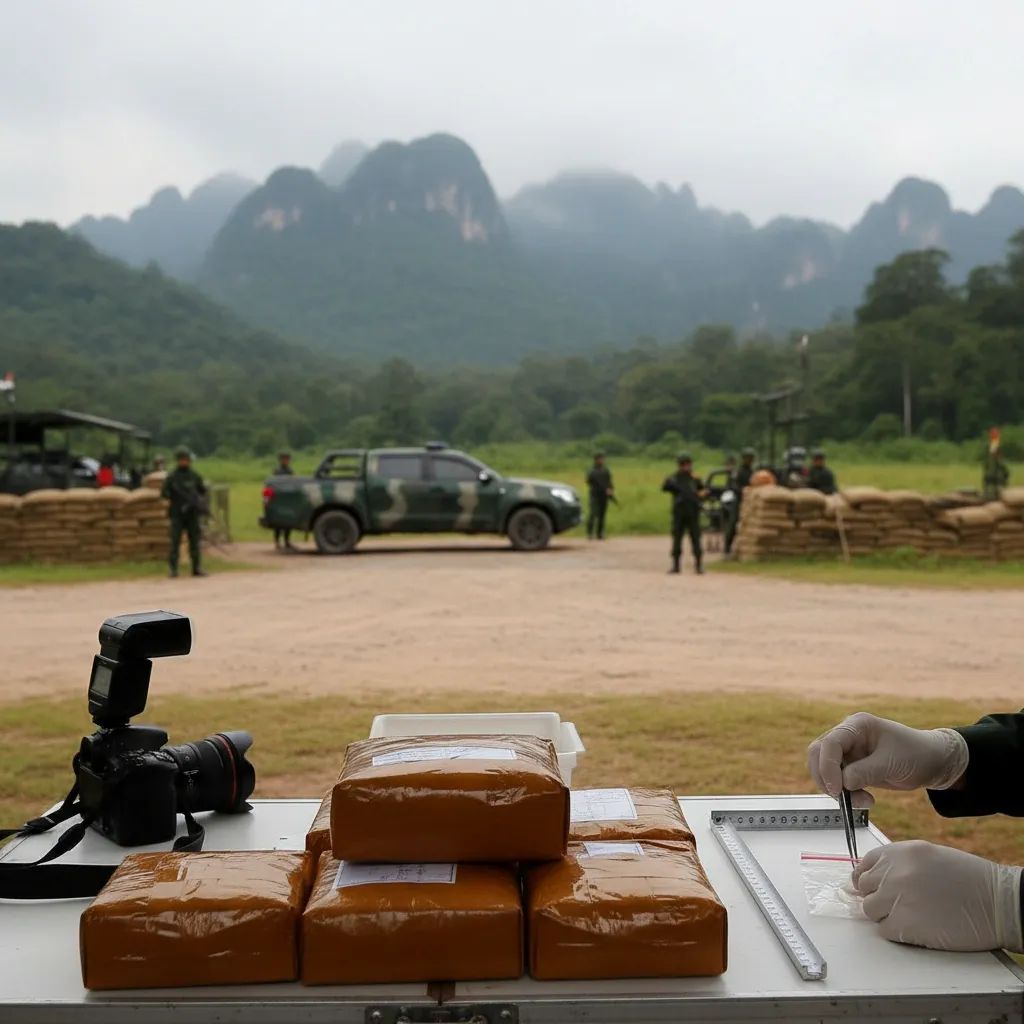
The Thailand Royal Army intercepted 92 kilograms of crystal methamphetamine during a firefight with traffickers in Mae Sai district on Sunday—a confiscation that reads as a tactical win but masks a far deeper failure. This single bust, while significant in isolation, represents barely a fraction of the synthetic drug flow now saturating northern Thailand and illustrates precisely why military and law enforcement officials privately acknowledge the crisis has become unmanageable.
Why This Matters:
• Checkpoints will intensify — Border security operations continue escalating, with military and law enforcement conducting frequent armed operations along the Chiang Rai frontier, directly affecting civilian travel and commerce in the region.
• Street prices are collapsing — Methamphetamine pills now sell for as little as ฿5 at the factory gate and ฿20-30 within Thailand, making the drug accessible to younger demographics and compounding public health burdens for northern communities.
• Significant quantities of narcotics await smuggling attempts — Current intelligence suggests the confiscated cargo represents a tiny fraction of what law enforcement expects will cross successfully in coming weeks.
The Sunday Engagement and What It Reveals
Soldiers from the Thailand's Pha Muang Task Force clashed with armed traffickers along the Myanmar frontier during early morning patrols, recovering the crystalline payload after suspects fled into jungle terrain. The engagement itself—brief, fierce, and ultimately successful—follows a pattern that has become numbingly routine in Chiang Rai province.
What makes Sunday's operation noteworthy isn't the seizure itself but rather what enforcement data reveals about everything else getting through. Between October 2024 and mid-April 2025, the Pha Muang Task Force alone intercepted approximately 149M methamphetamine pills, 8,120 kilograms of crystal methamphetamine, and 145 kilograms of heroin. On March 6, forces captured 600 kilograms of ice and 104 kilograms of ketamine in Mae Fa Luang district. By late February, the Mekong River Patrol Unit seized 9M pills in a single interdiction. Early April brought another confiscation of 4.3M pills from a crashed pickup truck in the same district.
These seizures represent a fourfold increase compared to the identical eight-month period in the previous year, according to assessments by the Thailand Office of the Narcotics Control Board (ONCB) and military intelligence units. Yet officials themselves concede this explosive growth in confiscations signals not successful suppression but expanding supply.
How Geography Amplifies the Crisis
The Thailand-Myanmar frontier in Chiang Rai province operates as one of the world's most active narcotics corridors, shaped by geography and geopolitics in equal measure. Myanmar's Shan State—particularly the northern regions adjacent to China—remains the primary manufacturing hub. Production facilities operate with minimal interference, benefiting from a steady flow of precursor chemicals sourced through Chinese suppliers and distributed via a fragmented territorial landscape where competing armed factions control territory but lack centralized control.
Trafficking networks have evolved tactically. Initial enforcement pressure on traditional overland routes through Mae Sai and Wiang Kaen districts prompted diversification. Traffickers now deploy "ant armies"—large groups of porters, each carrying 20 to 30 kilograms through remote jungle paths—coordinating pickups at prearranged locations. The Mekong River has emerged as a critical secondary corridor, with small boats departing from northern Shan State and making clandestine landings along the Chiang Rai and Chiang Saen riverbanks during nighttime hours when monitoring capacity diminishes.
The economic logic driving this expansion is straightforward. Synthetic methamphetamine production costs a fraction of traditional heroin manufacturing. Pills costing ฿5 to produce in Myanmar command ฿20-30 at the Thai border, climb to ฿100-200 in Bangkok, and fetch exponentially higher prices in Malaysian, Australian, and Japanese markets. Crystal methamphetamine margins exceed these figures substantially, making the risk-to-reward calculus favorable despite intensified enforcement.
What This Means for Residents
Northern Thailand communities, particularly those in Chiang Rai and Chiang Mai provinces, experience the drug trade in immediate, tangible ways that transcend headline seizures.
Roadblocks have become normal infrastructure. Routes 1 and 1089 approaching border districts now feature routine military and police checkpoints where documents are inspected, vehicles are searched, and delays of 30 minutes or longer occur during peak hours. Residents commuting to work, transporting agricultural products, or traveling between districts encounter these operations daily. Businesses dependent on cross-border commerce face unpredictable delays and heightened scrutiny.
The Thailand Cabinet's "SEAL-STOP-SAFE" policy—designed to seal borders, stop internal distribution networks, and provide treatment access—has translated operationally into visible security infrastructure. Barbed wire installations, observation posts, and permanent military encampments now mark rural landscapes in districts like Mae Sai, Chiang Saen, and Mae Chan.
More consequentially, the plummeting street price of methamphetamine has created a public health emergency. Where the drug once remained economically inaccessible to many younger users, current pricing places it within reach of teenagers and unemployed urban populations. Local hospitals report rising addiction admissions among 15-to-25-year-old demographics. Schools have implemented urine-testing protocols. Community leaders report visible increases in substance-use disorders in provincial towns.
Border clashes and enforcement operations continue to generate sporadic violence in remote areas and underscore the serious weaponry within smuggling networks. For residents in these frontier communities, this reality shapes daily awareness and security concerns.
The Production Pipeline and Supply Chain Economics
Myanmar's civil conflict—intensified since 2021—has fundamentally reshaped narcotics economics. Competing armed groups now depend heavily on drug revenue to purchase weapons and sustain operations. Ethnic militias, military-affiliated enterprises, and transnational criminal syndicates operate production facilities with tacit territorial tolerance. The United Nations Office on Drugs and Crime (UNODC) has documented that this conflict-driven production surge represents the largest methamphetamine manufacturing capacity globally.
Precursor chemical sourcing has similarly adapted. While international regulations restrict acquisition of key components, Chinese suppliers continue exports to Myanmar through legal-trade camouflage and informal channels. Once in Myanmar, these chemicals flow to production labs concentrated in northern Shan State, where proximity to Chinese border crossings facilitates raw material arrival and finished product distribution.
The trafficking pathway mirrors the supply chain's sophistication. Small shipments originate from multiple production sites, consolidate at transit hubs, and funnel toward Thai border crossing points through a variety of intermediate handlers. Some movements involve armed convoys moving in daylight along recognized routes, relying on coordination with corrupt local officials or military units. Others employ the "ant army" methodology—dispersed porters reducing per-unit seizure vulnerability. River movement occurs during seasonal windows when water levels permit navigation.
Internal Thai distribution operates through separate networks. Border seizures represent product destined for Bangkok-based wholesalers, Malaysian syndicates, or international markets. Intelligence assessments suggest approximately 30-40% of intercepted cargo was destined for domestic consumption, while the remainder targeted transshipment through Thailand toward wealthier markets in Southeast Asia and beyond.
How Enforcement Agencies Operate—and Why It's Failing
The Thailand Royal Army, particularly the Pha Muang Task Force and Chao Tak Special Task Force, maintains permanent forward bases along the most vulnerable border sections. Daily patrols, temporary checkpoints, and coordination with Royal Thai Police Region 5 and provincial police commands represent the operational front line.
When seizures occur, chain-of-custody procedures dictate that military units document and photograph confiscations, transfer evidence to Thailand National Police investigators, and support prosecution proceedings. Large confiscations undergo public destruction ceremonies orchestrated by the ONCB, designed to demonstrate governmental resolve and theoretically deter trafficking networks.
Yet the mathematics underlying enforcement failure illuminate why officials describe the situation as surpassing institutional capacity. Monthly interdiction rates have stabilized around 15-20 tons of assorted narcotics regionally—a volume that represents a limited percentage of estimated trafficking flow, according to ONCB internal assessments.
Procedurally, enforcement operates reactively. Patrols discover shipments already in motion. Intelligence collection depends heavily on informants whose reliability fluctuates. International coordination with Myanmar authorities remains inconsistent, hampered by political instability and competing interests within Myanmar's fragmented governance structure. Cross-border operational coordination exists in principle but functions haltingly in practice.
The Structural Problem Nobody's Solving
The fundamental limitation confronting Thailand law enforcement and military agencies centers on production capacity in Myanmar, not interdiction effectiveness in Thailand. As long as civil conflict continues and armed groups depend on narcotics revenue, manufacturing will persist at volumes exceeding Thailand's interception capability.
The United Nations Office on Drugs and Crime has repeatedly emphasized that escalating seizure rates—regardless of absolute quantities confiscated—indicate expanding supply rather than successful suppression. Put plainly: the 92 kilograms seized Sunday, while representing effective field operations, simultaneously suggests hundreds of similar shipments likely crossed successfully in recent days.
For northern Thailand residents, this translates into a structural permanence. Military checkpoints will remain fixtures of daily life in border provinces. Sporadic enforcement operations will continue, generating headlines before fading from attention. Street-level drug accessibility will persist at historically low prices, sustaining public health challenges for local medical systems already stretched thin.
The official characterization of the crisis as "beyond manageable" represents less hyperbole than frank institutional acknowledgment. Enforcement agencies possess neither the personnel, budget, nor international leverage to substantially alter trafficking volumes while production capacity in Myanmar remains unchecked. The seizure in Mae Sai—successful as an isolated operation—exists as a symptom rather than a solution.


