
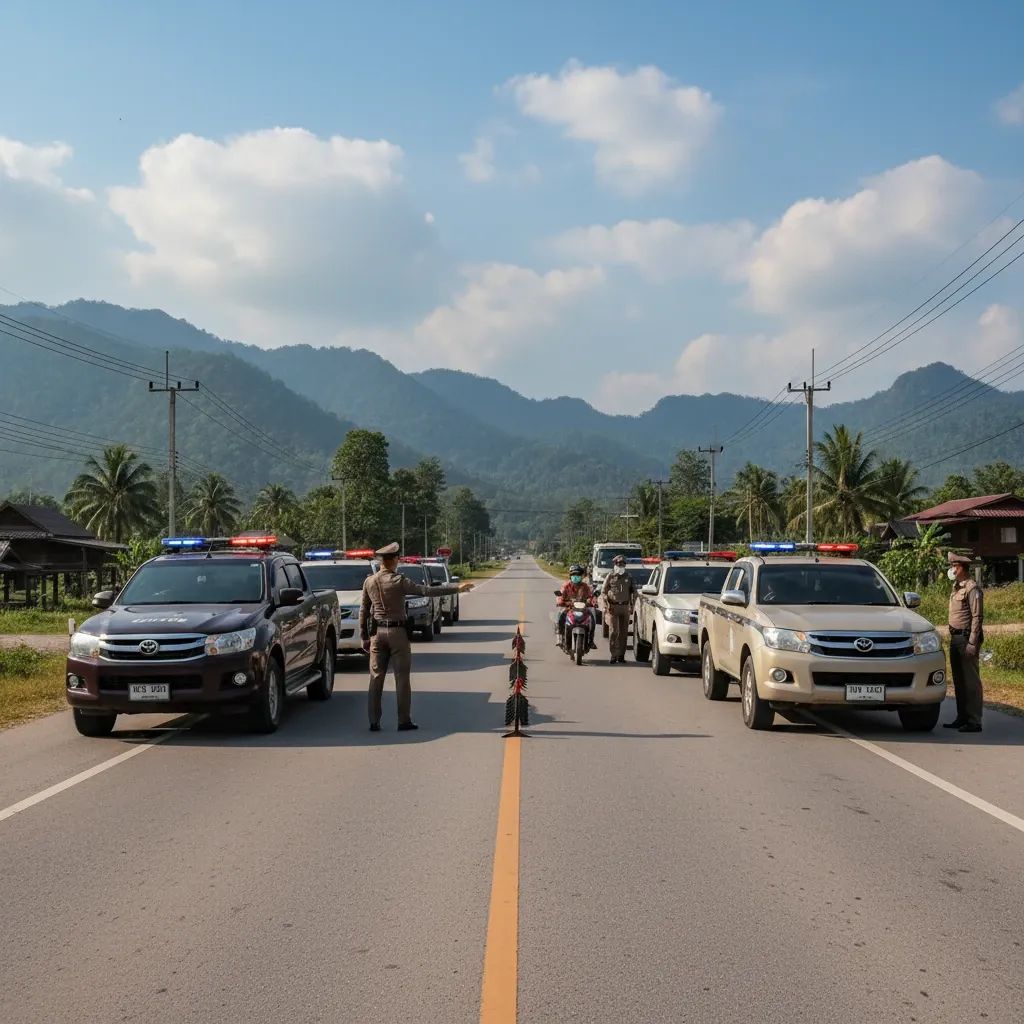
The Thailand Provincial Police Region 5 has disrupted a major narcotics transport operation, seizing approximately 2.8 million methamphetamine pills in Lampang province and arresting five suspects linked to a smuggling network that originated in the northern border zones. The operation unfolded after checkpoint officers pursued a suspect vehicle that fled, eventually abandoning the shipment along a rural highway between Thoen and Thung Saliam districts.
Why This Matters:
• Border trafficking intensifies: This bust reflects a broader trend of surging meth flows from Myanmar's Shan State into Thailand's northern corridor, with production escalating amid regional instability.
• Tech-enabled pursuit: License plate recognition (LPR) cameras enabled police to track two additional escort vehicles, leading to the capture of all five suspects — four from Chiang Saen district in Chiang Rai and one from Nong Muang Khai district in Phrae.
• Lampang as a transit hub: The province is increasingly used as a temporary storage and redistribution point for narcotics heading deeper into the country, not just a production zone.
Chase Ends With 14 Cardboard Boxes on Roadside
Officers manning the Saliam Wan checkpoint in Wiang Mok district and the Nong Chiang Ran checkpoint in Thoen district — both key enforcement points in Lampang province — flagged a suspicious vehicle during routine screening on February 25, according to police reports released this week. Rather than comply, the driver accelerated and fled. A pursuit ensued along the Thoen–Thung Saliam highway, ending near kilometer marker 56 where officers discovered the vehicle abandoned and its occupants vanished into the forest.
Inside the car sat 14 cardboard boxes crammed with methamphetamine tablets. Initial field counts suggested the haul totaled 2.8 million pills, one of the larger single seizures in the province this year. The vehicle itself bore no signs of structural modification, indicating the smugglers relied on speed and evasion rather than concealment engineering.
License Plate Cameras Crack the Network
Investigators reviewed footage from the Thailand Royal Police's LPR camera network, which blankets key arteries linking Chiang Rai and Lampang. The system flagged two additional vehicles traveling in convoy formation with the abandoned car, both entering Lampang from Chiang Rai province along routes known for narcotics movement. This surveillance breakthrough allowed officers to identify and apprehend the suspects before they could disperse.
All five detainees hail from districts with long-standing ties to cross-border smuggling. Four suspects are residents of Chiang Saen, a Mekong River town directly opposite Myanmar and Laos, where "ant army" foot porters routinely carry drugs across forested borders before handing off to vehicle-based couriers. The fifth suspect is from Nong Muang Khai district in Phrae province, a staging area for southbound redistribution.
Northern Thailand's Meth Superhighway
Lampang sits at a strategic juncture in the narcotics supply chain. Drugs produced in Myanmar's Shan State — the epicenter of Southeast Asia's methamphetamine industry — cross into Thailand via Chiang Rai, Chiang Mai, and Mae Hong Son provinces. From there, shipments either head south toward Bangkok and the central plains or west toward the Andaman coast.
The Thailand Office of the Narcotics Control Board (ONCB) has identified 25 high-risk districts across six northern provinces, including Chiang Rai's Mae Chan, Mae Fah Luang, Mae Sai, Chiang Saen, and Chiang Khong; Chiang Mai's Mae Ai, Fang, Chiang Dao, and Wiang Haeng; and Mae Hong Son's Pai and Pang Mapha. These zones are focal points for both initial incursion and onward trafficking.
Smugglers adapt constantly. Methods now include modified vehicles with hidden compartments, small boats traversing the Mekong and Ruak rivers, drones for reconnaissance and small-batch drops, and the so-called "ant army" — porters who carry 100,000 to 200,000 pills each through jungle trails, coordinating handoffs via encrypted messaging apps. Ethnic minorities, including Hmong and Akha communities, are sometimes coerced or recruited as couriers, while Thai nationals from distant provinces serve as middlemen to obscure the chain of custody.
Myanmar Conflict Fuels Production Surge
Conflict in Myanmar has paradoxically accelerated meth output. Armed groups and militias finance their operations through drug production, and instability has weakened enforcement along the Thai-Myanmar frontier. The volume of methamphetamine flowing into Thailand in 2026 is markedly higher than in previous years, according to Northern Border Narcotics Suppression Command (NBC 35) assessments.
In January 2026 alone, Lampang Provincial Police — a key jurisdiction within NBC 35's operational area — reported two major drug busts totaling 400,000 meth pills and quantities of crystal methamphetamine (ice). In November 2025, Lampang officers seized 168,000 pills in Pa Sang district. These figures underscore a regional pattern: as enforcement tightens in one province, traffickers pivot to adjacent routes, creating a whack-a-mole dynamic for law enforcement.
What This Means for Residents: Practical Guidance During Heightened Enforcement
For people living in Thailand's northern provinces, the surge in drug trafficking carries real consequences. Increased enforcement means more roadblocks, longer checkpoint delays, and heightened scrutiny of vehicles and individuals traveling between provinces.
Key checkpoints where delays are likely: Residents traveling on the Thoen–Thung Saliam highway (particularly near kilometer markers 50–60), Saliam Wan checkpoint in Wiang Mok district, and Nong Chiang Ran checkpoint in Thoen district should expect heightened screening during peak enforcement hours (typically dawn and late afternoon). Similar operations are active across Chiang Rai, Chiang Mai, and Phrae provinces along primary highway corridors.
What to expect at checkpoints: Officers will conduct vehicle searches, request documentation (identification and vehicle registration), and may ask about passenger identities and travel purpose. Remain cooperative, keep documents readily accessible, and avoid sudden movements or suspicious behavior. Border district residents face additional scrutiny, including nighttime patrols and drone surveillance.
Legal consequences: The Thailand Narcotics Act imposes severe penalties on those convicted of trafficking Category 1 drugs such as methamphetamine. Possession for distribution of quantities exceeding 20 grams of pure substance can result in life imprisonment and fines ranging from 1M to 5M baht, or in extreme cases, the death penalty. Even possession for personal use carries up to two years' imprisonment and a 40,000 baht fine, though first-time offenders may qualify for diversion to rehabilitation programs instead of jail.
Vulnerable demographics: Local labor sectors — construction workers, agricultural day laborers, and factory employees — remain high-risk demographics for both consumption and small-scale dealing. Authorities have observed a troubling trend: former users graduating to become street-level distributors, coordinating sales via LINE and Messenger and arranging dead-drop exchanges to avoid face-to-face contact and arrest. The criminal liability is identical regardless of distribution scale.
Regional Enforcement Ramps Up
NBC 35 has escalated its 2026 operational tempo, deploying night-vision drones, mobile X-ray scanners, and thermal imaging cameras at critical junctions throughout Lampang and neighboring provinces. The command structure integrates units from the Thailand Royal Police, Thailand Border Patrol Police, Thailand Army, and the ONCB, aiming to dismantle networks from the border crossing point to the kingpin level.
One high-priority target is the network led by "Major Ja Tae," a militia commander in Myanmar's Wa State who uses routes through northern Thailand as primary conduits. Thai authorities have flagged his organization for coordinated cross-border operations, though extradition and prosecution remain complicated by jurisdictional barriers.
The "No Drugs No Dealers" campaign, launched across northern provinces, emphasizes a four-pillar approach: prevention, deterrence, suppression, and rehabilitation. In Lampang province alone, authorities recorded substantial narcotics cases in the current fiscal year, seizing hundreds of thousands of pills and confiscating assets tied to trafficking organizations.
The Bigger Picture
Thailand's northern frontier remains a critical flashpoint in Southeast Asia's drug war. The Lampang seizure is one data point in a much larger phenomenon: the transformation of rural provinces into high-throughput logistics hubs for industrial-scale narcotics production centered in Myanmar. As long as conflict persists across the border and economic incentives remain strong, the flow of methamphetamine will continue, forcing Thai authorities into an increasingly sophisticated game of detection, disruption, and deterrence.
For residents, travelers, and businesses in the region, vigilance is essential. Report suspicious activity to local police or the ONCB hotline (1386). Be prepared for checkpoint delays, especially along highways linking Chiang Rai, Lampang, Phrae, and Chiang Mai. And understand that the penalties for even casual involvement in the drug trade — whether as a mule, middleman, or small-time dealer — are severe and life-altering under Thai law.


