
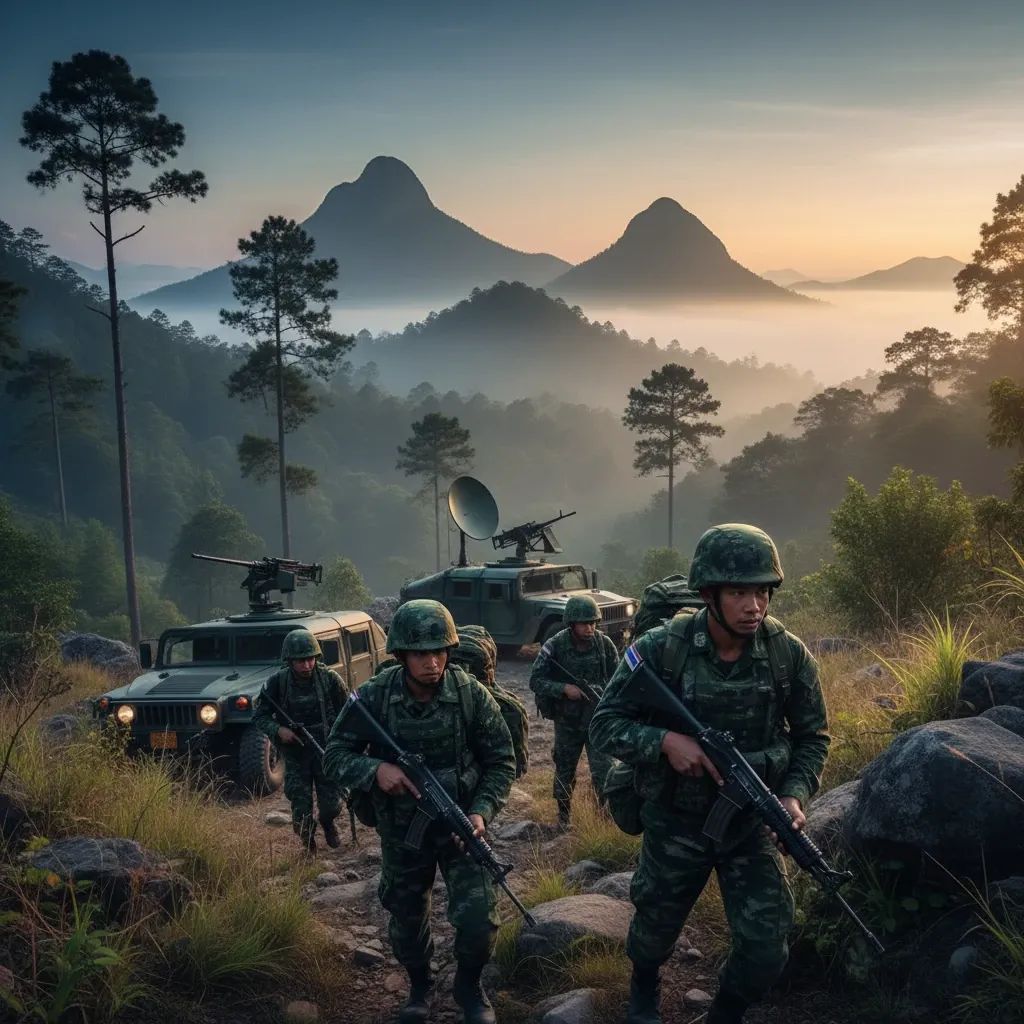
On February 27, the Thailand Royal Army's Pha Muang Task Force intercepted a major narcotics shipment near the Myanmar border. The seizure—one of the largest this year—yielded 5.46 million methamphetamine pills and 50 kilograms of crystal methamphetamine worth tens of millions of baht. The bust underscores the relentless flow of synthetic drugs across the northern frontier.
Why This Matters:
• Volume spike: The 5.46 M pills in a single bust reflect industrial-scale production in Myanmar's Shan State, where armed ethnic groups operate labs 24/7.
• Route remains open: Despite 33 firefights since October 1, cartels still funnel drugs through Chiang Dao's forest trails at night, using local terrain knowledge to evade patrols.
• Price paradox: Even as seizures mount, street prices for methamphetamine in Thailand continue to fall, signaling vast quantities still slip through the net.
• Street prices keep falling: Despite record seizures, methamphetamine costs less than ever—proof that vast quantities still reach Thai markets unchanged from traffickers' hands.
• Resident risk: Traffickers increasingly stash drugs in rural villages along the border, putting ordinary communities in the crossfire of military operations.
What This Means for Residents
For expatriates, retirees, and long-term residents in northern Thailand, the escalation carries multiple implications:
Security friction: Village checkpoints have multiplied along Routes 107 and 118, particularly after nightfall. Travelers can expect impromptu document inspections and vehicle searches; carrying passport copies or Thai ID is essential.
Real-estate considerations: Properties near the Chiang Dao, Fang, and Mae Ai uplands may see intermittent military activity. Some buyers have reported surveyors flagging plots within 10 kilometers of known smuggling trails as higher insurance risk.
Community dynamics: Rural Hmong and Karen settlements serve as both victims and occasional unwilling hosts to traffickers, who leave drugs hidden in orchards or forest groves. Village headmen have been instructed to report suspicious activity under the Interior Ministry's "Eyes and Ears" campaign, intensifying local tension.
Legal exposure: Thailand's 1979 Narcotics Act imposes life imprisonment or death for possessing more than 20 grams of methamphetamine with intent to distribute. Even unwitting landowners can face accessory charges if drugs are discovered on their property without a credible alibi.
The Chiang Dao Corridor
Soldiers from the 2nd Cavalry Company, Chaiyanuphap Special Task Force spotted approximately 20–25 individuals loading narcotics sacks onto a black Ford Ranger pickup (Phuket registration) at Ban Arunothai in Mueang Na subdistrict around dusk. When troops revealed themselves and demanded a search, the group melted into the surrounding jungle, leveraging darkness and intimate knowledge of trails to escape. Left behind: the entire shipment, the vehicle, and—critically—no casualties among either side.
The area sits in a natural funnel zone where mountain passes descend into Thailand's Chiang Dao district, a corridor that has witnessed more than 250 seizure operations (border checkpoint busts) since the start of the fiscal year on October 1, 2025. Military reinforcements—including surveillance drones and narcotics-detection dogs—arrived shortly after the confrontation to secure the scene and sweep adjacent valleys for additional stashes or accomplices.
Pattern of Escalation Across Northern Provinces
This latest bust is part of a dramatic surge in border seizures across Thailand's northern arc. Between October 2025 and January 2026, authorities confiscated more than 330 million methamphetamine tablets nationwide, with the northern provinces accounting for the lion's share. In Chiang Mai and Chiang Rai alone, operations recorded:
• February 24: 1.6 M pills seized and one suspect arrested in Mae Ai district, Chiang Mai.
• February 15: Nearly 10 M pills confiscated alongside one detainee in Chiang Dao—the same subdistrict as this week's operation.
• January 29: A firefight in Fang district, Chiang Mai, resulted in two suspects killed and 1.5 M pills recovered.
• January 12: Troops clashed with a caravan in Wiang Haeng district, leaving one trafficker dead, one in custody, and 3.98 M pills on the ground.
Since the Thai fiscal year began last October, the Pha Muang Task Force has logged 254 seizure operations, detained 263 suspects, and engaged cartels in 33 armed clashes that left 21 traffickers dead, according to Pha Muang Task Force figures. Crystal methamphetamine (known locally as ice or ไอซ์) seizures have soared 95% year-on-year, while tablet seizures have doubled.
Shan State Production Nexus
The methamphetamine flooding Thailand originates primarily in Myanmar's Shan State, where ethnic armed organizations—the Wa, Kokang, Mong La, and Akha militias—control sprawling jungle labs. A single facility can churn out 100,000 tablets per hour using precursor chemicals smuggled from China, according to the United Nations Office on Drugs and Crime (UNODC).
Since Myanmar's February 2021 military coup, governance vacuums in border areas have turbocharged production. UNODC recorded an "unprecedented" rise in synthetic-drug output across the Golden Triangle, with methamphetamine seizures in northern Thailand's three main provinces spiking 284% for crystal meth, 201% for pills, and 77% for heroin between 2021 and 2025.
Armed groups leverage narcotics revenue to finance weapons, recruit soldiers, and maintain territorial control against the Myanmar military. Intelligence assessments shared by the Thailand Office of the Narcotics Control Board (ONCB) estimate at least 90 million pills and 2 metric tons of crystal methamphetamine are currently stockpiled in border warehouses opposite Chiang Mai and Chiang Rai, awaiting the next transport window.
Smuggling Routes and Tactics
Traffickers employ a three-pronged logistics network:
Overland trails: Mule trains depart Shan State at nightfall, crossing unguarded ridgelines into Thailand's Doi Luang National Park and adjacent forest reserves. Porters carry 50-kilogram loads in camouflaged sacks, often escorted by armed guards equipped with assault rifles and satellite phones. Payment typically reaches 5,000–10,000 baht per trip, a fortune in Myanmar's collapsed economy.
Mekong River convoys: Speedboats depart from Sop Luey port in Myanmar's Special Region 4 (Mong La) and land on the Lao or Thai bank after midnight. River patrols by the Thailand Naval Riverine Security Force have captured more than 240 kilograms of crystal meth in Bueng Kan province this year, but the Mekong's 1,000-kilometer length makes comprehensive coverage impossible.
Container concealment: Larger shipments travel via modified trucks or maritime containers from Myanmar's coastal zones. A February 24 operation in Roi Et province dismantled a network that moved drugs from the northeast border to staging houses in Saraburi before distributing them to Bangkok and central Thailand—1.1 million pills were recovered.
Enforcement Challenges and the Price Paradox
Despite record seizures, wholesale methamphetamine prices in Thailand have fallen by approximately 30% over the past two years, dropping to as low as 15 baht per tablet in some northern markets. This inverse relationship—more busts, lower prices—signals that authorities interdict only a fraction of the total volume crossing the border.
The Thailand Narcotics Control Board estimates that for every kilogram seized, three to five kilograms reach distribution networks in Bangkok, Pattaya, and tourist zones. Law-enforcement analysts attribute the shortfall to:
• Insufficient manpower: The Pha Muang Task Force fields roughly 2,000 soldiers along a 600-kilometer frontier, an average density of 3 troops per kilometer.
• Terrain advantage: Smugglers know every goat path, cave, and river ford; many are former porters or local villagers coerced by cartels.
• Corruption leakage: Periodic scandals have implicated border-checkpoint officers, though the Royal Thai Army insists internal-affairs units prosecute offenders aggressively.
Bilateral Diplomacy and Myanmar's Role
Thailand's Ministry of Foreign Affairs has pressed Myanmar's military government to dismantle labs in Shan State, but cooperation remains patchy. In December 2025, Myanmar authorities extradited two drug suspects to Thailand in a goodwill gesture, yet large-scale eradication campaigns have not materialized.
A February 2026 meeting between Thai and Myanmar foreign ministers reaffirmed a joint counter-narcotics working group, but diplomats privately acknowledge that Naypyidaw lacks both the will and the capability to rein in ethnic militias that view drug revenue as existential funding.
Meanwhile, China—the principal source of precursor chemicals—has tightened export controls on ephedrine and pseudoephedrine but cannot monitor every clandestine shipment leaving Yunnan province.
Government Strategy: Interception and Asset Seizure
Thailand's Cabinet has authorized a multi-agency crackdown under the slogan "Destroy the Network, Not Just the Drugs." Key elements include:
High-value-target lists: The ONCB maintains a "Most Wanted" roster of 47 cartel kingpins, 12 of whom are believed to operate from Shan State. Bounties reach 10 million baht per capture.
Asset confiscation: Since October 2025, authorities have frozen 3.39 billion baht in property, vehicles, and bank accounts linked to trafficking proceeds, invoking Thailand's Anti-Money Laundering Act.
Village surveillance: The Interior Ministry's "Eyes and Ears" initiative trains village heads to recognize telltale signs—unusual late-night traffic, unfamiliar faces, abandoned backpacks—and offers rewards up to 500,000 baht for intelligence leading to major busts.
Drone and sensor deployment: The Thai Army is installing thermal cameras and motion sensors along 15 high-risk mountain passes, with real-time feeds monitored at a command center in Chiang Mai's Kawila Camp.
What Comes Next
The Thailand Office of the Narcotics Control Board predicts that 2026 will see no let-up in smuggling attempts, citing intelligence that Shan State labs ramped up production during the February dry season to stockpile for the coming monsoon, when trails turn impassable.
For residents in Chiang Mai, Chiang Rai, Lamphun, Lampang, Phayao, Nan, and Mae Hong Son, the takeaway is straightforward: the northern border remains a contested zone where military operations, cartel logistics, and civilian life intersect daily. Heightened checkpoints, occasional firefights, and village tensions are the new normal, not anomalies.
Those living near the frontier should remain alert to unusual activity, cooperate fully with checkpoint protocols, and understand that Thailand's legal framework offers no leniency for narcotics possession—even accidental proximity to a trafficker's stash can trigger lengthy detention while investigators sort facts from alibis.
The February 27 bust in Chiang Dao represents both a tactical victory and a sobering reminder: the volume of drugs flowing south from Myanmar far exceeds what any single seizure can capture, and the economic incentives—desperate poverty in Shan State, insatiable demand in Thailand and beyond—show no sign of weakening.


