
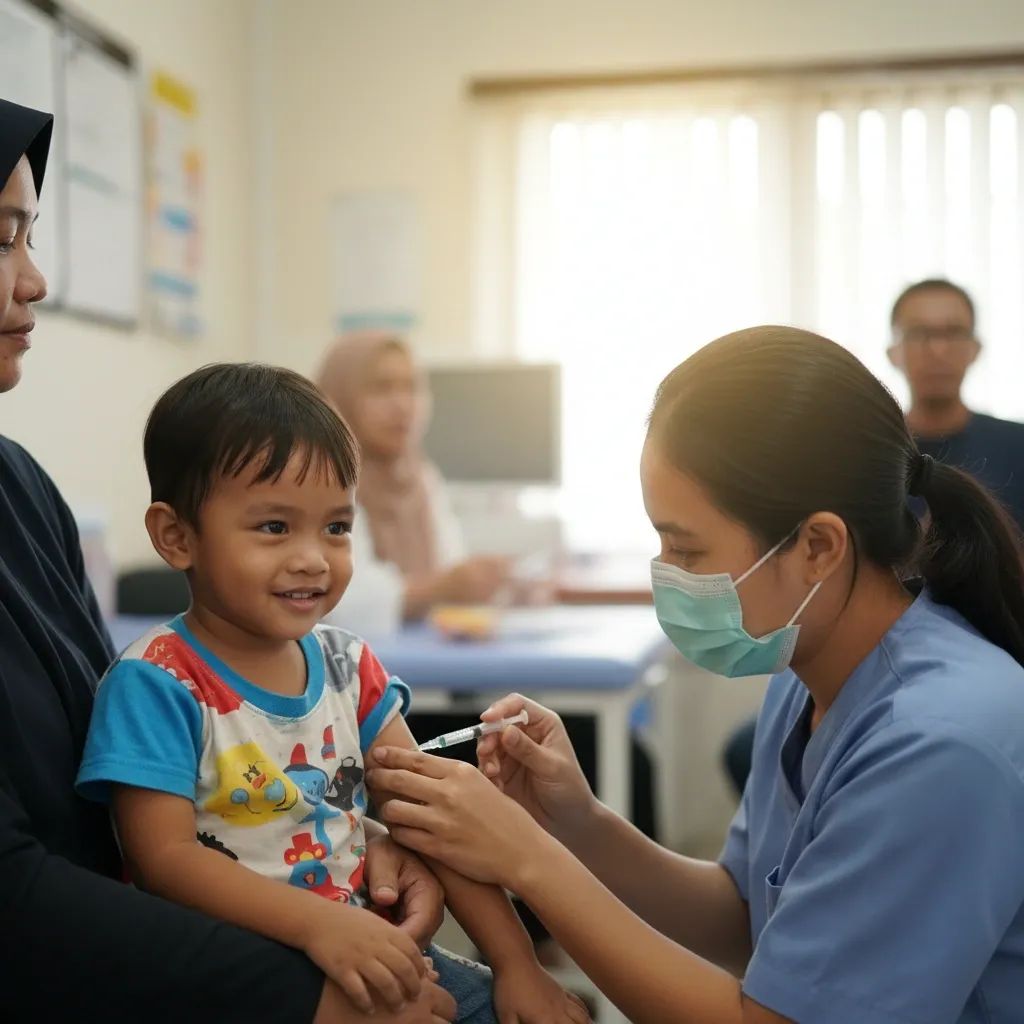
Indonesia's Health Ministry has launched a nationwide campaign targeting 100 regencies and cities in March 2026, attempting to reverse vaccine hesitancy fueled by persistent misinformation across social media and religious concerns about vaccine ingredients—just as measles cases surge across the archipelago.
The government's emergency vaccination drive comes after 63,769 suspected measles cases and 69 deaths were recorded throughout 2025, a stark increase from 7,191 confirmed cases in 2024. By February 2026, authorities had already documented another 8,810 suspected cases and 5 deaths, all involving unvaccinated toddlers under age 5. The crisis has exposed deep-seated vaccine resistance across Indonesian communities, where misinformation campaigns on social platforms continue to outpace official health messaging.
Why This Matters
• Religious fatwa permits vaccines: Indonesia's Ulema Council declared the measles-rubella vaccine mubah (religiously permitted) in 2018, yet halal concerns persist among Muslim-majority families.
• Coverage far below threshold: Second-dose measles vaccination coverage dropped to 77.6% in 2025, well below the 95% needed for herd immunity.
• Children bear the brunt: 80% of 2025 measles cases involved children aged 9 and below, with infants and toddlers under 5 accounting for 53% of infections.
• Deaths concentrated in outbreak zones: Pamekasan Regency in East Java alone reported 12 deaths from 1,248 cases in 2025, while neighboring Sumenep recorded 17 child fatalities from over 2,000 infections.
What This Means for Thailand and the Region
Indonesia's measles crisis carries direct implications for Thailand and the broader Southeast Asian region. The two nations share porous borders, particularly in southern Thailand where cross-border trade, travel, and migration create potential pathways for disease transmission. With Indonesia's second-dose measles vaccination coverage at only 77.6%—well below the regional target—the country now represents a significant epidemiological concern for neighboring countries with higher vaccination rates.
Thailand maintains stronger measles vaccination coverage compared to Indonesia, with national immunization rates consistently above 95% in recent years. However, this regional disparity creates vulnerability, particularly in border provinces where vaccination coverage may be lower and cross-border movement is frequent. Thai residents who travel to Indonesia for business, tourism, or family visits—as well as those with Indonesian domestic workers or regular transnational contacts—should understand the elevated measles transmission risk in affected regions. The outbreak zones in East Java, where case fatality rates reached approximately 1% in 2025, represent potential sources of infection spillover.
The misinformation ecosystem driving Indonesia's vaccine hesitancy also poses a cautionary lesson for Thailand. False claims circulating on social media platforms transcend borders, and similar anti-vaccine narratives targeting religious concerns or promoting alternative remedies have already gained traction in Thai communities. Thailand's health authorities have expressed concern about vaccine misinformation spreading through cross-border messaging apps and social networks, particularly affecting immigrant communities and areas with lower health literacy. Understanding how misinformation fueled Indonesia's crisis—outpacing government rebuttals and exploiting religious concerns—provides Thailand's public health officials with critical insights for strengthening regional disease surveillance and counter-misinformation strategies.
The Misinformation Ecosystem
Social media platforms have become the primary vector for anti-vaccine messaging in Indonesia, where false claims circulate faster than government rebuttals. Parents receive messages through messaging apps suggesting that natural immunity acquired from measles infection is "five to 10 times better" than vaccine-induced protection—a medically unfounded assertion that health officials say ignores the disease's potentially fatal complications.
Other popular myths gaining traction include linking vaccines to paralysis, behavioral problems, and allergies. Some Indonesian parents share advice recommending coconut water, dates, or sea cucumber jelly as alternatives to medical treatment, while influencers promote "holistic health" approaches that frame measles as a harmless childhood rite of passage easily overcome by the natural immune system.
The COVID-19 pandemic intensified these trends, with pseudoscientific conspiracy theories gaining mainstream acceptance among segments of the population already skeptical of pharmaceutical companies and government health programs. Parents now cite distrust in profit motives behind vaccination campaigns, viewing immunization programs as revenue generators rather than public health necessities.
Religious Concerns Override Medical Advice
In the predominantly Muslim nation, concerns about haram (forbidden) ingredients—specifically porcine-derived components used as stabilizers—drive much of the vaccine resistance. Despite the Indonesian Ulema Council's 2018 fatwa explicitly permitting the measles-rubella vaccine due to public health necessity and the absence of halal alternatives, the religious objection remains entrenched.
Indonesia's Ministry of Religious Affairs now plays a fundamental role in the government's counter-campaign, collaborating with local imams and Islamic scholars to reinforce the message that protecting children's health takes religious priority. Health authorities are calling on community and religious leaders to endorse immunization efforts from mosque pulpits and during community gatherings, recognizing that scientific messaging alone fails to reach families whose primary concerns are spiritual rather than medical.
What This Means for Families
The measles virus poses severe risks, particularly to young children. Pneumonia, encephalitis (brain inflammation), and severe dehydration represent the most common life-threatening complications, with infants under 12 months and those with weakened immune systems facing the highest mortality risk. The case fatality rate in some Indonesian outbreak zones reached approximately 1% during 2025, a figure that reflects both the severity of the illness in unvaccinated populations and potential delays in accessing appropriate supportive care.
Parents who opt out of vaccination based on misinformation expose their children not only to direct infection risk but also to secondary complications that require intensive medical intervention. The East Java outbreaks in 2025 demonstrated how quickly measles spreads in under-vaccinated communities, with single outbreak zones accounting for thousands of infections within weeks.
For families living in Indonesia, the government's March 2026 mass vaccination campaign represents a critical opportunity to protect children. The initiative includes booster shots for health workers and targets identification of missed children in disease hotspots through enhanced surveillance systems, epidemiological investigations, and contact tracing to locate unreported cases.
Government Response and Ongoing Challenges
Health Minister Budi Gunadi Sadikin has publicly acknowledged the growing crisis in public trust, pledging improved communication strategies to combat misinformation. The ministry's current approach emphasizes that measles vaccines are safe and effective in preventing not just the initial infection but the severe complications that lead to hospitalization and death.
The August 2025 mass vaccination drive in Sumenep regency aimed to immunize more than 78,000 children aged 9 months to 6 years, demonstrating the scale of the catch-up effort required in outbreak hotspots. Similar campaigns are now being replicated across approximately 100 regencies and cities nationwide, with particular focus on areas where vaccination coverage has fallen below critical thresholds.
However, significant obstacles remain. Low public awareness, limited human resources in rural health clinics, and the continued viral spread of false information on social platforms undermine government efforts. Health experts recommend involving more local figures, including cultural leaders, and localizing vaccine information by translating educational materials into regional languages beyond standard Indonesian.
The Immunity Gap
Indonesia's vaccination coverage tells the story of the current crisis. In 2021, national coverage for the first dose of measles-containing vaccine (MCV1) stood at 87%, while second-dose coverage (MCV2) reached only 59%—leaving a massive population of susceptible children. By 2025, even as health officials mounted intensive campaigns, second-dose coverage had climbed to just 77.6%, still 17 percentage points below the 95% threshold required to achieve herd immunity and halt measles circulation.
This immunity gap, combined with declining trust in vaccination programs, created ideal conditions for the 2022-2026 measles resurgence that has now claimed dozens of young lives. Each unvaccinated child represents not only an individual at risk but also a potential transmission node that can spark new outbreak clusters in schools, markets, and residential compounds where young families congregate.
The measles virus remains one of the most contagious pathogens known to medicine, capable of lingering in the air for up to two hours after an infected person leaves a room. In populations with insufficient vaccination coverage, a single case can generate 12 to 18 secondary infections—a transmission rate that quickly overwhelms local health systems and creates the explosive outbreak patterns seen across Indonesian provinces in recent years.
Path Forward
Indonesia's health authorities continue to emphasize that vaccination remains the only proven method to prevent measles and its potentially fatal complications. The current emergency campaign represents the government's most comprehensive response yet, combining mass immunization with targeted outreach to vaccine-hesitant communities through trusted religious and cultural intermediaries.
For Thai residents and the broader Southeast Asian region, Indonesia's measles crisis underscores the critical importance of maintaining robust vaccination coverage and combating cross-border misinformation. The outbreak demonstrates how quickly vaccine hesitancy can erode herd immunity, turning a preventable disease into a regional health security concern. As Thailand continues to strengthen its public health infrastructure, learning from Indonesia's experience—particularly regarding the effective communication strategies needed to counter misinformation and engage religious communities—will be essential for protecting the health of families across the region. For every family, whether in Indonesia or neighboring Thailand, the statistics remain unambiguous: measles vaccination remains the only proven defense against this potentially fatal disease, making regional cooperation on vaccination campaigns and health education vital for Southeast Asia's collective wellbeing.


