
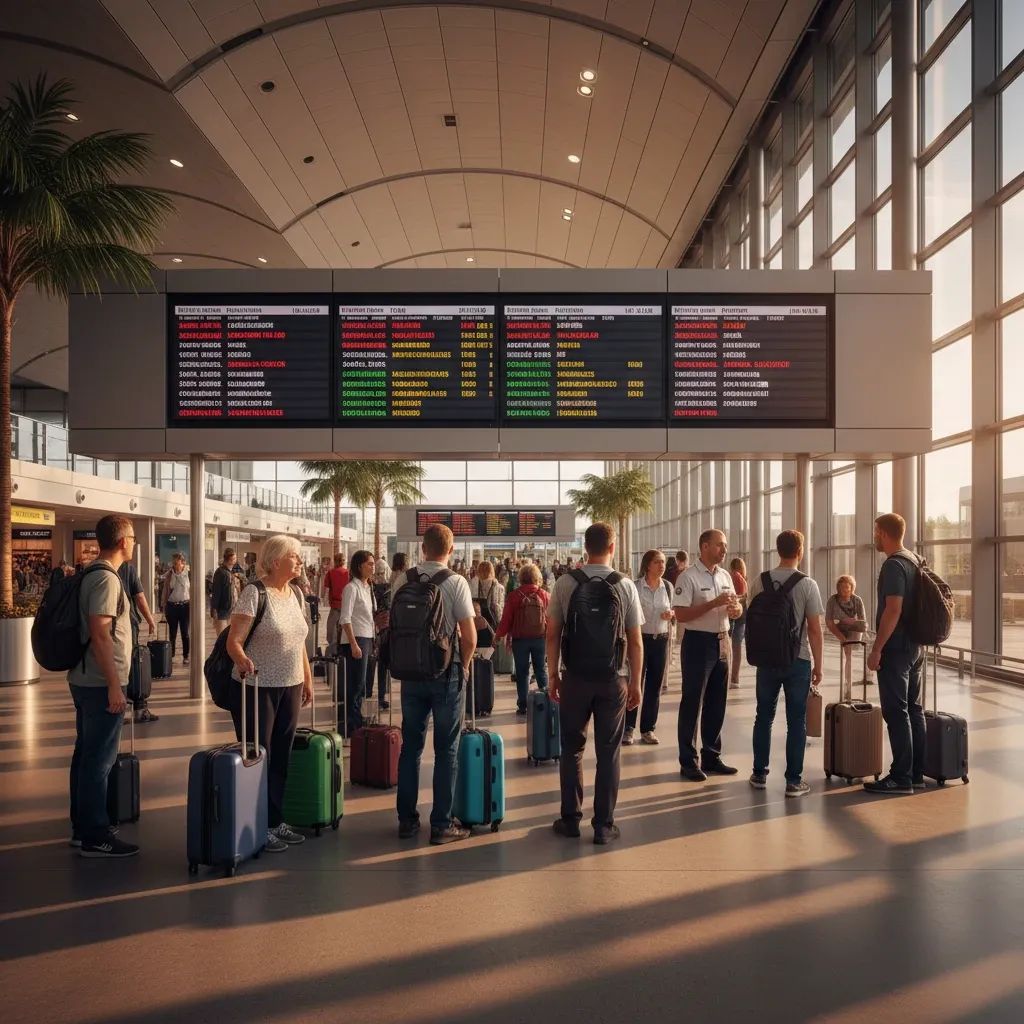
Thailand Immigration Police intercepted a 57-year-old Chinese national at Suvarnabhumi Airport on April 13, marking the latest arrest in an 18-month surge of in-flight thefts plaguing short-haul routes into Bangkok. The incident underscores a regional security challenge that has cost passengers across Southeast Asia more than 8M baht in recent months—and reflects a pattern that residents flying regional routes should be aware of.
Why This Matters:
• Over 80 in-flight theft incidents recorded at Bangkok airports in early 2026, with losses exceeding 8M baht across 18 financial institutions.
• Short-haul flights under 3 hours—including routes from Vientiane, Hong Kong, and Kuala Lumpur—have emerged as prime targets for organized theft rings.
• Flight crews and airport authorities are now actively monitoring overhead bins, but passengers remain the first line of defense.
The Arrest at Gate C6
Zheng Xiaobo was waiting at Gate C6 when Tourist Police Bureau officers boarded Thai Airways flight TG571 from Vientiane shortly after its arrival on April 13. Three Chinese passengers had alerted cabin staff mid-flight that cash was missing from their bags—approximately 65,000 baht in mixed currencies. One victim, Yiu Yuejin, reported the theft to the crew, who had already observed Zheng reaching into overhead compartments during the 90-minute flight.
According to Pol Lt Gen Saksira Phueak-um, commissioner of the Tourist Police Bureau, officers recovered the stolen money during a search at the gate and escorted Zheng to Suvarnabhumi airport police station to face formal theft charges. The swift apprehension was possible only because flight attendants recognized the pattern and alerted ground security before landing—a protocol that has become standard practice on high-risk routes.
A Growing Pattern Across the Region
Bangkok has emerged as a focal point for in-flight theft incidents operating across Southeast Asia. The Thailand Immigration Bureau logged more than 80 cases of credit card and cash theft on international flights in the first quarter of 2026, with the majority occurring on routes lasting no more than three hours. Hong Kong authorities recorded 169 cases in the first 10 months of 2024—a 75% year-over-year increase—and traced roughly 70% of those incidents to regional flights originating in Thailand, Vietnam, Malaysia, and India.
The pattern is consistent: Thieves purchase last-minute tickets, travel light to avoid checked baggage, and target overhead compartments when passengers are asleep or distracted during meal service. They often work in pairs, with one accomplice creating a diversion while the other rifles through bags. Stolen items typically include small amounts of cash and one or two payment cards—losses subtle enough to escape immediate notice, allowing criminals to complete mobile banking transactions the moment they land and vanish into crowded terminals.
In March 2025, a passenger on a Thai Airways flight from Bangkok to Hong Kong reported more than HK$10,000 (roughly US$1,286) stolen from a backpack in the overhead bin. Singaporean authorities have publicly attributed the uptick to organized crime networks that rotate routes and carriers to evade detection, exploiting the anonymity of high-volume short-haul travel.
What This Means for Residents and Travelers
If you fly regularly between Bangkok and regional hubs—Vientiane, Chiang Mai, Hong Kong, Kuala Lumpur—these incidents reflect a measurable shift in the security environment. The Thailand Tourism and Sports Ministry issued formal guidance in February 2025 urging airlines to step up cabin inspections and passenger advisories, but enforcement remains inconsistent. Thai Airways, Bangkok Airways, and AirAsia have all circulated internal memos instructing crews to watch for suspicious behavior, yet the burden of prevention still falls on individual travelers.
Practical steps residents should take:
• Never store wallets, passports, or devices in overhead bins. Keep them in a small crossbody bag or security belt worn under your seat.
• Turn bags upside down when placing them overhead, with zippers facing the cabin wall, to reduce opportunistic access.
• Use small combination locks on backpack zippers. Even a basic deterrent encourages thieves to move to easier targets.
• Stay alert during boarding and dimmed-cabin phases. More than 40% of thefts occur during the initial scramble for bin space.
• Report loitering or unusual movement near your row to flight attendants without hesitation. Crew members on high-risk routes are trained to intervene.
The Civil Aviation Authority of Thailand (CAAT) has coordinated with the Immigration Bureau to deploy a "Crime Triangle" strategy—addressing victim vulnerability, criminal opportunity, and offender motivation simultaneously. This includes proactive public relations at departure gates, multilingual warning posters in lounges, and expedited prosecution for suspects caught red-handed.
Legal Consequences and Enforcement Gaps
Suspects apprehended for in-flight theft in Thailand face prosecution under the Criminal Code for theft in a public conveyance, which carries a potential sentence of up to three years' imprisonment. Convicted foreign nationals also risk visa revocation and blacklisting, effectively barring re-entry for years. Yet enforcement gaps persist: Many victims only discover thefts after clearing customs, by which point thieves have already used stolen cards or exchanged currency. Financial institutions report losses often go unreported because victims assume they misplaced cash or forgot transactions.
Suvarnabhumi Airport has responded by installing additional hidden cameras in gate hold areas and expediting police processing for theft cases. Baggage handlers now undergo mandatory certification and random audits, though these measures primarily address checked-luggage theft rather than cabin incidents.
The Bigger Picture: A Post-Pandemic Vulnerability
Industry analysts attribute the in-flight theft surge to two converging trends: the explosive rebound in regional air travel post-pandemic, and the shift toward cashless economies that make physical currency less traceable once stolen. Thieves can quickly convert baht, Hong Kong dollars, or Singapore dollars into cryptocurrency or mobile payment platforms, rendering traditional law enforcement tools less effective.
The International Air Transport Association (IATA) has convened discussions among Southeast Asian carriers to standardize reporting protocols and share suspect watch lists, but progress remains slow. Until airlines implement synchronized surveillance systems or adopt biometric tracking for gate access, passengers must remain aware of the security environment.
A Practical Approach to Travel Safety
For residents flying regional routes frequently, these incidents underscore the need for heightened awareness. While most flights remain secure, treating valuables as you would in any public space—keeping them on your person rather than in overhead storage—reduces risk substantially. The goal is not to create anxiety about flying, but to adopt commonsense precautions that align with how you'd protect belongings in a crowded marketplace or transit hub. Regional mobility remains safe and convenient when paired with practical vigilance.


