
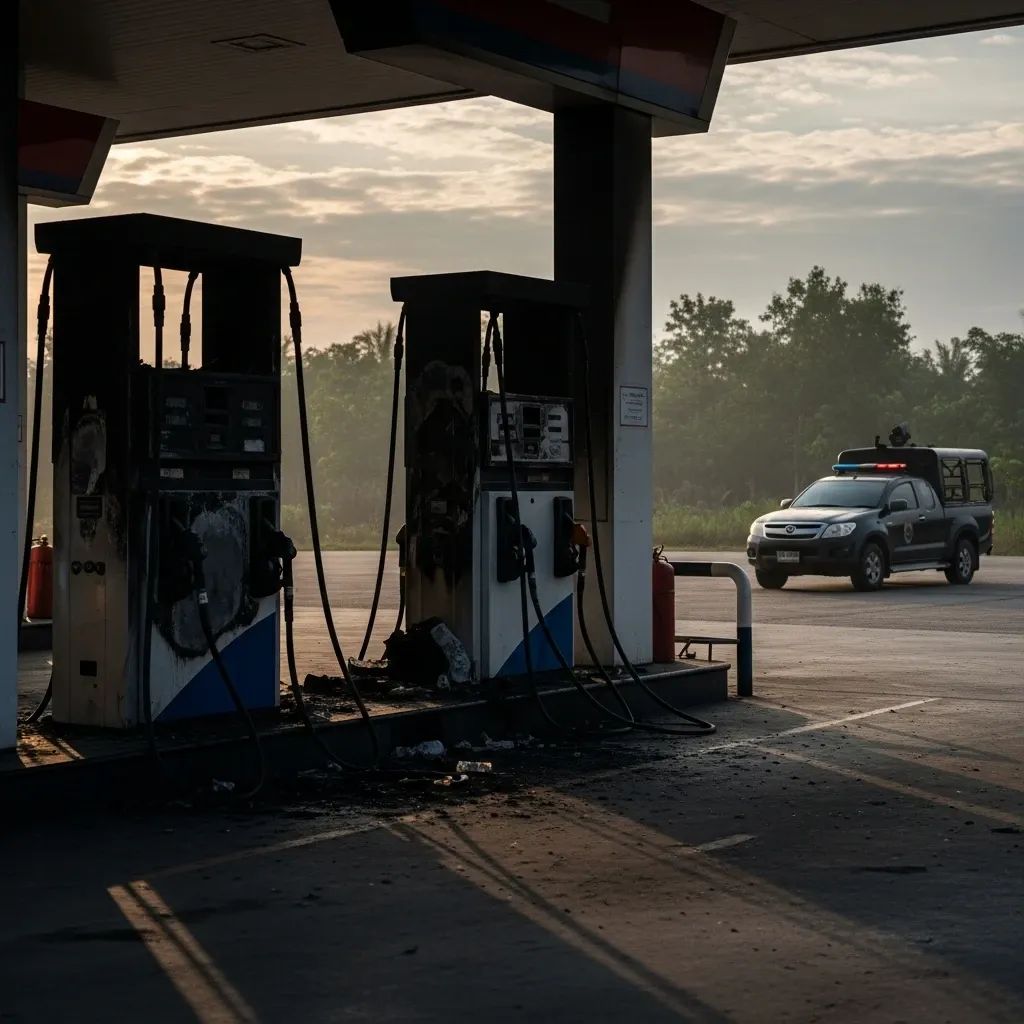
Eleven coordinated strikes on filling stations shattered Friday’s pre-dawn quiet in Thailand’s far South, but officials say the response will be measured, not militarised. Bangkok’s security planners are scrambling to reassure residents and investors alike that the insurgency’s latest show of force will not derail daily life or the slow-moving peace talks.
Rapid Recap: What Matters Now
• Eleven petrol stations in Pattani, Yala and Narathiwat were hit within an hour.
• The National Security Council (NSC) labels the assaults a bid for attention, not legitimacy.
• No fatalities were reported, yet property damage has rattled local business owners.
• Bangkok conveyed an unambiguous message to the Barisan Revolusi Nasional (BRN) through Kuala Lumpur: violence jeopardises the dialogue track.
• Extra patrols will guard energy infrastructure, but officials insist fuel supplies remain stable.
A Night of Fire & Fear
The raids unfolded between 02:00 and 03:00, when most stations were shuttered and staff had gone home. Attackers doused pumps with accelerants, set them alight and fled into the darkness. CCTV footage shows small teams arriving by motorbike — the hallmark of past militant operations in the Deep South’s rural districts. Although emergency crews contained the blazes quickly, the imagery of charred dispensers spread rapidly across social media, reigniting anxieties that had eased during last year’s relative lull.
Community Pulse: Resilience and Fatigue in Equal Measure
Shopkeepers along Highway 42 reopened within hours, but the undercurrent of unease is palpable. Some residents expressed relief that no civilians were hurt, yet many worry the attacks signal a tactical shift toward soft economic targets. A teacher in Yala city summarised the mood: “We’re used to checkpoints, but seeing the places we refuel turned into fireballs hits differently.”
Local clerics and civil-society volunteers have since convened impromptu forums, urging neighbours to report suspicious activity and reminding youths of the Islamic principle of safeguarding community assets. Their message: the insurgency’s actions harm the very population it claims to defend.
Government Countermoves: Security without Siege
Authorities rolled out heightened patrols, vehicle searches and drone overflights, yet avoided the sweeping curfews imposed after earlier attacks in 2019. Energy Ministry officials dispatched additional petrol tankers along guarded convoys to keep supplies flowing. Oil retailers pledged price stability, keen to avoid panic buying.
NSC secretary-general General Supoj Malaniyom framed the response as a balancing act: “We will protect citizens without strangling commerce. The goal is to deny militants propaganda fodder.” Behind the scenes, Bangkok is also studying whether the incident exploited security gaps created when 300 soldiers were rotated out of the region last month.
The Dialogue Track: Fragile but Breathing
Thailand’s peace committee was already scheduled to meet BRN negotiators in Kuala Lumpur next month. According to insiders, Bangkok will now demand a concrete ‘no-attack period’ during Ramadan. Pro-dialogue activists fear the petrol-station assault will embolden hard-liners on both sides to ditch the table. Yet Malaysian facilitator Zulkifli Zainal insists the meeting is still on: “Tension is high, but the process has survived worse.”
Why Fuel Sites? Tactical Logic Explained
Security analysts note that petrol stations tick several boxes for insurgents:
Symbolic disruption of daily routines without mass casualties.
Low-cost, high-flame visuals perfect for viral videos.
Ability to strike simultaneously across multiple districts, showcasing coordination.
Limited insurance coverage, amplifying economic pain for small Thai-Malay franchisees.
Economic Undercurrents
The southern border provinces contribute barely 1.1% to national GDP, yet they are critical transit points for cross-border trade with Malaysia worth ฿380B annually. Any perception of spiralling violence risks rerouting cargo through safer checkpoints, shaving millions off local tax receipts. Tourism had just begun to rebound in Betong and Narathiwat’s Sukhirin eco-zone; travel agents now fear another wave of cancellations.
Conflict in Numbers
• Nearly 7,400 deaths have been recorded since the insurgency reignited in 2004.
• Last year saw 155 insurgency-related incidents, the second-lowest annual tally in two decades.
• Development budgets earmarked for the Deep South reached ฿49B in FY2025, with 38% allocated to infrastructure and 14% to education.
The Road Ahead
Officials are hinting at a multi-layered plan: bolster station security, channel more funds into quick-impact community projects, and maintain media pressure on militants seen as undermining progress. For residents, the immediate concern is simpler — topping up their tanks without looking over their shoulders.
Still, analysts caution that true security will come from political compromise, not firefighting patrols. Whether Friday’s flames galvanise or derail that compromise could become the single most important storyline in Thailand’s Deep South for the rest of the year.


