
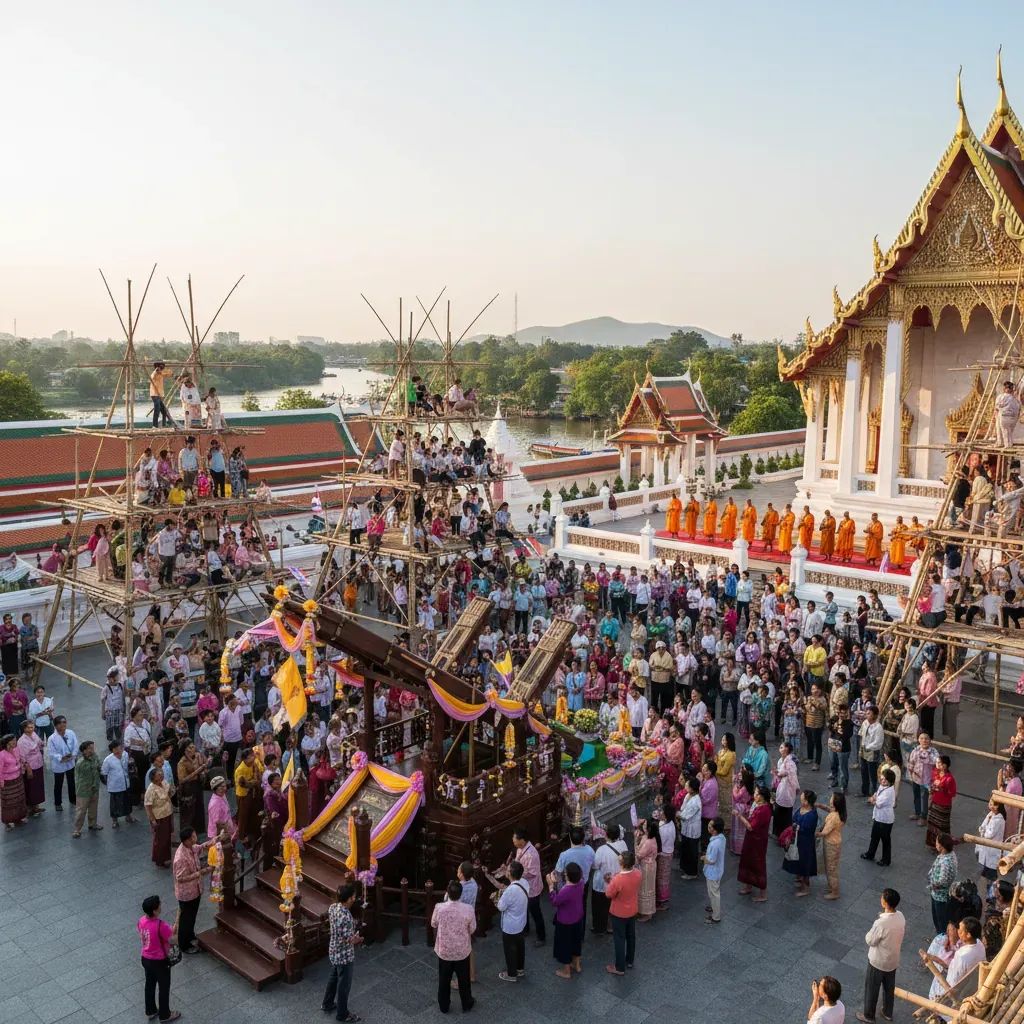
The Thailand Mon community in Pathum Thani province fired up its centuries-old "Luk Noo" rocket tradition this week, launching handcrafted projectiles along steel wires toward replica castle targets in a spectacle that blends religious reverence with village rivalry. The opening round at Wat Hatthasan Kaset in Khlong Luang district drew both local competitors and international onlookers, underscoring the province's push to monetize heritage festivals and pull tourism revenue away from Bangkok's orbit.
What Luk Noo Actually Means
The name translates as "little rat," a diminutive that belies the engineering behind each rocket. Mon-Thai villagers originally devised the contraption to ignite royal funeral pyres from a respectful distance—commoners were forbidden to light the wood directly when cremating high-ranking abbots. Over generations, the ceremony morphed into a friendly contest as competing temple districts brought multiple rockets to the same cremation, each crew determined to prove superior craftsmanship.
Today's version retains the wire-guided launch but substitutes a scale model of a Khmer prang (castle tower) for the actual pyre. Teams earn maximum points if their rocket strikes the spire cleanly enough to topple the structure. Secondary prizes go to any crew that snaps a support post or uproots the foundation entirely.
Why This Matters
• Cultural continuity: The Mon ethnic minority's rocket ceremony, rooted in centuries-old funeral rites for senior monks, is now registered as intangible heritage by Thailand's Culture Ministry.
• Tourism revenue: Similar festivals in Thailand generate additional income for small businesses during event windows, boosting local economies.
• Safety protocols: Participants and spectators must observe designated zones as the bamboo rockets—packed with homemade gunpowder—reach considerable speeds.
• Provincial celebration: Pathum Thani hosts this traditional event alongside other regional rocket festivals that draw visitors and celebrate Thai heritage.
Construction and Combustion
Each rocket begins as a length of heavy bamboo or hardwood bored hollow and packed with a powder mixture. Artisans seal both ends with clay plugs, leaving a fuse aperture at the center. The exact formula remains a closely guarded family recipe; subtle variations in ingredients and moisture content can mean the difference between a clean launch and a misfire.
On competition day, organizers rig a steel cable from launch cradle to target, tensioned to prevent sag. The rocket body is lashed to a sliding collar that rides the cable. When the fuse ignites, exhaust gases blast through a rear nozzle, driving the assembly forward with an audible crack as the projectile impacts wood or wire.
What Comes Next for Festival-Goers
For residents planning to attend, admission remains free, though temple committees solicit donations that fund both rocket construction and merit-making activities. Parking can be scarce; arriving by motorcycle taxi from the nearest Red Line commuter station at Rangsit often proves faster than driving. English signage is minimal, so bringing a Thai-speaking companion or downloading a translation app will ease navigation.
The spectacle itself lasts only seconds per launch—a flash of sparks, a metallic shriek, and the sharp crack of bamboo meeting wood—but the buildup, including processions of dancers and drummers circling the target prang three times counterclockwise, stretches the program to several hours. Plan accordingly, bring sun protection, and expect a mix of solemn ritual and raucous cheering that captures the dual nature of Thai merit-making: serious devotion leavened by unabashed fun.
Impact on Local Communities
For Khlong Luang district, the rocket festival brings energy and activity to the local area. Food stalls selling grilled pork skewers, som tam, and sticky rice attract crowds, while visitors from out of province explore the region. Handicraft vendors sell miniature rocket replicas and woven bamboo souvenirs, tapping interest in authentic cultural experiences.
Local businesses have adapted to modern payment methods, with many accepting QR-code payments via PromptPay. The festival draws spectators who contribute to local spending on food, lodging, and crafts throughout the temple grounds and surrounding community.
Safety and Regulatory Oversight
Organizers work with local authorities to ensure proper safety measures at each event. Spectators are positioned at safe distances from launch areas, and fire safety equipment is required on site. The Thailand Ministry of Interior requires organizers to secure proper permits before events, a process that ensures oversight and safe operations.
Injuries are rare, and the province continues to enhance safety protocols, including paramedics on standby and protective barriers around launch areas—measures that reflect the community's commitment to safe celebrations.
Broader Cultural Context
Luk Noo occupies a distinct place in Thai festival traditions, emphasizing precision and accuracy in rocket launching. Other regional festivals like Bun Bang Fai in the northeast launch rockets to celebrate different aspects of Thai and Southeast Asian heritage. Both traditions trace their roots to ancient practices, later woven into Buddhist merit-making ceremonies.
Thailand's National Heritage Board recognizes Luk Noo as part of Pathum Thani's cultural heritage, acknowledging the tradition's importance to the Mon community and Thai society. Whether that support proves sufficient to keep the practice vibrant as younger people pursue different career paths remains a question the community continues to address through youth engagement and festival celebrations.
A Living Tradition
The Mon rocket festival represents a living link to centuries-old traditions—a celebration where precision engineering, spiritual devotion, and community pride come together in seconds of explosive spectacle. For Pathum Thani residents and visitors, it's an opportunity to witness authentic Thai-Mon culture, support local communities, and participate in a heritage that continues to evolve while honoring its roots.


