
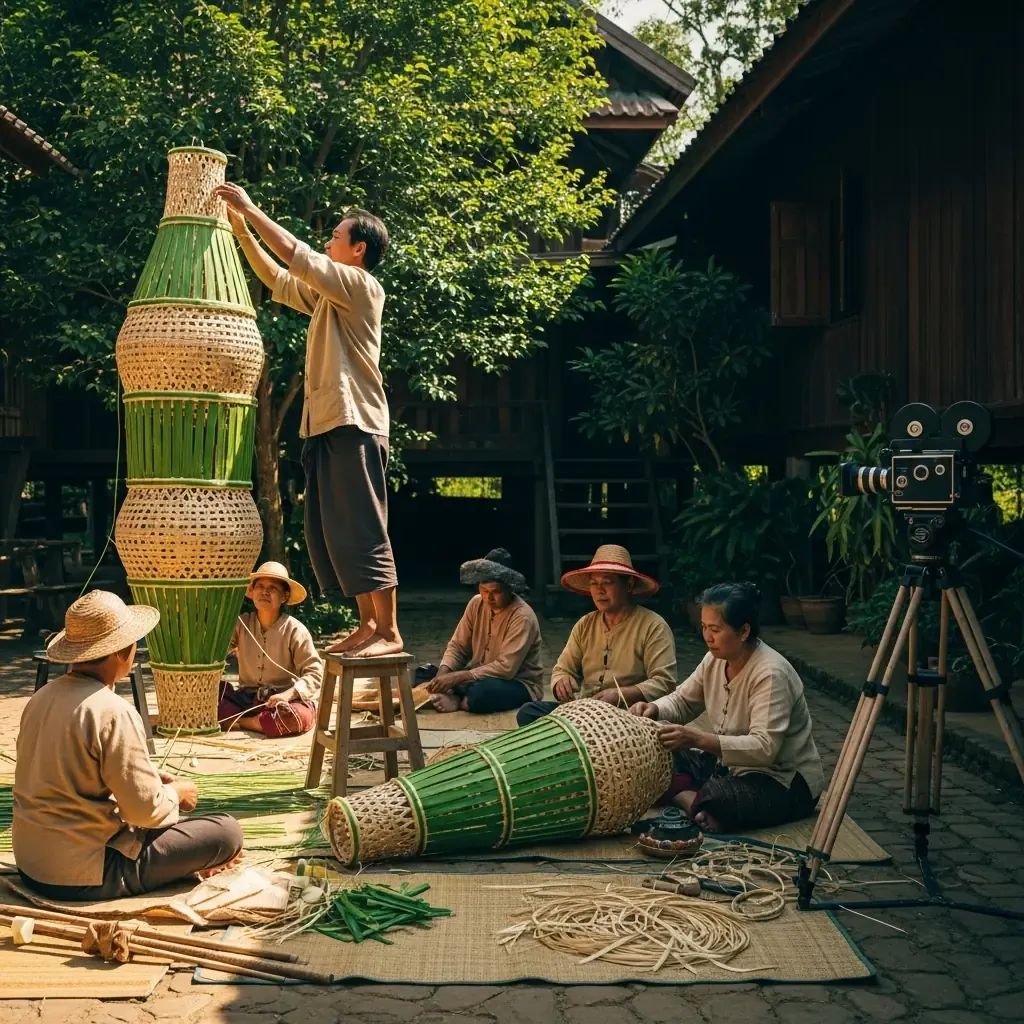
Thailand's film industry generated 1.18 billion baht in direct local spending during Q1 2026 alone—paying Thai crew wages, equipment rentals, and production costs. By May's close at Cannes Film Festival, that momentum crystallized into 1.082 billion baht in new business deals, signaling the Thailand Department of Tourism's most ambitious pivot yet from treating film as a tourism accessory to treating it as a serious export industry that directly benefits residents and workers.
When 15 Thai production houses sat down across negotiating tables at the Cannes Film Festival in May 2026, they were selling production capability, creative expertise, and the machinery that turns ideas into finished content. By the festival's close on May 23, those conversations had crystallized into documented business agreements—a figure that matters deeply to Thailand's creative workforce.
Why This Matters for Thailand's Residents
• Immediate cash flow and employment: Foreign studios now recover 20% of digital production costs (animation, VFX, gaming, sound) on contracts above 5 million baht. To clarify: this means foreign productions working in Thailand receive cash back equal to 20% of their spending on these digital services—but only for contracts exceeding 5 million baht, a threshold designed to attract substantial productions rather than small projects. This cash incentive drives more work to Thai facilities.
• Local crew expansion rippling outward: Over 1.18 billion baht in local crew spending during the first three months of 2026 alone projects to approximately 8.5 billion baht annually if current pace holds—representing a measurable 10% expansion from 2025's record 7.7 billion baht. This translates to expanded hiring for cinematographers, sound engineers, colorists, and production assistants across Thailand, with the heaviest concentration still in Bangkok and Chiang Mai pending infrastructure development in secondary cities.
• Artisanal credibility established: Two Thai features broke into Cannes's most competitive sidebars for the first time in roughly two decades, shifting the festival's perception of Thai filmmaking from regional curiosity to craftspeople-level discipline.
The Thailand business delegations orchestrated 329 individual meetings during those 12 days, working buyer networks from eight countries. Buyers flew in from the United States, Japan, the United Kingdom, South Korea, India, Taiwan, Vietnam, and Russia—not the typical regional film market attendance. That geographic spread suggests something has shifted in how international studios perceive Thai content production: no longer as a cost-cutting option for secondhand work, but as a legitimate creative partner capable of handling primary production responsibilities.
The Breakthrough: Format Sales Over Finished Film
Beneath the headline numbers sits a more strategically significant development. Thailand negotiated not just licensing agreements for existing films, but format sales—rights to adapt Thai narrative concepts and story structures for foreign audiences. One unnamed Boys' Love property attracted interest from a European production company specifically to develop a localized version for broadcast. Five years ago, the same European commissioners dismissed Thai content as culturally impenetrable. Now Thai BL and GL series command subscriber loyalty across Asia and India, with licensing inquiries extending into Latin America and Southeast Asia.
This represents a fundamental reorientation. Thai storytellers are being evaluated for creative substance, not visual exoticism. Horror films—buoyed by strong domestic box office returns—appeal to Western buyers hunting cost-efficient alternatives to Korean and Japanese acquisitions. Drama serials continue functioning as scheduling workhorses across regional broadcasting slots. But the core insight animating Cannes 2026 was simple: Thai narrative voice has market value independent of Thailand's geography.
Structural Friction Points That Will Test Momentum
Before celebrating too loudly, residents and business stakeholders should understand the real operational obstacles that will determine whether Thailand can sustain this trajectory. Thai copyright law remains opaque to international legal teams, and enforcement mechanisms for intellectual property protections are inconsistent. Co-production financing regularly stalls because Thai commercial banks classify creative projects as elevated-risk lending, forcing producers into dependency on personal guarantees or overseas capital structures.
The Board of Investment, which administers the 20% digital rebate, has cultivated a reputation for sluggish application processing and restrictive eligibility interpretations. Labor compliance complicates matters further. While the government markets "skilled crews," many experienced technicians operate through informal employment structures, a reality that creates payroll compliance friction for foreign productions seeking rebate qualification and official documentation.
Building provincial technical depth requires years of sustained investment. Malaysia and Vietnam possess technical talent pools that took decades to develop. Thailand is starting from a narrower base, with most specialized expertise concentrated in Bangkok and Chiang Mai. Training initiatives may eventually relieve the capital's production bottleneck, but expectations of rapid provincial capacity development lack grounding in realistic timelines.
Two Films, Separate Spheres of Prestige
Thai cinema cracked two separately prestigious festival sections, each carrying different industry weight. "9 Temples to Heaven," directed by Sompot Chidgasornpongse and produced by Palme d'Or laureate Apichatpong Weerasethakul, earned selection into Directors' Fortnight—the first Thai feature to secure that slot in approximately 20 years. The film follows a multigenerational family undertaking a spiritual pilgrimage across nine temples, weaving comedy, faith, and generational friction into a road narrative. The film generated overflow crowds at its projected screenings and prompted immediate inquiries from international distributors.
The significance lies in craft credibility: neither production carried studio backing or recognizable star power. Both succeeded through craft and conceptual originality, and that distinction matters for international buyers weighing whether to commission Thai teams with primary creative responsibility.
Donsaron Kovitvanitcha, who directs the Bangkok International Film Festival and holds considerable influence in Thai film criticism, served as a Critics' Week jury member during the festival—embedding Thai perspectives directly into Cannes's governing structures and decision-making committees.
Where the Real Money Moved: The Marché du Film
The Thailand Pavilion functioning as a dedicated operation hub within Cannes's International Village—the festival's dedicated industry marketplace—hosted thousands of square meters of screening rooms and negotiation suites. While celebrities like BamBam worked red carpet assignments promoting the horror feature "The Confession of Shaman," behind closed doors Thai producers were executing the economic heavy lifting.
The 1.082 billion baht total breaks into three distinct tranches: 27.89 million baht in immediate cash settlements, 202.06 million baht in transactions projected to close within 12 months, and 852.23 million baht structured across two- to five-year partnership windows. This staggered revenue recognition reflects how creative partnerships actually function—a feature acquisition may close fast, but co-production pipelines and animation outsourcing contracts require longer lead times and staggered payment schedules.
Existing titles transitioned licensing rights to new territories: "Exchange," "God Skin," "Death Whisperer: Saming The Werebeast," "The Last Bliss," "Khong Khaek 2," and "The Confession of Shaman" all moved digital rights, theatrical distribution agreements, or streaming exclusivity. Beyond individual titles, producers signed forward contracts for animation pipelines, post-production suites, and visual effects rendering farms still in the planning stages—commitments that anchor future employment for technical specialists in Bangkok and provincial creative centers.
Ground Economics: Where Thai Workers Actually Benefit
The economic cascade filters into provincial labor markets faster than headline valuations suggest. Foreign productions shooting within Thailand generated 1.18 billion baht in direct local spending during the first quarter of 2026 alone—crew wages, location rentals, equipment hire, catering, transport logistics. The Department of Tourism reported 162 foreign productions operational in that same three-month window, a pace that projects to approximately 8.5 billion baht annually if current momentum sustains, representing a measurable 10% growth over 2025's already record-setting 7.7 billion baht.
Freelance cinematographers, sound engineers, colorists, and production assistants based in Thailand face denser booking calendars and extended work contracts. Technical workers specializing in animation and digital post-production see the clearest runway for stable employment. The rebate structure effectively subsidizes foreign studios' expenses when outsourcing work to Thai facilities, making Bangkok-based animation cells and VFX studios more price-competitive against alternatives in Vietnam, Indonesia, or the Philippines. A foreign production commissioning 10 million baht in color grading and visual effects work recovers 2 million baht in cash rebates—an advantage that tilts project economics toward Thailand over regional competitors.
Secondary cities hold potential but remain underdeveloped. The government's rhetoric around "Film-Friendly Destination" branding and provincial filming hubs sounds ambitious, yet concrete infrastructure deployments remain vague. Green production standards and crew training pipelines are described as "in the pipeline," but no public announcement has confirmed launch timelines or budget allocations.
Soft Power with Financial Spreadsheets
What remains striking is how Thailand's cultural bureaucracy—typically fragmented and turf-conscious—aligned across three separate ministries to execute a cohesive strategy. The Ministry of Commerce, Ministry of Culture, and the National Soft Power Development Committee collaborated on messaging, logistics, and negotiation support. This interagency coordination is unusual in Thai government, where territorial competition between departments often derails unified initiatives.
The newly established Thailand Creative Culture Agency (THACCA) theoretically operationalizes strategy across 14 creative sectors—film, television, animation, gaming, music, fashion, and others. The government now explicitly frames creative exports as soft power with measurable financial return, departing from the older "promote tourism through cultural storytelling" playbook. At "Thai Night Cannes 2026," the formal reception hosted by the Tourism Authority of Thailand and themed "Reimagining Thailand," Her Royal Highness Princess Ubolratana Rajakanya attended as a signatory guest—an indication that the creative export agenda carries palace-level endorsement and legitimacy.
Foreign potential partners hear a simplified pitch: Thailand offers cost-competitive post-production infrastructure, existing rebate structures (20% for digital services, 30% for foreign film projects exceeding 50 million baht in local spend), and mechanisms to structure deals as equity co-productions rather than vendor-only relationships. This distinction matters. Traditional location-hire arrangements position Thai firms as service providers. Co-production frameworks position them as creative stakeholders.
The Treaty Question Hanging Overhead
Despite the momentum, Thailand has not yet signed formal bilateral co-production agreements with any foreign government, though several nations have signaled exploratory interest. Formal treaties would classify joint projects as domestic productions in all signatory markets, unlocking local subsidies, tax incentives, and broadcast quotas that fundamentally reshape project economics. The absence reflects bureaucratic caution rather than disinterest. Officials are deliberating frameworks that protect Thai intellectual property while simultaneously granting reciprocal market access—a balance requiring negotiation concessions on both sides and legal expertise that apparently hasn't yet crystallized into finalized language.
By year-end, whether Thailand actually executes its first bilateral co-production treaty will test whether Cannes 2026 represented the genuine beginning of systemic transformation or merely the peak of a cyclical surge.
Context: Building on Earlier Momentum
Thailand's Cannes results built directly on earlier performance at FILMART 2026 in Hong Kong. During March's International Film & Television Market, the country negotiated approximately 1.4 billion baht across 705 business meetings, positioning Thailand as a cost-efficient alternative to Singapore and Malaysia for tropical and urban shooting work. The Cannes engagement broadened geographic scope by directly engaging North American and European streaming platforms—entities that typically allocate substantially larger production budgets and production windows measured in months rather than compressed weeks.
Both events reflect a deliberate two-market strategy: first consolidate Asia-Pacific partnership density, then systematically break into Western platform markets where licensing fees and co-production budgets dwarf regional commercial norms.
What Happens Next: 2027 as the Real Test
The Tourism Authority of Thailand has begun framing Cannes 2026 as the opening maneuver in a larger strategic play: "Thailand FILMAZING Year in 2027," a 12-month campaign intended to cement the nation's production hub reputation. Details remain sparse. The initiative is expected to include location showcases, crew skill-development programs, and expanded rebate eligibility windows—language that remains aspirational rather than concrete.
The actual test begins now. Whether Thailand's creative momentum sustains depends fundamentally on three execution mechanisms: whether the government processes rebate applications without excessive delays, whether film permit backlogs clear efficiently, and whether at least one formal co-production treaty gets negotiated and signed by year-end. Those three delivery mechanisms—not festival accolades or celebratory announcements—will determine whether Cannes 2026 marks the genuine beginning of industrial transformation or merely the zenith of temporary visibility before international interest shifts elsewhere.


