
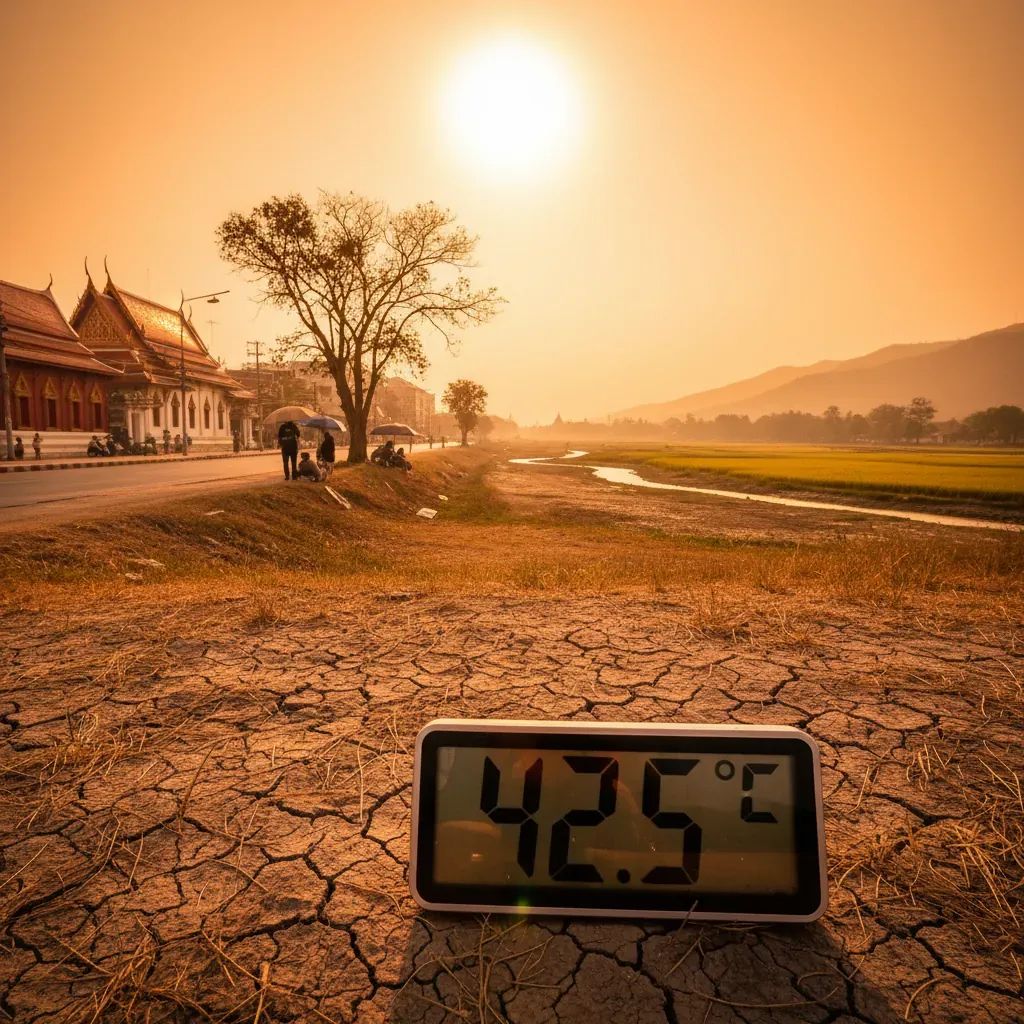
Immediate Practical Guidance for Residents and Workers
Download the AirBKK application immediately. The Bangkok Metropolitan Administration provides real-time heat index monitoring via the app, available on the App Store and Google Play. The app uses a color-coded warning system—when the index reaches "Red zone" (above 52°C), outdoor activity should cease entirely. For informal workers dependent on outdoor income, this creates genuine hardship, but it's the medical reality: exposure at red-zone levels triggers rapid heatstroke onset.
Recognize heatstroke immediately. Heatstroke presents with confusion, loss of consciousness, or seizures—call emergency services (191 for ambulance) at once. Delays of 5–10 minutes increase death risk. Do not wait to see if symptoms improve.
Vulnerable populations—elderly, young children, pregnant women, outdoor workers—should avoid peak heat (10 a.m.–3 p.m.). The BMA has placed 304 cooling centers within roughly 800 meters of most residents, operating 10 a.m.–3 p.m. through May 16. These include schools, health clinics, and district offices across all 50 districts. Cooling centers provide air conditioning, free drinking water, and first aid.
For outdoor workers, the cooling centers provide legitimate refuge during dangerous hours. Loss of a few hours of daily income is preferable to heatstroke. Some informal-sector workers have begun shifting work to early morning (5–9 a.m.) or evening (4–7 p.m.).
When Bangkok's Afternoon Heat Becomes a Medical Countdown
The Thailand Meteorological Department's April forecast has triggered something rare in the capital: a shared acknowledgment that outdoor life becomes genuinely hazardous during midday hours. From now through mid-May, residents face a scenario where the combination of temperature and humidity creates conditions where the human body cannot cool itself through normal mechanisms. The Bangkok Metropolitan Administration isn't framing this as inconvenience—they're positioning it as infrastructure survival, opening 304 climate-controlled spaces because staying home or working outside simply isn't viable for large segments of the population.
Why This Matters:
• The danger window narrows: Heat index conditions exceeding 52°C make outdoor activity medically inadvisable; forecasts suggest 60°C is possible by mid-April.
• Access matters now: The BMA has placed 304 cooling centers within roughly 800 meters of most residents, operating 10 a.m.–3 p.m. through May 16.
• Mortality baseline: Thailand recorded 63 heatstroke deaths in April 2024; hospitalizations are already climbing as April 2026 begins.
• Work doesn't stop for weather: Informal workers—delivery riders, street vendors, construction labor—face crushing income loss as medical necessity prohibits outdoor activity during peak earning hours.
The Heat Crisis: Why April 2026 Is Different
Thailand's climate has shifted permanently. The country's average surface temperature has risen 1.5°C—exceeding the global average increase of 1.3°C—over the past century. January 2025 set a record as the warmest January ever measured.
Here's what this means for residents: A forecast of 38°C air temperature combined with Bangkok's typical April humidity (70–80%) creates a heat index closer to 53°C. When humidity and temperature combine this way, your body cannot cool itself through perspiration alone. Core temperature rises, and heatstroke becomes imminent.
The Thai Meteorological Department has identified why April 2026 is particularly dangerous. A low-pressure system is stalled over upper Thailand while weak westerly winds fail to provide cooling. The northeast monsoon has ended, and the southwest monsoon—which brings rain and cloud cover—won't arrive until mid-May. This leaves April with virtually unbroken sunshine and no cloud cover to break the heat. Bangkok's concrete landscape compounds the problem: asphalt, glass, and steel absorb heat during the day and radiate it back at night, preventing the thermal recovery that makes survival manageable.
The TMD expects maximum air temperatures between 36°C and 42°C across the capital. These readings will likely be exceeded in dense construction areas. Residents in tin-roofed housing or multi-unit buildings without air conditioning will experience interior temperatures 5–10°C higher than outside readings—creating indoor environments that become unlivable without active cooling.
What Happens to Your Body
Heatstroke symptoms appear suddenly and can be fatal. The elderly (60+), children under 5, pregnant women, outdoor workers, and individuals with chronic conditions face disproportionate risk. A person can appear to be merely sweating profusely moments before confusion and seizure begin.
If someone loses consciousness, becomes confused, has seizures, or has a core body temperature above 40°C, call 191 immediately. This is a medical emergency. Hospital treatment—using ice immersion and rapid cooling techniques—must begin within 10 minutes to prevent death.
The Thailand Ministry of Public Health has directed hospitals to activate emergency protocols if air temperatures exceed 43.1°C. However, hospitals have limited capacity. A major Bangkok hospital might have 20–30 ICU beds available; a severe heatwave could generate 50+ heatstroke admissions in a single afternoon. Patients requiring intensive care consume resources for days or weeks.
Economic impact spreads unevenly across society. Formal-sector office workers experience the heatwave as an inconvenience (a higher electricity bill). Informal workers face a stark binary: work in dangerous conditions risking heatstroke, or skip work and lose income. A Bangkok delivery rider earning 400–500 baht daily cannot afford to take two weeks off. Construction workers, street vendors, and agricultural laborers similarly cannot pause labor. This disparity underscores the importance of robust cooling center infrastructure to protect vulnerable populations and ensure equitable access to heat protection.
The Infrastructure Response
The Bangkok Metropolitan Administration activated 304 climate-controlled cooling centers beginning April 1, distributing sites across all 50 districts. The network comprises 100 schools, 10 vocational training centers, 68 public health clinics, 76 cultural and sports facilities, and 50 district offices. Each provides air-conditioned space, free drinking water, and basic first aid supplies.
Supplementing these are 178 "cooling spots" in public parks and the city's network of "15-minute forests." Additionally, 2,806 free drinking water stations have been deployed, acknowledging that dehydration accelerates heat illness even in air-conditioned environments.
The usage numbers reveal both success and expanding reach. In the first week of April, 30,208 residents accessed cooling centers. A satisfaction survey of 990 visitors found 99.6% approved of the service, with 98.89% stating they would return. These metrics demonstrate strong public confidence in the infrastructure. As more residents become aware of available resources and heat threats intensify, higher utilization is expected. The network's distribution ensures that informal workers, residents of inadequate housing, and elderly individuals unable to sustain home cooling costs have reliable access to life-saving infrastructure within walking distance.
A Permanent Shift in How Bangkok Functions
The cooling center initiative represents a forward-thinking response by city leadership to ensure that heatwaves—now recognized as recurring seasonal challenges—are managed through permanent, equitable infrastructure. By maintaining 304 cooling centers every April through May, Bangkok's public health system demonstrates adaptive governance that protects all residents. Heat mitigation has become a core and essential function of responsible urban administration.
Looking outward to 2050, climate economists project Thailand's GDP could contract 7–14% without serious adaptation measures. Agricultural productivity faces compounding threats—drought stress, flooding, temperature extremes, and pest proliferation—all occurring simultaneously. Fisheries will shift as ocean temperatures rise. Proactive infrastructure investment now—including the cooling center network—positions Thailand to mitigate these economic and social risks.
For residents navigating April 2026, the practical implication is straightforward: the cooling centers and water stations are essential resources for maintaining public health and safety. Learning to use them efficiently, understanding heatstroke symptoms, adjusting work schedules, and securing backup cooling sources are now standard components of urban resilience.
This is not a passing inconvenience. Thailand is witnessing a permanent shift in the baseline climate, and April 2026 is the inflection point where that shift becomes undeniable to residents and policymakers simultaneously. The BMA's proactive response demonstrates Thailand's capacity to manage emerging challenges through effective public infrastructure and coordinated governance.


