
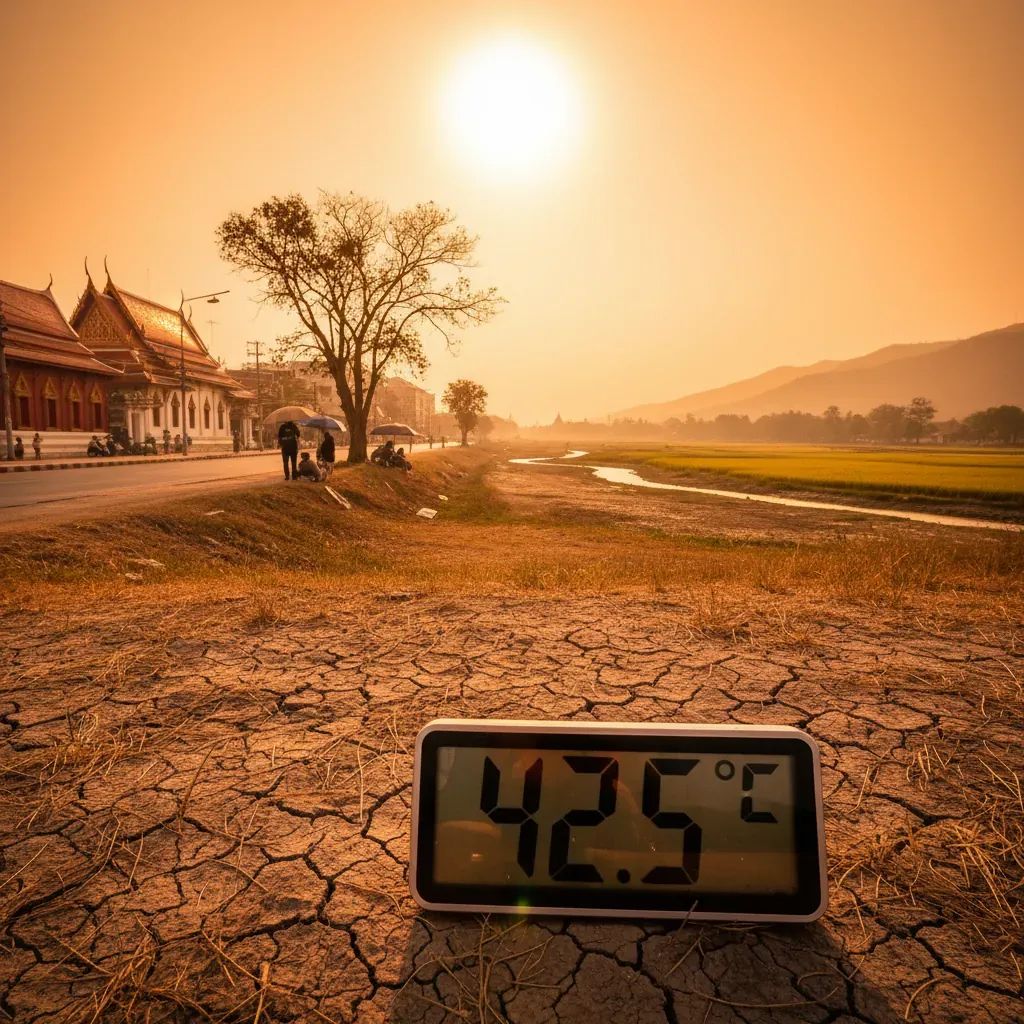
Thailand's meteorological authorities are signaling an urgent atmospheric shift that will reshape outdoor activities, work schedules, and agricultural planning across the northern and central regions through the first week of April. A stubborn heat low-pressure system will anchor itself over upper Thailand starting March 29, generating a collision of extreme heat, sudden convective storms, and occasional hail that officials have specifically flagged as requiring immediate public precautions.
Why This Matters
• Temperature extremes peak near 42°C in the North and Northeast—a threshold where outdoor labor becomes medically dangerous without strict heat-management protocols.
• Isolated hail on March 29 creates acute crop vulnerability during a sensitive growing window when vulnerable trees and seasonal harvests face obliteration.
• Structural and maritime hazards emerge: Wind gusts accompanying storms can compromise loose construction materials, outdoor signage, and small vessel operations.
• Regional variation is significant: Bangkok and the South experience milder conditions than northern provinces, affecting whether businesses implement heat response measures.
The Atmospheric Setup: Why This Matters
The reason for such intense conditions lies in how Thailand's geography creates a weather pressure cooker. During late March, the region sits in a transitional zone where warm, moist southeasterly winds flowing from the Gulf collide with a stagnant heat dome positioned over inland plateaus. This collision is unstable—when humid air rises rapidly through such a superheated layer, it explodes into violent updrafts capable of generating hail, heavy precipitation, and dangerous wind shear in a matter of minutes.
The Thailand Meteorological Department has positioned March 29 as the flashpoint, when these competing air masses reach peak intensity. After that date, the pattern gradually weakens, though temperatures remain elevated through April 3. The transition occurs because the low-pressure system will begin drifting, allowing cooler air masses to filter into the region.
Understanding the mechanism explains why this isn't merely an inconvenience forecast but rather a sequence requiring behavioral adjustments and protective infrastructure.
Geographic Risk Breakdown: Where Impact Concentrates
The North bears the full force. Minimum temperatures will only dip to 20-26°C at night—insufficient for physiological recovery—while daytime peaks consistently reach 36-42°C with hail and thunderstorm coverage affecting 10-20% of the region on March 29. Overnight hours offer almost no cooling benefit because the heat remains trapped by the low-pressure dome. Southwest winds at 5-15 km/h provide minimal air circulation. Residents and workers face accumulated heat stress across an extended period.
The Northeast mirrors this severity. Maximum temperatures reach 36-40°C, with similar nighttime minimums (22-27°C), creating the same recovery deficit. Southeasterly winds at 10-15 km/h are marginally stronger than the North but remain inadequate for meaningful convective cooling.
Central Thailand and Bangkok experience notably different conditions. The capital will reach only 34-39°C with thunderstorm coverage limited to 10% of the metropolitan area. Nighttime temperatures in the 25-27°C range feel oppressive but are survivable without emergency intervention. Southern portions of the Central region push toward 41°C, creating localized heat pockets within the broader zone.
The East faces 33-39°C with the region's strongest winds (10-30 km/h southeasterly). Waves in the Gulf normally remain below 1 meter except during thunderstorms, when conditions deteriorate rapidly. Maritime activity here requires careful timing.
Southern Thailand—both Gulf and Andaman coasts—experiences the mildest exposure. Maximum temperatures stay in the 32-38°C range with only 10-30% thunderstorm coverage. Waves remain manageable near 1 meter except during active storm cells. This regional variance means southern businesses and agricultural operations will not require the same emergency response as northern counterparts.
Who Bears the Greatest Exposure
Agricultural operations in northern provinces face the most immediate threat. Isolated hail reaching ground level can damage young fruit trees, harm flowering crops, and destroy vulnerable seedlings. For farmers operating at tight profit margins, such losses represent genuine financial catastrophe. The Thailand Meteorological Department has emphasized that protective measures must be completed before March 29—waiting for storm development leaves no time for action. Physical bracing of fruit trees using stakes and flexible supports should be prioritized. Irrigation systems require full charges to rapidly replenish soil moisture in heat-stressed plants. Young seedlings vulnerable to hail should be relocated under temporary roof structures. Livestock operations need expanded shade infrastructure and continuous water access; animals exceeding 40°C body temperature deteriorate quickly, and farmers frequently underestimate how rapidly dehydration becomes fatal.
Construction and ground-level workers across the North and Northeast operate in genuinely hazardous conditions. The combination of extreme heat exceeding 40°C and wind gusts accompanying thunderstorms creates a compounding risk environment. Scaffolding, metal roofing, unsecured framing materials, and billboard structures become projectile hazards when wind speeds exceed 50-60 km/h. Employers must legally mandate work schedule compression—shifting labor-intensive tasks to early morning (5-7 AM) and late afternoon (4-6 PM) while eliminating the 11 AM-3 PM window when heat reaches peak intensity. Rotation periods through shaded rest zones should not exceed 90-minute intervals. On-site medical protocols should include electrolyte replenishment stations and the ability to rapidly evacuate workers exhibiting heat stroke symptoms (disorientation, cessation of perspiration, rapid heartbeat).
Bangkok's urban workforce will experience respiratory and thermal stress despite temperatures remaining below northern extremes. The combination of haze, stagnant southerly winds at 10-15 km/h, and 36-39°C temperatures creates what public health officials recognize as a respiratory stress index. Office environments lacking robust air conditioning should implement work-from-home protocols or shortened hours during March 29-April 1. Schools may voluntarily shift to half-day sessions. Government offices frequently announce schedule modifications. Residents without air conditioning should plan movement to climate-controlled public spaces (shopping malls, libraries, community cooling centers) during peak afternoon hours.
Coastal fishing and ferry operations require specific attention to timing rather than cancellation. Gulf wave forecasts of approximately 1 meter reflect calm-to-moderate conditions, but the critical caveat is that wave heights exceed 1 meter during thunderstorms. Wind direction shifts associated with storm development create chaotic sea states rapidly. Fishing crews should establish a hard return-to-port deadline of 2 PM starting March 29, avoiding both afternoon storm development and nighttime navigation in deteriorating visibility. Ferry operators should confirm real-time weather updates before departing rather than relying on morning forecasts.
Hail: A Signal of Atmospheric Danger
Hail in tropical Thailand signals unusually powerful storms—something many residents don't expect. These ice particles form only when storm updrafts are strong enough to carry raindrops into freezing altitudes far above ground. The presence of hail tells you the storm will likely bring heavy rain, dangerous winds, and frequent lightning rather than the gentle tropical showers residents typically experience. Hail reaching the surface in upper Thailand typically remains small (pea to marble-sized) rather than the grapefruit-sized stones occurring in colder climates, but size matters less than what the phenomenon signals: a storm system with serious convective power.
Outdoor events and gatherings scheduled near March 29 should be postponed or shifted indoors. Songkran celebrations planned for early April can proceed normally if meteorological updates confirm the system has weakened by April 2-3, but organizers should confirm weather status 48 hours prior.
Seasonal Context and Historical Perspective
This pattern arrives during Thailand's annual heat peak—the final weeks before Songkran when the year's maximum temperatures typically occur. The 42°C maximum forecast sits within historical norms for upper Thailand, though such extremes do not arrive annually and represent the upper boundary of comfortable variation. Urban areas amplify heat through thermal mass and reduced vegetative cooling, so Bangkok residents experience temperatures feeling 2-4°C hotter than official weather station readings.
Haze during this period reflects typical late-March air quality degradation caused by agricultural burning across northern provinces. However, when combined with extreme heat and stagnant wind conditions, haze concentrations can reach unhealthy thresholds for sensitive populations—children, elderly residents, and those with respiratory or cardiac conditions face genuine medical risk.
Forecasters expect the pattern to dissipate by April 4, allowing gradual temperature moderation before Songkran celebrations commence April 13. However, atmospheric systems occasionally persist beyond official predictions, so continued monitoring through early April remains prudent rather than excessive caution.
Essential Preparation Actions
Generic "stay hydrated" advice misses the operational specificity required for genuine preparedness. Stock minimum 3-5 liters of drinking water per household member daily—this exceeds normal consumption during heat stress periods. Charge all portable electronic devices and portable battery packs before March 29, as severe storms occasionally trigger temporary power disruptions. Verify that refrigerated medications have backup cold storage capacity using portable coolers or ice packs. Confirm elderly neighbors possess communication access and arrange check-in protocols during peak heat days. Employers should service air conditioning equipment March 27-28, test backup cooling capacity, and confirm staffing flexibility if reduced-hour operations become necessary. Agricultural producers should finalize all crop protection measures by March 28—attempting emergency measures as storms arrive is operationally futile.
The Thailand Meteorological Department issues forecast updates twice daily (morning and afternoon). Checking afternoon updates for the next calendar day allows real-time schedule adjustments and refined operational planning rather than relying on overnight forecasts that may not capture overnight model adjustments.


