
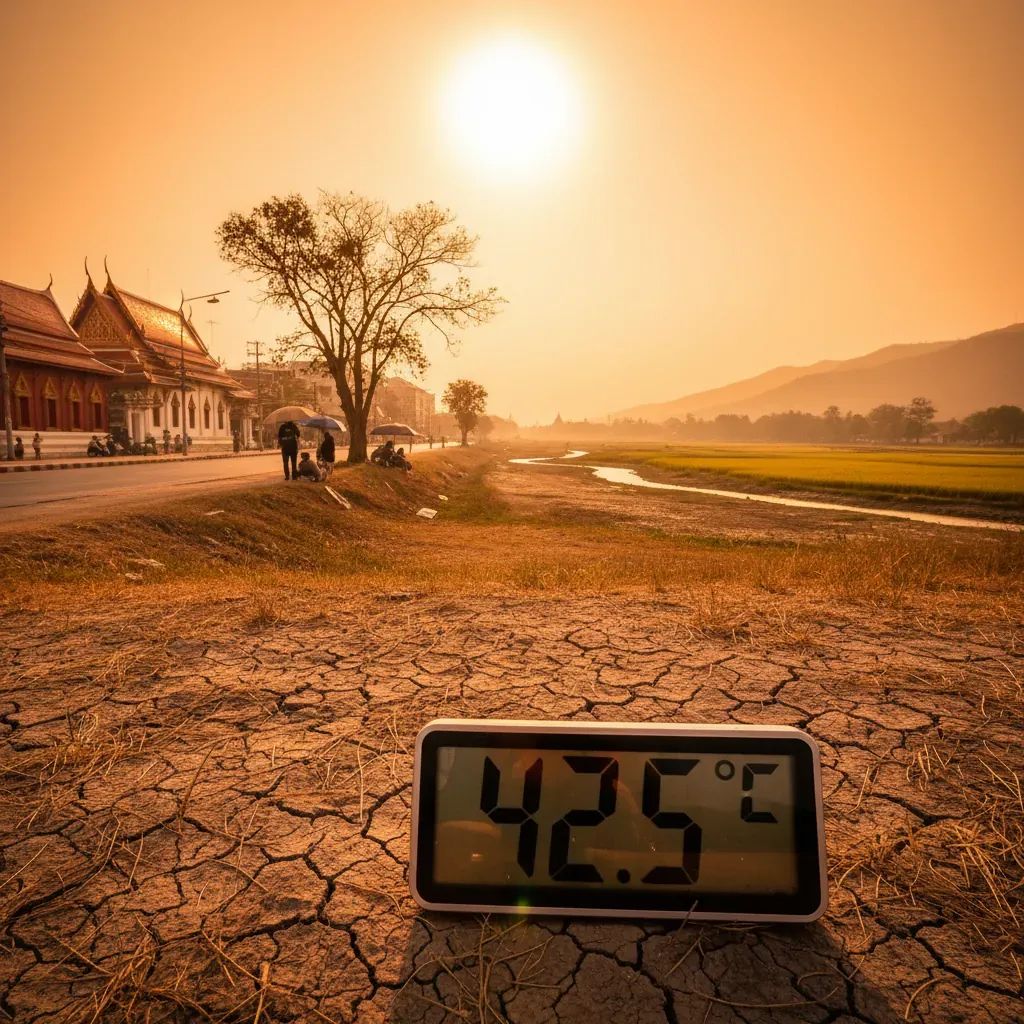
Pacific Water and Heat Shifts Reshape Thailand's Summer and Fall Plans
As Thailand enters the summer of 2026, the picture becomes increasingly clear. The US National Oceanic and Atmospheric Administration has signaled that tropical Pacific temperatures will slip into El Niño territory, with an 82% probability that the pattern will persist through the Northern Hemisphere winter. For people living here, the implications span water access, food prices, employment stability, and daily health routines. The convergence of climate forecasts—each pointing toward significant heat and moisture disruption—demands practical attention beginning immediately.
Why This Matters
• Heat index readings potentially reaching 44–48°C: Temperature peaks will climb into dangerous ranges across much of the country from mid-2026 through August, with prolonged exposure becoming a genuine occupational and public health hazard. (Note: These are heat index projections, not actual air temperatures, and will be most severe in lowland provinces.)
• Water utilities flagged supply vulnerabilities: The Thailand Provincial Waterworks Authority has identified critical raw water shortages affecting millions of households; rationing timelines remain fluid but preparations must begin now.
• Agricultural transitions are underway: Government subsidy programs for drought-resistant crop varieties are live; enrollment deadlines will pass in the coming weeks and next month.
• Extreme volatility compressed into one year: Severe drought lasting through August will be followed by intense downpours September through November—infrastructure and households must prepare for both.
The Pacific Mechanism and Thailand's Position
El Niño emerges when equatorial Pacific sea surface temperatures warm roughly 0.5 degrees Celsius above their historical average. This seemingly modest shift triggers atmospheric circulation changes that ripple across continents, altering wind patterns, rainfall distribution, and surface temperatures. The US Climate Prediction Center now places the probability of this occurrence through Northern Hemisphere winter 2026–2027 at 82%, with forecasters indicating roughly one in three chance that the event reaches "very strong" intensity (temperatures exceeding 2 degrees Celsius above average) by late 2026.
What makes the 2026 scenario distinct from previous cycles is the underlying temperature baseline. The globe has warmed approximately 1.5 degrees Celsius since preindustrial times. When El Niño arrives atop this already-warm planetary state, the compounding effect becomes severe. Computer models operated by multiple institutions converge on scenarios where either 2026 or 2027 becomes one of the hottest years on record—a distinction with tangible consequences for infrastructure stress, energy demand, and water system strain.
Thailand occupies a geographic zone particularly vulnerable to El Niño's effects. Monsoon rainfall diminishes precisely when agricultural water demand peaks. Subsurface ocean temperatures across the tropical Pacific have climbed above average for six consecutive months, a precursor signal suggesting the phenomenon will solidify rapidly once sea surface conditions cross the critical threshold expected this month.
Drought, Then Flooding: The Compressed Crisis
The phrase "two-pole water crisis" circulating among Thai climate analysts describes the compressed pattern awaiting mid-to-late 2026. Mid-year through August brings genuine drought risk with heat index readings potentially approaching 44–48 degrees Celsius in lowland provinces. Reservoir levels typically decline sharply during these months. Agricultural demand for irrigation peaks while rainfall remains suppressed.
Then, beginning in September, monsoon patterns shift. Concentrated rainfall arrives with intensity heightened by global warming. Flash flooding, overflowing drainage systems, and sudden inundation become probable rather than exceptional. Within a single calendar year, regions face both severe water scarcity and destructive excess—a volatility pattern infrastructure designed for historical averages cannot easily absorb.
The Thailand Ministry of Agriculture and Cooperatives has recognized this duality in its operational framework. Rather than a single-crisis response, the ministry structured initiatives around four simultaneous operations: reservoir storage discipline, atmospheric water augmentation through rainmaking units, rapid agricultural restructuring toward low-water crops, and early-warning networks.
What Water Utilities and Provinces Are Flagging
The Provincial Waterworks Authority identified utility branches across provinces facing critical raw water shortages during mid-2026 through August. These are not speculative assessments—they reflect current reservoir inventories and projected consumption against anticipated rainfall. Provinces including Surin, Sisaket, and Khon Kaen in the northeast, Tak in the north, and Kanchanaburi centrally have been formally notified that supply rationing may become necessary if rainfall falls below certain thresholds in June and July.
Household groundwater reliability also faces strain. Wells in water-stressed zones may experience depressed levels or temporary exhaustion if drought extends beyond historical patterns. The practical implication for residents in potentially affected areas is straightforward: establish backup water storage now. A week's supply of potable water stored in sealed containers requires minimal space and investment but becomes invaluable if municipal systems implement rationing or experience temporary disruption.
Urban residents relying on municipal supply should monitor announcements from local water utilities; rationing schedules will be released through government channels and media once implementation timelines are confirmed. Rural households dependent on wells should assess stored reserves and consider repairs or deepening now, before peak demand arrives in mid-2026.
The Agricultural Restructuring Unfolding Now
Thailand's farming sector faces compounded pressure. Traditional rice cultivation—economically central to rural livelihoods—demands consistent water during growing seasons that El Niño typically disrupts. Higher-value fruit and vegetable varieties use less water while commanding premium market prices, yet require different soil preparation, seed sourcing, and market linkages than rice.
The Ministry of Agriculture's extension system has mobilized across 77 provinces, distributing seedlings and technical guidance for drought-resistant alternatives. These are not experimental crops; they are market-tested varieties—dragon fruit, passion fruit, high-value vegetable species—with established export and domestic demand. Farmers willing to transition receive government compensation for early adoption, though details are being finalized at provincial levels.
The window for decisions is constrained. Seedling selection, soil preparation, and market coordination require months before harvest. District agricultural extension offices (found in every district) are offering free consultations in the coming weeks; farmers should initiate conversations immediately to understand available varieties, subsidy eligibility, and feasibility for their specific plots.
Rainmaking and Reservoir Management Operations
Thailand's Department of Royal Rainmaking operates cloud-seeding aircraft and ground-based operations during drought episodes. The technology is not a panacea—it increases rainfall by a measurable but modest margin—yet every percentage point of moisture augmentation reduces agricultural losses and extends municipal water supply windows. By July 2026, operational tempo will accelerate in historically vulnerable zones.
Simultaneously, the Thailand Royal Irrigation Department has tightened water release protocols from major reservoir complexes serving millions of hectares of farmland and urban populations. Storage conservation targets are now explicit, and cross-sector coordination between irrigation, municipal, and power generation water users has intensified. Officials will begin releasing detailed rationing schedules in June pending final rainfall assessments.
This is not abstract bureaucratic repositioning. It translates into specific irrigation schedules reaching farmers by mid-June and municipal supply advisories arriving by early July. Those dependent on agricultural income or living in water-stressed zones should expect notifications from local government offices and respond by implementing household-level water conservation measures immediately.
Heat Index Thresholds and Public Health Adaptation
Heat index readings potentially reaching 44–48 degrees Celsius create genuine physiological risk, particularly in lowland areas and during peak hours. The human body struggles to dissipate excess heat above certain thresholds, and prolonged outdoor exposure invites heat exhaustion, heat stroke, and exacerbation of chronic cardiovascular conditions. Vulnerable populations—elderly residents, outdoor laborers, children—require deliberate protection strategies.
The practical calculus is straightforward. Limit outdoor activity between 11 a.m. and 3 p.m. when solar radiation peaks. Maintain consistent hydration, particularly for outdoor workers. Employers should coordinate adjusted shift schedules or heat rest periods with staff. Households should teach children and elderly relatives to recognize heat exhaustion symptoms—dizziness, nausea, confusion, rapid heartbeat—and seek shade or indoor cooling immediately upon onset.
Industrial and agricultural workers face occupational exposure that household strategies cannot fully mitigate. The Ministry of Labor has issued guidance permitting scheduled breaks in shaded or cooled environments during extreme heat periods; workers should know their rights and employers should proactively implement these protocols rather than awaiting complaints or medical incidents.
Economic Ripple Effects on Food and Energy Prices
Reduced agricultural productivity and higher cooling demand during El Niño years typically push food and electricity prices upward. Crop failures in major agricultural regions reduce supply and increase commodity costs. Air conditioning demand during sustained heat waves strains power generation capacity, elevating per-kilowatt rates for utilities managing system load.
These are not speculative concerns; historical El Niño events document consistent price pressures. Households should budget consciously for elevated staple costs through mid-2026 and into 2027. Pantry stocking of shelf-stable essentials—rice, cooking oils, canned proteins, shelf-stable vegetables—purchased during current prices provides price-lock protection and supply security if disruption occurs. This is prudent financial planning, not hoarding.
Energy costs will similarly climb. High-efficiency air conditioners, ceiling fans, and behavioral adjustments—drawing curtains, reducing daytime cooling temperatures by 1–2 degrees—reduce consumption and limit bill shock. Employers should anticipate higher operational costs during peak heat months and adjust budgets accordingly.
The Comparative Historical Context: 2015–2016 and 2026
The 2015–2016 El Niño reached 2.4 degrees Celsius above average, making it one of the most intense events since modern record-keeping began in 1950. It pushed both 2015 and 2016 into hottest-year-on-record territory and triggered global climate impacts—severe droughts in East Africa and Australia, flooding in South America, atmospheric circulation disruptions across hemispheres.
Yet that event unfolded when the planetary temperature was roughly 0.5 degrees Celsius cooler than 2026. The baseline warmth itself acts as a multiplier. Current forecasts show roughly one in three chance that the 2026 El Niño will reach "very strong" intensity (temperatures exceeding 2 degrees Celsius above average) by late year, potentially matching or exceeding the 2015–2016 peak. If realized, this would mark the first comparable event in over a decade—occurring under fundamentally different planetary conditions.
The implication extends beyond meteorology. Water stress, wildfire risk, disease vector expansion, and infrastructure strain all accelerate sharply at temperature thresholds. Historical precedent captures only part of the vulnerability; the novel aspect is the compounding of a powerful natural climate fluctuation atop an already-warm baseline from human-driven climate change.
Southeast Asia's Synchronized Preparation
Thailand's response reflects broader regional mobilization. Singapore has opened cooling centers citywide and expects monthly rainfall to decline 40–80% during peak El Niño months. The city-state operates within razor-thin water margins; its contingency protocols are detailed and regularly drilled.
Malaysia, particularly Kuala Lumpur, has issued heat-stress warnings. When temperatures sustain at 35–37 degrees Celsius for three consecutive days, officials activate extended hours at public facilities offering air conditioning and expanded health monitoring.
Vietnam anticipates earlier and more intense heatwaves. The Mekong Delta, already grappling with saltwater intrusion from sea-level rise, faces exacerbated risk during dry seasons when freshwater flows diminish. Agricultural losses in the delta—source of roughly 50% of Vietnam's rice export—cascade through regional food security.
The Philippines is transitioning conditions for El Niño impacts. High-elevation zones face elevated heat index readings, and El Niño will compress that vulnerability. Typhoon patterns remain uncertain but residents should maintain preparedness.
Indonesia anticipates severe forest fire seasons. El Niño historically correlates with intense wildfires across Kalimantan and Sumatra, and the resulting transboundary haze affects air quality across the region. Thailand should monitor Indonesian fire preparedness closely, as smoke intrusion could degrade air quality regardless of local conditions.
Immediate Action Calendar for Mid-2026 and Beyond
Coming weeks (May–early June 2026): Establish household water storage if you live in water-stressed areas. Farmers should contact district agricultural extension offices for crop transition consultations and seedling availability. Employers should review air conditioning and worker safety protocols.
Early to mid-June 2026: Finalize agricultural decisions; seedling planting windows are narrow. Water utilities will release preliminary supply advisories. Monitor official rainfall forecasts as they refine regional impact predictions.
July onward: Expect confirmed rationing schedules if drought conditions materialize. Implement household conservation measures—shower duration reduction, landscaping water restrictions, laundry timing adjustments. Outdoor workers should begin practicing heat-stress mitigation routines.
August through November 2026: Sustain drought awareness through August; shift to flood preparedness starting September. Store sandbags, buckets, evacuation supplies, and first-aid kits. Keep emergency contacts accessible.
The Resilience Question
El Niño effects typically persist 12–18 months beyond the phenomenon itself, meaning adaptation investments made in 2026 will determine vulnerability through 2027. The Thailand government's four-pillar framework—storage, replenishment, transition, surveillance—represents institutional recognition that climate volatility is intensifying and adaptation infrastructure must advance in parallel.
The framework itself is not novel; past drought episodes prompted similar responses. What distinguishes the current mobilization is inter-agency coordination scale and advance notice. Preparation timelines are compressed, resources are being allocated preemptively, and communication channels between national agencies, provincial governments, and households have been explicitly activated.
Whether mid-to-late 2026 and into 2027 becomes a managed disruption or a compounded crisis depends substantially on decisions and preparations unfolding across government and private sectors over the next six to eight weeks. The scientific consensus is clear: El Niño is arriving, intensity remains uncertain but possibly severe, and impacts will be felt unevenly across regions and sectors.
The practical response—water reserves, agricultural adaptations, employment protections, household precautions—remains available to anyone willing to implement it now. Waiting for peak drought or extreme heat to begin preparations guarantees worse outcomes.


