
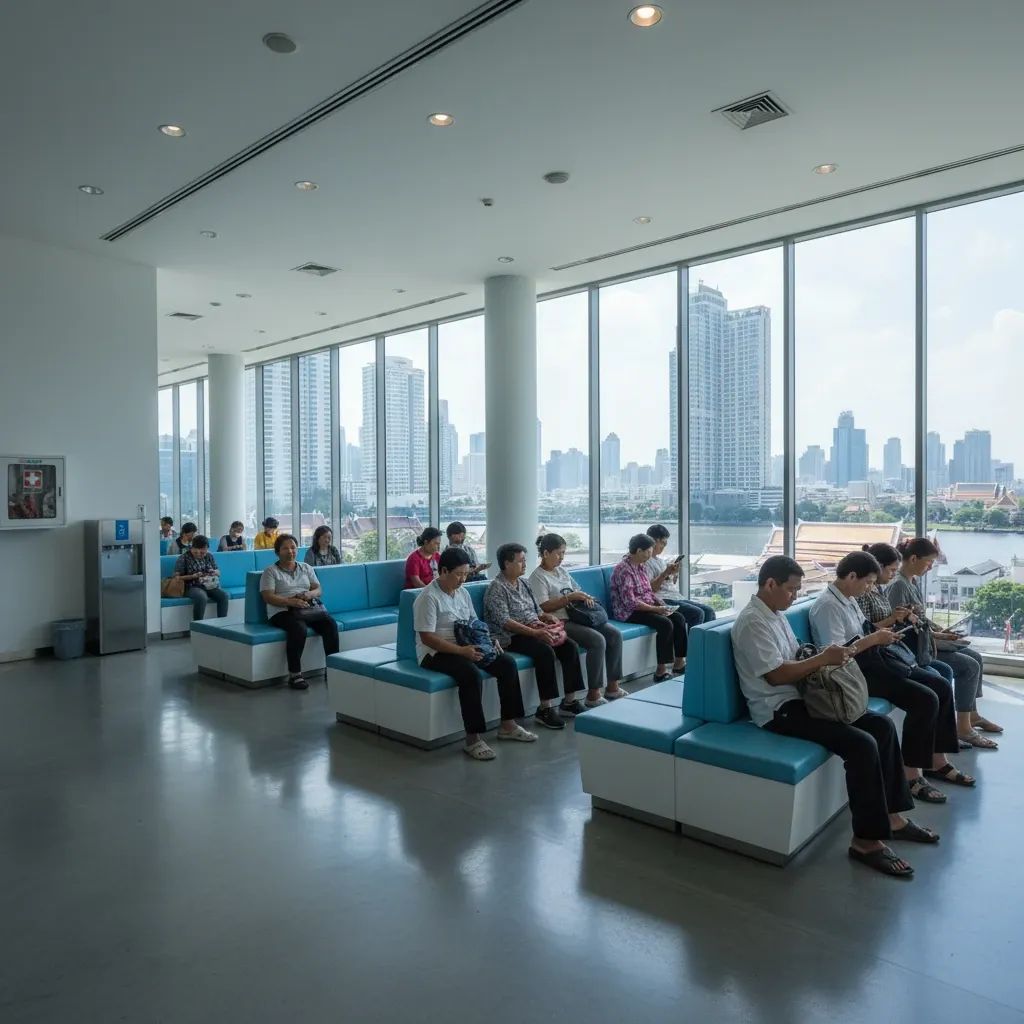
The Bangkok Metropolitan Administration has activated 120 air-conditioned cooling rooms across the capital, a direct response to forecasts predicting temperatures will soar to 42-43°C during the coming hot season—a move that transforms public buildings into literal shelters from heat that has already killed 61 people nationwide in a single recent year.
Why This Matters
• Cooling centers open March-April, 11 AM to 3 PM at all 50 district offices, 69 public health centers, and select schools—drinking water and first-aid included.
• 379 heat-risk zones identified citywide, including construction sites, markets, motorcycle taxi stands, and dense communities where outdoor workers face maximum exposure.
• Heat index warnings now color-coded: green (monitoring), yellow (warning), orange (danger), red (extreme danger)—with the "feels-like" temperature frequently exceeding 52°C when humidity is factored in.
• Peak danger window runs late February through mid-May 2026, hotter than last year according to the Thailand Meteorological Department.
Regional Context: Bangkok Among First to Deploy Mass Cooling Infrastructure
While neighboring capitals like Manila and Kuala Lumpur are still drafting heat action plans for 2026, Thailand's capital has already mapped every vulnerable block and opened doors to climate-controlled refuge. The strategy, developed with World Bank technical support under the "Shaping a Cooler Bangkok" initiative, places the city ahead of much of Southeast Asia in operationalizing immediate heat relief.
Singapore maintains a comparable level of readiness with its national Mercury Taskforce and expanding network of Wet-Bulb Globe Temperature monitors, but Bangkok's 120-center rollout represents one of the region's most extensive public cooling networks per capita. Jakarta has pivoted to weather modification operations and tree planting, while Vietnam acknowledges significant knowledge gaps in managing urban heat islands despite having a national adaptation framework through 2050.
The difference is implementation speed. Bangkok's cooling rooms are already accessible via an online GIS map at greener.bangkok.go.th, allowing residents to pinpoint the nearest refuge in real time—a level of service infrastructure that remains aspirational in cities like Ho Chi Minh City and Hanoi.
What This Means for Residents and Workers
If you work outdoors between March and April, the new system is designed explicitly for you. The BMA identified motorcycle taxi drivers, construction laborers, street vendors, and market workers as the highest-risk groups—precisely the demographics that accounted for most of Thailand's 212 heat-related deaths between 2019 and 2024. Men aged 41-60 with underlying health conditions and those consuming alcohol while exposed to sun are statistically the most vulnerable.
The cooling centers stock drinking water, basic medicines, and emergency contact systems. While the typical operating window is 11 AM to 3 PM—the period when the heat index peaks—district offices also function as cooling spaces during standard government hours, effectively extending refuge availability for morning and late-afternoon workers.
For families, the network includes state-run schools and sports facilities, ensuring children and elderly relatives have nearby options. The 69 public health service centers within the network can provide immediate medical assessment if heat exhaustion symptoms—dizziness, confusion, slurred speech, blurred vision—begin to manifest.
The Science Behind the Four-Level Alert System
Bangkok's color-coded heat index warnings synthesize temperature and humidity into a single "feels-like" metric aligned with Thailand Ministry of Public Health guidelines. This approach mirrors international best practices: Singapore uses WBGT (Wet-Bulb Globe Temperature) monitoring with a threshold of 33°C signaling high stress, while experts in Malaysia have criticized their own meteorological agency for relying solely on dry-bulb temperature readings that underestimate actual heat danger.
The Thai system triggers progressively urgent advisories:
• Green (Monitoring): Normal outdoor activity permissible, but hydration recommended.
• Yellow (Warning): Limit strenuous outdoor work; vulnerable groups should stay indoors.
• Orange (Danger): Outdoor labor strongly discouraged; heat exhaustion risk elevated.
• Red (Extreme Danger): Life-threatening conditions; outdoor exposure can cause heatstroke within minutes.
During April 2024, Bangkok recorded consecutive days of red-level warnings, with actual temperatures hitting 40.1°C and the heat index surpassing 52°C. That month contributed to a national death toll that nearly doubled the previous year's total by early May.
Long-Term Infrastructure: Beyond Emergency Cooling
The cooling centers are the visible front edge of a broader transformation. The BMA Heat Management Committee, a new coordinating body established specifically for this initiative, is steering long-term interventions that include:
• One million tree planting project targeting the urban heat island effect, which adds several degrees to Bangkok's baseline temperature compared to surrounding rural areas.
• 15-minute park initiative ensuring every neighborhood has accessible green space within a quarter-hour walk.
• Revised building codes requiring new construction to incorporate climate-adaptive design, improved airflow, and cool materials.
• Water body expansion to increase evaporative cooling across the metropolitan footprint.
These measures parallel Singapore's national cooling strategy, which integrates green roofs, vertical gardens along transport corridors, and district-level cooling technology. Jakarta is accelerating tree planting but lacks the regulatory framework Bangkok is implementing for new buildings.
Who Is Most at Risk and How to Access Help
The 379 heat-risk zones cataloged by the BMA disproportionately affect low-income communities where housing lacks air conditioning and residents rely on outdoor labor. Open-air markets, informal settlements, and construction sites dominate the map. Residents can search the GIS portal by district or GPS coordinates to locate their three nearest cooling rooms.
For those without internet access, every district office serves as a guaranteed cooling station. Public health centers offer the added benefit of on-site nurses who can assess symptoms of heat-related illness and administer IV fluids if dehydration has progressed beyond oral rehydration capacity.
The system is free and open to all residents during operating hours—no identification or registration required. The BMA has emphasized that cooling rooms are intended as public infrastructure, not emergency-only facilities, meaning workers can use them proactively during lunch breaks rather than waiting until symptoms appear.
Regional Heat Projections: Why 2026 Is Critical
The Thailand Meteorological Department forecasts the 2026 hot season will run from late February through mid-May, with peak temperatures exceeding last year's highs. Globally, the U.S. National Oceanic and Atmospheric Administration (NOAA) projects 2026 will rank among the five hottest years on record, with El Niño effects continuing to amplify heat across Southeast Asia through late 2026 and potentially into early 2027.
For Thailand, this translates to above-average temperatures and reduced rainfall in many regions. Bangkok's position as a dense urban center with significant concrete surface area magnifies the heat island effect, meaning the capital consistently experiences higher temperatures than rural provinces—often by 3-5°C during peak afternoon hours.
The proactive deployment of cooling infrastructure acknowledges that heat is no longer an occasional seasonal discomfort but a chronic public health threat requiring permanent institutional response. The 32 heat-related illness cases reported as of April 2025—a rate of 0.07 per 100,000 population—underscore that early intervention can prevent the death toll spikes seen in 2024.
Practical Guidance for the Coming Months
The BMA advises all residents to:
• Monitor the color-coded heat index daily via local news or the greener.bangkok.go.th portal.
• Avoid outdoor exertion between 11 AM and 3 PM when the heat index typically reaches dangerous levels.
• Carry water and seek shade immediately if dizziness, nausea, or rapid heartbeat develop.
• Check on elderly neighbors and relatives, particularly those living alone without air conditioning.
• Use cooling centers liberally—they are designed for prevention, not just emergency response.
For employers managing outdoor labor forces, the cooling center network provides a compliance-ready solution for mandatory heat breaks, a measure that labor unions in the Philippines are currently demanding but which remains unformalized in much of the region.
Bangkok's infrastructure now offers a template: scheduled breaks, hydration stations, and nearby climate-controlled rest areas during peak heat hours can reduce heat illness rates while maintaining productivity during the brutal late-morning and early-afternoon window when most heatstroke cases historically occur.


