
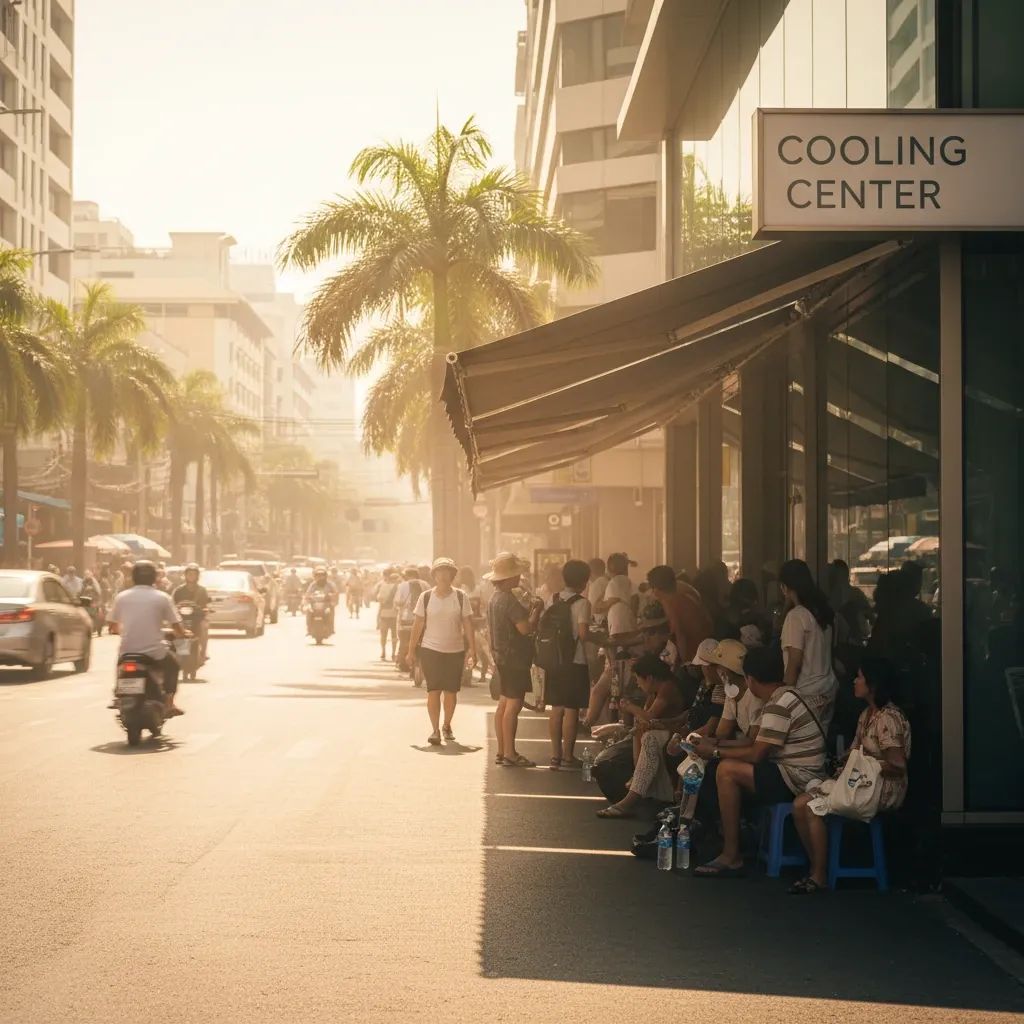
The Thailand Meteorological Department has confirmed what millions of residents already knew viscerally: Bangkok and central Thailand are enduring a brutal, sustained heat siege. Since April 1, the capital has logged 19 consecutive days of "dangerous" heat index readings—a streak that transforms the city into a public health emergency zone and threatens to shave billions of baht off the national economy.
Why This Matters
• Dangerous heat index levels (42–51.9°C) have persisted since the start of the month, with predictions of spikes near 60°C during peak hours.
• Over 300 free cooling centers are now open across Bangkok—libraries, health clinics, schools—designed to be reachable within 15 minutes of any neighborhood.
• The government has released an emergency relief package worth 7.74 billion THB to cushion economic fallout, with the World Bank warning of 44 billion THB in lost wages if worker productivity drops by just 25%.
• Vulnerable groups—elderly, pregnant women, outdoor laborers—face the highest risk of heat stroke, a potentially fatal condition.
What Residents Are Experiencing
Air temperatures alone tell only part of the story. Bangkok's maximum air temperature has hovered around 38–40°C this month, with forecasts briefly touching 41°C in early April. Yet the heat index—a composite measure accounting for humidity—paints a far grimmer picture. This metric, which reflects what the human body actually experiences, has stayed locked in the "dangerous" band for nearly three weeks.
Comparatively, Bangkok's historical peak for April was 42°C in April 2023, while the heat index that year reached 54°C. This April's sustained readings approach or exceed those benchmarks, making 2026 one of the most oppressive springs on record. The TMD warns that between 11 AM and 3 PM, conditions become especially hazardous, with perceived temperatures in some microclimates potentially nearing 60°C.
The relentless heat is compounded by El Niño, which continues to grip the region and is forecast to intensify through May. This climatic pattern exacerbates water scarcity, drives up energy costs, and amplifies agricultural stress—creating what experts call a "perfect storm" for Thailand's rural economy.
Health Risks and Emergency Medical Guidance
Heat-related illnesses are surging. Hospitals report a spike in cases of heat exhaustion, heat cramps, and the most severe form—heat stroke—which can cause organ failure and death if untreated. Early warning signs include dizziness, rapid pulse, unusual sweating patterns, headaches, and muscle cramps. Left unchecked, symptoms escalate to slowed brain function, rapid breathing, acute physical exhaustion, and in extreme cases, acute heart failure.
The Bangkok Metropolitan Administration (BMA) has identified high-risk groups: young children, the elderly, pregnant women, individuals with chronic conditions such as heart disease or respiratory illness, people with obesity, outdoor workers (construction crews, farmers, delivery staff), outdoor exercise enthusiasts, and tourists unaccustomed to tropical extremes. Officials now classify heat as the primary environmental health threat, surpassing even the seasonal air quality concerns that typically dominate public discourse.
Medical authorities urge anyone experiencing abnormal symptoms to seek immediate care. The BMA's AirBKK platform now includes heat index classifications—watch, warning, danger, extreme danger—with tailored advice for each tier.
Economic Fallout and Power Grid Stress
The economic toll is mounting rapidly. Air conditioning demand has spiked, straining the national power grid and driving electricity costs upward. Outdoor productivity has plummeted: laborers in construction, agriculture, and logistics face shortened workdays or complete stoppages during peak heat hours.
Agriculture, a cornerstone of Thailand's economy, is under siege. Crops wilt under relentless sun, water reserves dwindle, and pest pressures intensify. Farmers contend with depleted soils, escalating fertilizer prices, and rising fuel costs—all while El Niño withholds rain. The World Bank's projection of 44 billion THB in lost wages assumes only a quarter of the workforce reduces output; the actual figure could climb higher if the heat wave extends into May.
The Thai government's 7.74 billion THB relief package aims to stabilize farm incomes, support water management infrastructure, and provide emergency assistance to the hardest-hit communities. Authorities are also accelerating water allocation planning, urging farmers to adjust crop schedules and strengthen irrigation systems.
What This Means for Residents
If you live in Bangkok or central Thailand, the next two weeks demand vigilance. Avoid prolonged outdoor exposure between 11 AM and 3 PM. If you must be outside, wear light-colored, breathable clothing, use umbrellas or wide-brimmed hats, and apply sunscreen liberally.
Hydration is non-negotiable: drink at least 2 liters of water daily, and avoid alcohol, caffeine, and high-sugar beverages, all of which accelerate dehydration. Seek out air-conditioned spaces—shopping malls, libraries, cooling centers—whenever possible. The BMA's network of free cooling facilities is mapped online and accessible via public transport.
Employers, particularly in construction and logistics, are under pressure to adjust schedules, providing breaks during peak heat and ensuring workers have access to water and shade. Parents should monitor children closely, as younger bodies regulate temperature less efficiently. The elderly and those with chronic conditions should remain indoors during the hottest hours and have a plan for emergency medical contact.
Summer Storms Add Another Layer of Complexity
Even as the heat persists, a high-pressure system from China is triggering summer storms across upper Thailand from April 23 through April 26. These storms bring thunderstorms, gusty winds, lightning, and hail—a sudden and violent contrast to the preceding weeks of unrelenting sun. Bangkok faces a 10–30% chance of thunderstorms during this window, with temperatures momentarily dipping but humidity remaining elevated.
The TMD advises avoiding open fields, large trees, and unstable structures during storm activity. For residents, this means rapid shifts in planning: from seeking shade and hydration during the day to preparing for sudden downpours and potential power outages as storms roll through.
Historical Context and Climate Trajectory
Thailand's "hot season" typically peaks in April, but the duration and intensity of this year's event mark a troubling escalation. Climate scientists point to a broader pattern: Southeast Asia is experiencing more frequent and severe heat waves as global temperatures rise. Bangkok's infrastructure—designed decades ago—struggles to accommodate the twin pressures of extreme heat and population density.
Urban heat islands, where concrete and asphalt trap warmth, intensify the problem in Bangkok's central districts. Low-income neighborhoods, often lacking green space or access to air conditioning, bear a disproportionate burden. The BMA's cooling center initiative attempts to address this disparity, but coverage gaps remain.
Looking ahead, Thai authorities are under pressure to integrate climate adaptation into urban planning: expanding tree canopy coverage, mandating reflective building materials, and upgrading the electrical grid to handle surging demand. For now, the immediate focus is survival—getting through the next two weeks without a catastrophic spike in heat-related deaths.
Practical Steps and Resources
Check the AirBKK app or BMA website for real-time heat index updates and cooling center locations. Stock your home with electrolyte solutions and ensure elderly relatives or neighbors have access to fans or air conditioning. If symptoms of heat illness appear—dizziness, confusion, cessation of sweating—treat it as a medical emergency and call for help immediately.
For outdoor workers, know your rights: labor laws in Thailand require employers to provide safe working conditions, which includes heat mitigation measures during extreme weather. If your workplace lacks adequate precautions, contact the Thailand Ministry of Labour hotline.
The convergence of record heat, economic strain, and upcoming storm activity creates a volatile and demanding environment. Vigilance, preparation, and community support will determine how well Bangkok navigates the remainder of this punishing April.


