
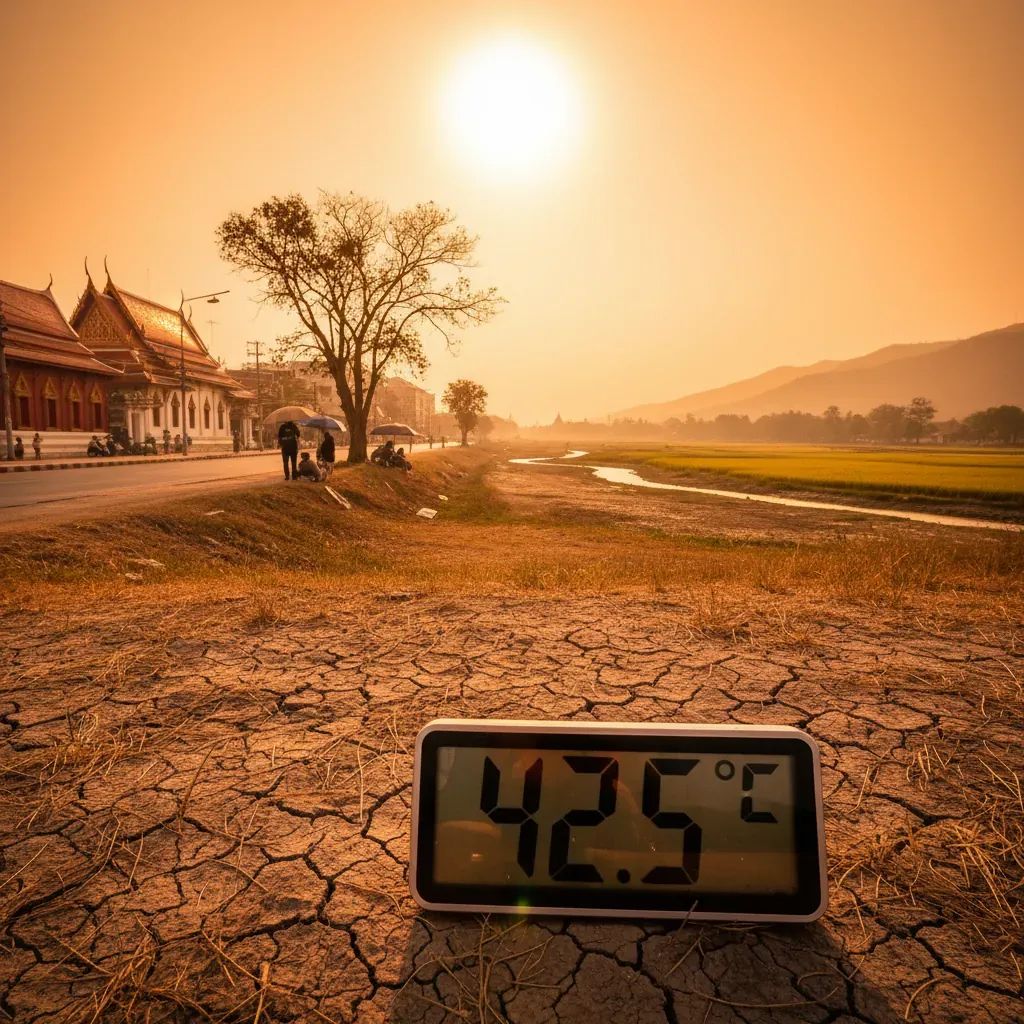
Bangkok's Unrelenting Heat Streak: 19 Days and Counting
Across Thailand's capital, the heat index has remained firmly locked in the "danger" classification for nearly three weeks, creating conditions where the combination of temperature and moisture makes outdoor activity genuinely hazardous for millions. Since April 1, residents and workers have endured a relentless cycle of extreme humidity paired with scorching temperatures—a stretch that shows no signs of breaking anytime soon.
Why This Matters:
• Immediate health threat across all ages: The risk isn't evenly distributed; construction workers, delivery drivers, street vendors, elderly residents, and young children face heightened danger of heat-related collapse and potentially fatal complications.
• Infrastructure stretched thin: The city has activated 255 cooling centers across all districts, but geographic access remains uneven—not all workers can easily reach these safe spaces during peak heat hours.
• Economic friction: Construction schedules have shifted, delivery services operate at reduced capacity, and outdoor markets report declining activity, creating cascading effects on retail and commerce.
The Mechanics of Heat Index: Why 35°C Feels Like 40°C
On April 20, when the mercury read 35°C and humidity sat at 49%, the Bangkok Metropolitan Administration Environment Office recorded a perceived temperature of roughly 40°C. This isn't meteorological drama—it's the body's actual experience. When air moisture reaches saturation, perspiration (the body's cooling mechanism) can't evaporate efficiently, trapping heat and causing core temperature to spike dangerously.
Over the coming weeks, forecasters expect heat index readings between 42°C and 51.9°C across various zones of Bangkok and surrounding districts. On several days in early April—particularly April 8 and 9—the index briefly climbed into "extreme danger" territory above 52°C, a threshold where outdoor activity poses severe risk to anyone caught without immediate access to cooling.
April is historically Bangkok's most grueling month. Average highs typically hover between 26.5°C and 34.4°C with about 9 hours of direct sunlight daily. This year, actual peak temperatures across Thailand have reached 38–42°C in Bangkok and surrounding areas, with some northern and central provinces reporting 40°C or higher. The combination—neither unprecedented individually nor together, but certainly punishing—has created conditions described by meteorologists as part of the broader "Monster Asian Heatwave" affecting Southeast Asia.
Root Causes: Climate Change Meets El Niño
The Thailand Meteorological Department attributes this prolonged period to a convergence of two forces. First, long-term climate change has accelerated warming across Asia at a faster pace than the global average, making extreme heat events more frequent and intense. Second, the 2026 El Niño phenomenon has suppressed rainfall and elevated atmospheric temperatures across the region. Record-high sea surface temperatures in the Indian and Pacific Oceans have amplified the effect, creating a feedback loop that traps heat over land and saturates air with moisture.
Neither element is particularly new. El Niño cycles have occurred for centuries. Climate warming has been measurable for decades. What's different is their combination and intensity. The World Meteorological Organization defines a heat wave as temperatures remaining roughly 5°C above the regional average for at least 5 consecutive days. Bangkok's current streak—19 days and counting—far exceeds that benchmark.
Urban areas face an additional burden: the urban heat island effect. Concrete, asphalt, and buildings absorb and radiate heat far more efficiently than vegetation or water. Bangkok's dense infrastructure means the city itself runs several degrees hotter than surrounding rural areas, compounding the effect for the 9 million residents navigating its streets.
Who's Most Vulnerable and Why
The Bangkok Metropolitan Administration has identified priority groups requiring targeted outreach. Young children (ages 0–5) and seniors (60 and older) have less efficient temperature regulation. Pregnant women face metabolic demands that increase heat sensitivity. Anyone with chronic illness—cardiovascular disease, diabetes, respiratory conditions—faces compounded cardiovascular stress. People living with obesity carry additional risk. Regular alcohol consumers face accelerated dehydration. Outdoor workers—street vendors, construction laborers, motorcycle taxi drivers, delivery personnel, agricultural workers—lack the ability to escape heat during working hours. Tourists and short-term visitors, unfamiliar with tropical intensity, often underestimate the danger.
Data from 2025 provides sobering context: Thailand recorded 182 heat-related illness cases across the entire country, with 21 deaths—57% concentrated in April. Men accounted for 59.3% of reported cases, while working-age adults (15–34 years) represented 42.8% of incidents and seniors 15.9%. Heat exhaustion (the mildest serious condition) appeared in 34.07% of cases, heat syncope (fainting) in 23.63%, heat cramps in 14.29%, and heat stroke (the most severe and often fatal condition) in 9.34%.
Most victims were outdoor workers, particularly those in manual labor roles where stopping work wasn't an option. Many worked without consistent access to shade or water.
The City's Emergency Response Architecture
Bangkok's heat management strategy for 2026 represents the most coordinated city-level response to date. The administration has mapped all 379 identified high-risk zones across the capital—construction sites, motorcycle taxi stands, open-air markets, public parks, outdoor sports facilities, and densely populated informal settlements. Work schedules have shifted informally: construction projects pause between 11:00 AM and 3:00 PM, street vendors compress their operating hours to early morning and late afternoon, and schools have rescheduled outdoor activities to cooler times.
The 255 cooling centers (244 permanent facilities plus 11 district office locations) represent the most visible intervention. Located in public health centers, schools, sports facilities, and district offices, these spaces provide air conditioning, drinking water, and rest areas—free to anyone, regardless of resident status. Operating hours concentrate on the peak danger window (11:00 AM to 3:00 PM), though some remain open longer. Real-time locations are mapped at greener.bangkok.go.th/heat-escape-room/.
Beyond physical infrastructure, the administration has trained public health workers, community health volunteers, park staff, childcare center employees, and teachers to recognize heat illness symptoms and respond appropriately. Teams have conducted surveys to identify vulnerable populations—particularly elderly residents living alone—to enable targeted welfare checks during extreme heat alerts.
What This Means for Residents
Practical guidance matters more than warnings when temperatures are this high. If you work or spend significant time outdoors in Bangkok:
Shift your schedule aggressively. Don't just avoid midday; restructure your day entirely. Start work early, wrap up by late morning if possible, pause during peak hours, and resume in late afternoon or evening. This applies whether you're a street vendor, construction worker, or even someone walking to appointments.
Hydrate before you're thirsty. Thirst is a lagging indicator—by the time you feel it, dehydration is already underway. Drink water consistently throughout the day, not just in response to thirst. Avoid alcohol and caffeine, which accelerate fluid loss.
Know the warning signs. Fatigue, dizziness, headache, skin rashes, swelling, muscle cramps, and nausea are early signals. Heat stroke—marked by hot, dry skin without sweating, rapid pulse, confusion, or loss of consciousness—is a medical emergency requiring immediate hospital care. Call 1669 without hesitation.
Use cooling centers strategically. A 20–30 minute break in an air-conditioned space during peak heat can stabilize your core temperature and prevent cascading heat illness. Don't view it as weakness; view it as maintenance.
Dress smartly. Loose, light-colored, breathable fabrics allow perspiration to evaporate efficiently. Dark colors absorb more heat. A simple hat or umbrella can make measurable difference.
Looking Ahead: No Immediate Relief
The Thailand Meteorological Department has not issued an end date for the current heat wave, and El Niño conditions are forecast to strengthen, not weaken, through the second half of 2026. Monsoon rains—typically the circuit breaker for extreme heat—may arrive later than usual or with reduced intensity, offering minimal relief.
For Bangkok residents, this means adapting expectations. April's heat will persist through month's end, and similar conditions may resurface as summer deepens. The city's cooling infrastructure, expanded surveillance systems, and public communication strategies represent genuine progress, but they function best when residents actively use them. Heat illness is preventable, but only when people recognize the risk and act accordingly.
Recovery protocols matter as much as prevention. If you witness someone struggling in heat—disorientation, collapse, or inability to respond—don't wait. Move them to shade or air conditioning immediately, provide water if conscious, and contact 1669. The difference between recovery and tragedy often depends on minutes, not hours.


