
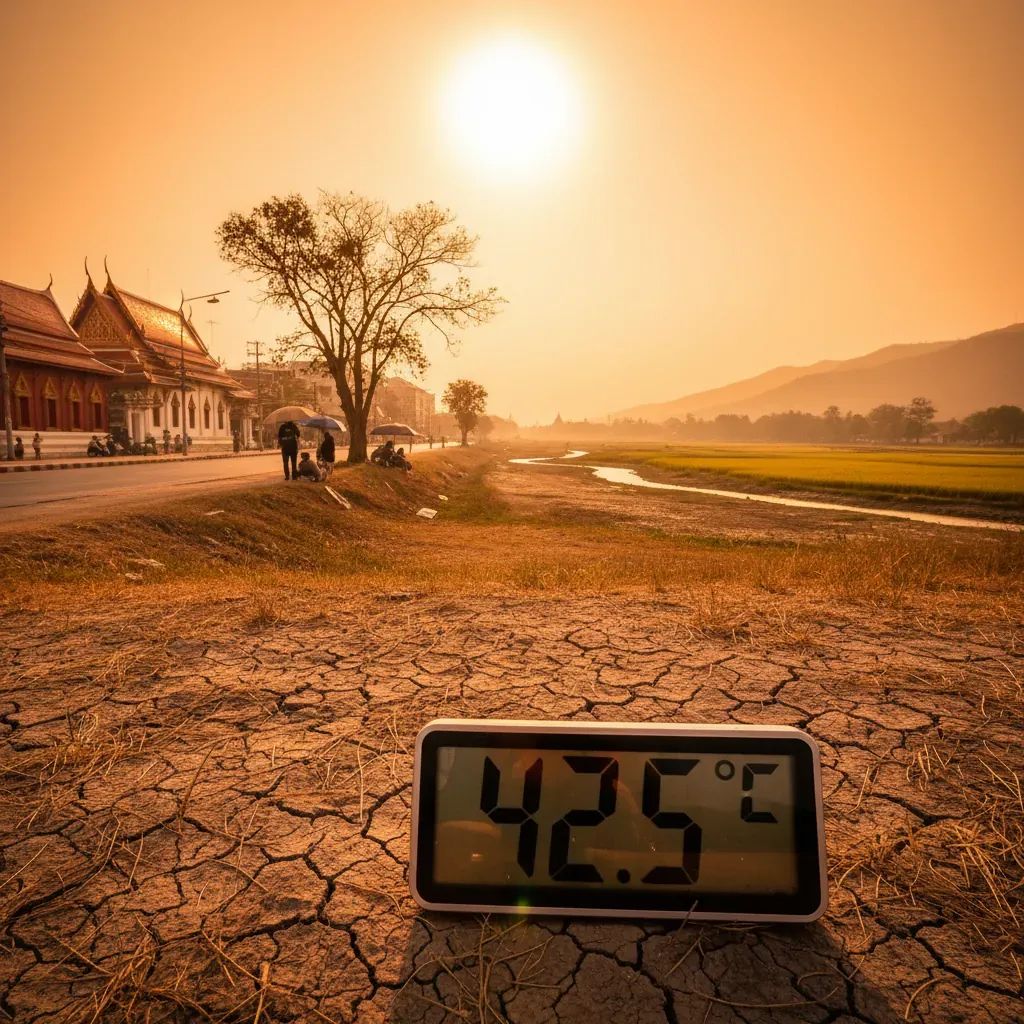
The Thailand Meteorological Department has issued urgent heat index warnings as Bangkok and the central plains register "dangerous" levels, pushing residents into a prolonged period of extreme thermal stress that health officials say could trigger a spike in heat-related illnesses.
Why This Matters:
• Dangerous heat index levels (42–52°C) now blanket Bangkok and the central region, with some areas approaching 60°C in perceived temperature.
• Vulnerable groups—children, elderly, pregnant women, outdoor workers—face heightened risk of heat exhaustion and potentially fatal heat stroke.
• El Niño patterns emerging in the Pacific suggest Thailand may experience one of its hottest and driest stretches on record through 2027.
• Water scarcity looms: Reservoirs in the Eastern Economic Corridor (EEC) and central plains could fall below minimum thresholds by mid-year.
Bangkok Enters Peak Heat Season Under Red Alert
As of yesterday, the Thailand Meteorological Department confirmed that Bangkok and surrounding provinces recorded a heat index in the "dangerous" category, with air temperatures climbing to 35–40°C and the central plains reaching 39–41°C. When humidity is factored in, the perceived temperature—what the human body actually feels—has surged past 52°C in several districts, placing residents at serious health risk.
April traditionally marks Thailand's hottest month, but this year's figures are tracking above historical averages. The Thailand Ministry of Public Health has activated early warning protocols, urging anyone spending extended periods outdoors to recognize symptoms such as dizziness, nausea, confusion, rapid pulse, and dry skin—all indicators of heat exhaustion or the more severe heat stroke, which can be fatal without immediate treatment.
Health facilities across the capital have been instructed to stock additional rehydration supplies and ice packs, and cooling centers in district offices, public health clinics, schools, and community gyms have opened their doors to offer air-conditioned refuge and free drinking water.
What This Means for Residents
For the estimated 10 million people living in Bangkok and the greater metropolitan area, the heat wave is not merely uncomfortable—it is reshaping daily routines. Outdoor workers, including construction crews, street vendors, and delivery riders, face compounded exposure. Employers are being advised to rotate shifts, provide shaded rest areas, and enforce mandatory hydration breaks, though compliance remains uneven.
Parents and schools are grappling with decisions about outdoor activities. Several private international schools have moved physical education classes indoors or rescheduled them to early morning hours. Public schools, many of which lack adequate air conditioning, are weighing shortened days or remote learning options similar to measures adopted in the Philippines and Cambodia during recent heat emergencies.
Chronic health patients—those with heart disease, hypertension, diabetes, and respiratory conditions—are at particular risk. The Thailand Ministry of Public Health recommends this demographic avoid the outdoors between 11:00 AM and 4:00 PM, the day's peak heat window, and to monitor air quality via the AirBKK platform (airbkk.com), as heat can exacerbate pollution-related symptoms.
Even the healthy are advised to consume 6–8 glasses of water daily, avoid alcohol and high-sugar beverages (which accelerate dehydration), wear loose, light-colored clothing, and seek shade or air conditioning whenever possible.
El Niño's Return: A Looming Climate Curveball
While April heat is expected, the intensity and duration this year are amplified by a broader climatic shift. Climate scientists monitoring subsurface temperature anomalies in the Pacific Ocean report a greater than 60% probability that El Niño conditions will return in 2026, with a 25% chance the event could escalate into a "super El Niño"—a classification reserved for the most severe episodes that reshape weather patterns globally.
El Niño occurs when warm ocean water accumulates in the central and eastern Pacific, disrupting normal atmospheric circulation. For Southeast Asia, the phenomenon typically brings reduced rainfall, weakened monsoons, prolonged dry spells, and elevated temperatures. The Thailand National Water Resources Office (ONWR) and the Department of Meteorology have flagged 2026–2027 as a potentially record-breaking period, with some models projecting sustained heat through early 2027.
The implications ripple across sectors. Agriculture, which employs roughly 30% of Thailand's workforce, is especially vulnerable. Rice, sugarcane, cassava, and cotton yields are projected to decline if rainfall during the monsoon season (July onward) falls short. The ONWR estimates this year's total precipitation at 1,479 millimeters—below the 30-year average of 1,500 mm—and warns that reservoir levels in the EEC, Mae Mok, Khlong Siyat, and Vajiralongkorn Dam could dip under 50% capacity.
Water Security: The Next Frontier
The convergence of intense heat and low rainfall threatens to trigger a water crisis in industrial and agricultural zones. The EEC, Thailand's flagship development corridor spanning Chonburi, Rayong, and Chachoengsao provinces, faces acute pressure. Demand for raw water has surged with the expansion of manufacturing, data centers, and logistics hubs, yet supply infrastructure has not kept pace.
The Thailand government, in partnership with the World Bank, has established an EEC Water Stakeholder Platform to coordinate emergency interventions, including dynamic reservoir management, accelerated irrigation expansion, and prioritization of drinking water over industrial and agricultural use during shortages.
The Department of Royal Irrigation has adopted a Dynamic Operation Curve framework, which integrates 6-month rainfall forecasts from meteorological agencies and the Electricity Generating Authority of Thailand (EGAT) to optimize dam releases and storage. The goal: ensure adequate water for consumption, industrial operations, and farming while avoiding catastrophic drawdowns.
Provincial governors across drought-prone regions have been directed by Deputy Prime Minister and Interior Minister Anutin Charnvirakul to establish provincial, district, and sub-district emergency command centers to coordinate relief, distribute water supplies, and support vulnerable communities.
Regional Lessons: How Neighbors Are Adapting
Thailand is not alone. Across Southeast Asia, governments are scrambling to shield populations from unprecedented heat. Singapore and Kuala Lumpur are investing heavily in urban greening—rooftop gardens, vertical forests, and reflective building materials—to combat the Urban Heat Island (UHI) effect, which can raise city temperatures by several degrees compared to surrounding rural areas.
Ahmedabad, India—a pioneer in heat preparedness—has inspired cities across the region to develop Heat Action Plans (HAPs), which combine early warning systems, public awareness campaigns, and cooling center networks. The Philippines has authorized schools to transition to remote learning during extreme heat events, while Cambodia has mandated reduced working hours for outdoor laborers.
In Bangkok, the Bangkok Metropolitan Administration (BMA) is piloting green corridors and expanding tree canopy coverage in high-density neighborhoods, though progress is slow. Urban planners are also exploring building codes that require enhanced ventilation and passive cooling design in new construction.
Preparing for a Hotter Future
Whether this year's El Niño materializes as a moderate event or intensifies into a "super" episode remains uncertain, but the signals from the Pacific are clear: Thailand must prepare for a future defined by more frequent and severe heat waves.
The Thailand Ministry of Natural Resources and Environment is accelerating low-carbon agricultural initiatives, including Premium T-VER (Thailand Voluntary Emission Reduction) projects that incentivize farmers to adopt water-efficient crops, shorter growing cycles, and reduced-emission rice cultivation techniques. The Geo-Informatics and Space Technology Development Agency (GISTDA) is integrating spatial data with drought risk mapping to enable faster, more targeted government responses.
For individuals, the calculus is simpler: recognize the signs, reduce exposure, stay hydrated, and monitor official channels. The Thailand Meteorological Department publishes daily and 10-day heat index forecasts online, while the Ministry of Public Health maintains a hotline for heat-related emergencies.
As one climate scientist monitoring Pacific conditions put it: "The question is no longer whether we'll see extreme heat—it's whether we're ready when it arrives."


