
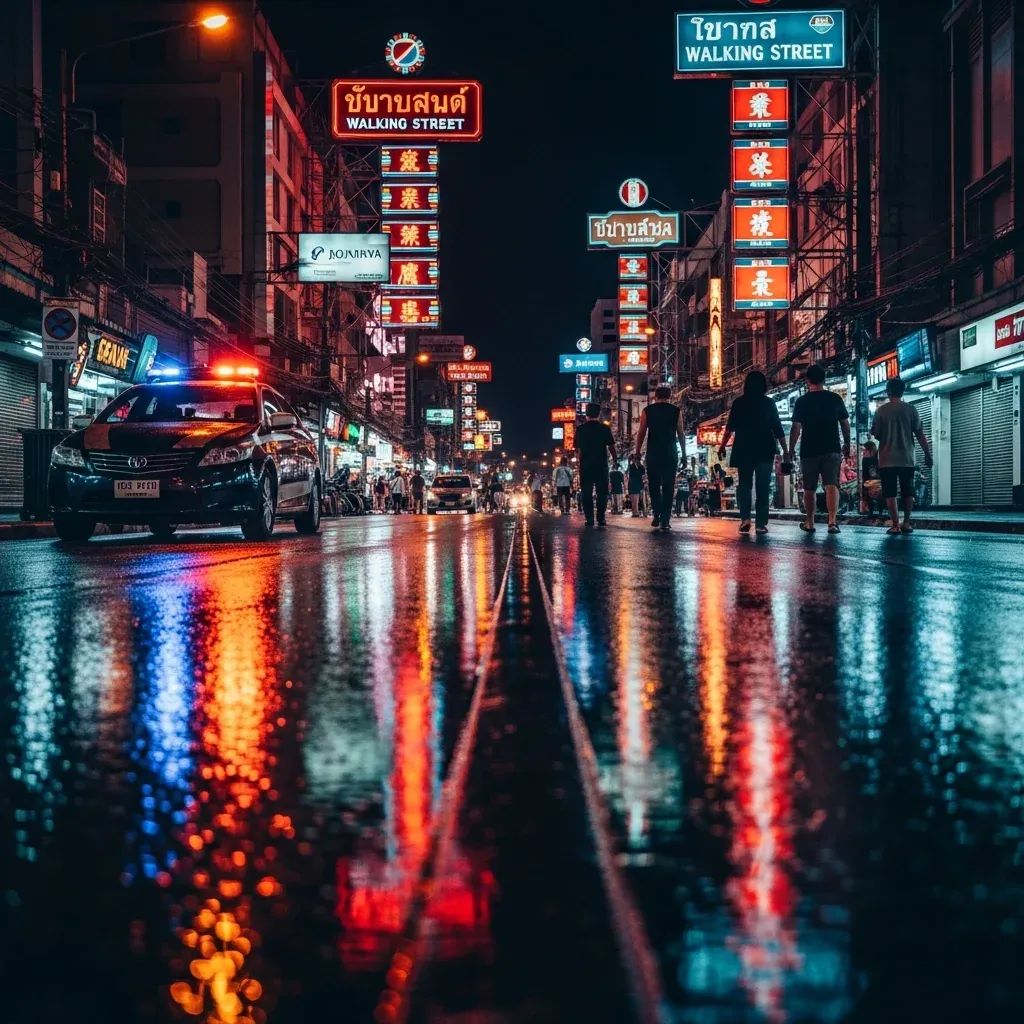
A brawl on Pattaya's Walking Street involving foreign women and transgender individuals has sparked debate—not about the fight itself, but about how the Royal Thai Police categorize foreigners in incident reports and what that means for expat visa security.
Why This Matters
• Misclassification affects tourism strategy: Grouping long-term residents, workers, and short-term visitors under "tourists" obscures the actual safety profile that potential travelers need to evaluate.
• Policy implications for expats: Residents face heightened scrutiny and visa complications when incidents involving foreigners are handled with imprecise terminology.
• Economic sensitivity: Pattaya's tourism sector depends on visitor confidence, making reputation management increasingly urgent as social media accelerates incident visibility.
The Distinction That Matters
When local media first reported the Walking Street altercation, describing participants as "tourists," it triggered resistance not from those defending the brawl itself, but from residents and community analysts who recognized the imprecision. Forum discussions across Pattaya's English-language networks quickly pivoted to a more granular argument: the individuals involved likely weren't package holidaymakers planning a two-week vacation.
Evidence suggested otherwise. Behavioral patterns—late-night presence in an area frequented by workers rather than casual visitors, apparent familiarity with the environment, and involvement in disputes typical of the service-sector economy—pointed toward something more complex. These were potentially long-term visa holders, foreign workers, or expats embedded in Pattaya's informal economy. The label "tourist" flattens a distinction that matters significantly for both immigration enforcement and tourism industry perception.
Thailand's Immigration Bureau maintains aggregate data but releases little public analysis disaggregating incidents by visa classification. This absence creates a vacuum that gets filled by assumption and frustration. A retiree on an annual extension visa behaves differently from a short-term holidaymaker; a foreign bar worker carries a different risk profile than both. Bundling everyone under "tourist" renders invisible the actual composition of nightlife-district populations.
Why Walking Street Remains a Pressure Point
Walking Street functions as Pattaya's commercial and social epicenter after sunset. The 1-kilometer pedestrian zone operates as a contained ecosystem where economic incentives, intoxication, crowding, and cultural friction compress into tight quarters. Venues operate on loose licensing frameworks designed to maximize throughput rather than minimize incidents. By design and necessity, the environment tolerates higher noise, more permissive behavior, and denser crowds than standard commercial districts would allow.
Thai authorities have installed enhanced CCTV coverage and maintained visible police patrols, yet enforcement remains reactive rather than preventative. Officers respond to complaints after escalation rather than de-escalating before situations harden. For venue staff, many of whom are foreign nationals themselves, the margin for managing disputes narrows when multiple languages, cultural communication styles, and alcohol involvement collide simultaneously.
Transgender individuals, a visible and economically significant part of Walking Street's service sector, have reported targeting in altercations before. Yet official police statistics rarely disaggregate these incidents by victim or perpetrator identity, leaving advocates without the data needed to argue for specialized training or targeted protective measures.
What Residents Need to Know
For expat communities in Chonburi Province, the terminology question carries practical weight. Immigration officials may potentially reference involvement in public incidents—however minor or peripheral—when reviewing visa applications, though such cases are not systematically documented in public policy. Being mislabeled as a "tourist" in an official police report could complicate visa processes, since it may suggest transience combined with behavioral concerns that immigration officers review during status assessments.
If you're involved in an incident where police reports your visa status:
• Request a copy of the incident report and verify your visa classification is accurately recorded
• Contact your immigration handling officer directly if errors appear
• Preserve documentation (visa stamps, extension letters) showing your actual status
• Reach out to expat advocacy groups operating in Pattaya if you encounter immigration complications following an incident
Expat advocacy networks have informally suggested that Thailand's Ministry of Tourism and Sports implement differentiated language in police statements and media advisory guidance. The suggestion: distinguish between short-term visitors (stay under 30 days), medium-term residents (tourist visas, ED visas, extended stays), and long-term residents (retirement or marriage visa holders). So far, no formal directive has emerged, leaving media organizations and police to improvise.
For Thai residents of Pattaya, the broader tension cuts differently. Walking Street's global notoriety as a nightlife epicenter has become synonymous with Pattaya itself, despite the city hosting family beaches, temple tourism, water sports, and retirement communities. Viral footage of brawls reinforces an outdated brand image that undermines efforts to position Pattaya as a diversified leisure destination rather than a party-focused enclave.
The Economic Calculus
Pattaya attracts approximately 10 million overnight visitors annually (based on Tourism Authority of Thailand data), a significant portion of Thailand's international visitor base. The city's economy depends acutely on perception stability. One high-visibility altercation, amplified through social media and travel forums, can trigger a measurable dip in bookings among risk-averse family travelers and older tourists who comprise an increasingly important market segment.
The Thailand Tourism Authority has invested heavily in repositioning Pattaya beyond its reputation as purely a nightlife destination, emphasizing wellness resorts, cultural attractions, and LGBTQ+-friendly tourism. Yet every incident that makes international headlines contradicts that messaging, forcing the organization into reactive damage control rather than proactive brand building.
Conversely, those defending Pattaya's status quo argue that mature urban destinations universally experience late-night disputes. Bangkok, Phuket, and Chiang Mai each manage similar incidents without triggering existential reputation crises. The question, they suggest, isn't whether incidents occur but whether authorities respond with transparency and proportionate accountability.
The Data Gap
A structural problem persists: Thailand's police and municipal authorities don't publicly release disaggregated incident reports that would allow independent analysis of trends, victim demographics, perpetrator backgrounds, or response protocols. This opacity fuels speculation and allows narratives to develop without verified data. Advocates argue that transparent incident reporting—anonymized but detailed—would actually serve both law enforcement and tourism interests by enabling targeted interventions rather than sweeping assumptions.
Current Investigation Status
As of publication, Pattaya City Police are reviewing CCTV footage and witness statements. No charges have been announced. The Chonburi Provincial Administration has not issued a public statement. No timeline for a formal conclusion has been announced; residents should monitor official police channels for updates.
Moving Forward
Online discourse continues fragmenting into competing interpretations: some demand stricter enforcement and harsher penalties for public disorder, while others advocate for cultural sensitivity training for police and de-escalation protocols that account for LGBTQ+ interactions in particular.
The unresolved question extends beyond this single incident. It points to how Thailand's nightlife economy operates at the intersection of permissiveness and regulation, where the incentives for economic tolerance frequently override impulses for strict order. For residents—Thai and foreign alike—clarity in terminology, transparent data, and proportionate enforcement would do more to rebuild trust than either defending the status quo or demanding blanket crackdowns.


