
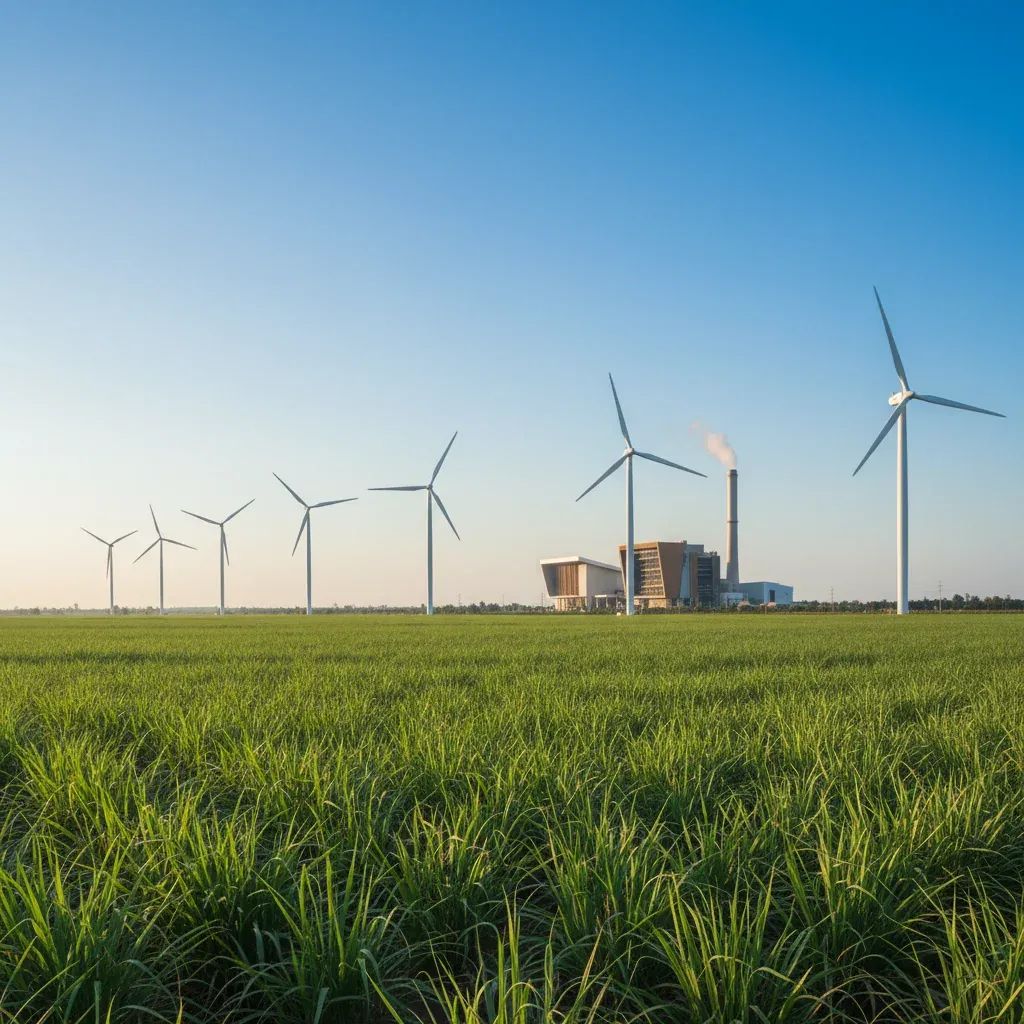
Khon Kaen Sugar Industry Plc (KSL) has accelerated its net-zero ambitions by a full decade, positioning the company among leaders in Thailand's sugar sector decarbonization—a shift that reflects both regulatory pressure and commercial opportunity as international buyers demand low-carbon supply chains. The company now targets carbon neutrality by 2045 and net-zero greenhouse gas emissions by 2060, marking a significant advancement from earlier commitments.
Why This Matters
• Faster timeline: KSL brought forward its net-zero target by 10 years, aligning with Thailand's national goal of net-zero by 2050.
• Pollution control: The company reduced emissions by 227,514 tonnes of CO2 equivalent in 2024, largely by curbing sugarcane field burning—a major source of PM2.5 air pollution.
• Production boost: KSL processed 6.6M tons of sugarcane in 2025, up 22.6% year-on-year, thanks to favorable weather and expanding capacity.
• Market advantage: Products now carry Carbon Footprint Reduction Labels, meeting European Union and global ecolabel demands.
The Burning Problem
Sugarcane cultivation is a significant source of greenhouse gas emissions in sugar production. The traditional practice of burning cane fields before harvest—done to remove leaves and speed up cutting—has been a persistent driver of PM2.5 smog, particularly during the dry season from January to April, when air quality in the Northeast and Central regions regularly breaches safe thresholds.
KSL has committed to a "Monitoring and Preventing Sugarcane Burning" project in partnership with the Office of the Cane and Sugar Board (OCSB), deploying drone technology and artificial intelligence to detect and deter burning in real time. In 2025, 86% of the sugarcane processed by KSL arrived as fresh, unburned cane—exceeding industry standards for burnt material reduction. The company also provides incentives and machinery support to contract growers to encourage mechanical harvesting, which preserves soil nutrients and eliminates the smoke plume problem.
Thailand's agricultural authorities have intensified efforts to reduce field burning through combined incentive and regulatory mechanisms, using subsidies for fresh cane deliveries and penalties for burned loads. These policies have driven a measurable decline in field fires in regions with strong enforcement, though progress remains uneven in remote provinces where labor costs and harvesting infrastructure lag.
Biomass and the Circular Economy Model
At the core of KSL's strategy is the Bio-Circular-Green Economy (BCG) model, a framework embedded in national industrial policy. The company operates four biomass power plants across Thailand with a combined output of 340 megawatts per day, fueled entirely by bagasse—the fibrous residue left after crushing sugarcane. A fifth facility in Sa Kaeo Province, which began crushing operations in the 2024/2025 season, adds further renewable capacity.
Surplus electricity is sold to the Provincial Electricity Authority (PEA) and the Electricity Generating Authority of Thailand (EGAT), contributing to the national grid and displacing fossil fuel generation. KSL also produces 2M liters of ethanol daily through its listed subsidiary BBGI Public Company Limited, supplying the domestic biofuel market. The push for Gasohol E20—a blend containing 20% ethanol—as Thailand's primary transport fuel could significantly boost demand, reducing crude oil imports and expanding revenue streams for sugar producers.
Filter cake, another byproduct, is converted into organic bio-fertilizer and sold back to cane growers, closing the loop and cutting reliance on synthetic nitrogen products, which carry their own carbon footprint.
What This Means for Residents
The transition has tangible implications for people living in Thailand, particularly in sugarcane-growing regions such as Khon Kaen, Udon Thani, Nakhon Ratchasima, and Kanchanaburi.
Air quality: Reduced field burning translates directly into fewer hazardous smog days. Residents in the Northeast historically endure weeks of poor visibility and respiratory health warnings; curbing cane fires can measurably improve seasonal air quality and reduce hospital admissions for asthma and bronchitis.
Energy security: Expanding biomass electricity generation—targeted at a national potential of 650 megawatts from sugarcane waste—helps stabilize domestic power supply and lowers exposure to volatile natural gas prices, which spiked following global energy shocks in recent years.
Farmer income: KSL's "buy-back" programs for sugarcane leaves, which are baled and sold as biomass fuel, create a secondary revenue stream for growers. Previously burned as waste, these leaves now generate payment, providing additional income per harvest cycle for participating farmers.
Trade continuity: As the European Union tightens green trade barriers and mandates carbon footprint disclosures for imported goods, Thai sugar producers without credible emissions data risk losing market access. KSL's Carbon Footprint Reduction Label and adherence to Bonsucro certification standards—verified by the European Commission for biofuel sustainability—help safeguard export competitiveness.
Industry-Wide Shifts
KSL is not operating in isolation. Mitr Phol Group, Asia's largest sugar and bio-energy producer, has installed 463 megawatts of biomass capacity across ASEAN and is the region's top ethanol producer. Thai Sugar Group (TSM Group) has pioneered bio-CO2 capture technology, recovering and purifying carbon dioxide from molasses fermentation for industrial reuse—the first such facility in Thailand's sugar sector. TSM Group aims for carbon neutrality by 2030, the most aggressive timeline among major producers.
Thai Roong Ruang (TRR Group) operates 320.4 megawatts of biomass generation and has set a net-zero target by 2050, consistent with the national roadmap. All three competitors have secured Bonsucro certification and participate in similar fresh-cane procurement and waste-to-energy programs.
The Office of the Cane and Sugar Board launched a "Sugar Ecolabel" in collaboration with the National Food Institute and ISO Certification Institute, certifying "low-emission sugar" for both domestic and export markets. The label responds to rising demand for traceable, low-carbon food ingredients and mirrors successful energy-efficiency labels that have influenced consumer behavior in appliances and vehicles.
Policy and International Pressure
Thailand has accelerated its national net-zero target to 2050, 15 years ahead of the original 2065 commitment. The country plans to submit its third Nationally Determined Contribution (NDC) by September 2025, including a 60% emissions reduction target by 2035 relative to 2019 levels. Unlike previous pledges benchmarked against business-as-usual scenarios, the new NDC adopts absolute emissions caps, raising the compliance bar for all sectors.
The sugar industry falls under both agriculture and industrial processes in the national framework, meaning producers must track and report emissions across cultivation, milling, and downstream processing. International partnerships amplify this pressure: Suntory Holdings has partnered with the VIVE Programme and Kaset Thai International Sugar Corporation (KTIS) on a three-year project applying regenerative agriculture techniques to lower on-farm carbon intensity.
The Thailand Carbon Neutral Network, aligned with the Paris Agreement and Race to Zero campaign, is building a domestic carbon credit market to monetize verified reductions. Producers who achieve measurable cuts could eventually trade credits, creating a financial incentive beyond compliance.
Outlook for 2025–2026
KSL anticipates higher sugarcane volumes in the 2025/2026 production year due to favorable rainfall patterns and expanded planting in the Central Plains and Northeast. The company's Sa Kaeo facility is ramping up to full capacity, and management has signaled potential additional biomass plant investments if government incentives for renewable power are extended.
The broader industry is lobbying for policy support on two fronts: mandatory E20 blending at fuel stations nationwide, and expansion of feed-in tariff programs for biomass electricity beyond the current cap. Both measures would accelerate decarbonization and improve project economics for mills investing in cleaner technology.
For investors and residents, the sugar sector's net-zero transition represents a convergence of environmental urgency, policy alignment, and commercial logic. KSL's accelerated timeline—and its competitors' parallel efforts—suggest the transformation is operationally underway, with measurable impacts on air quality, energy supply, and rural livelihoods across Thailand.


